
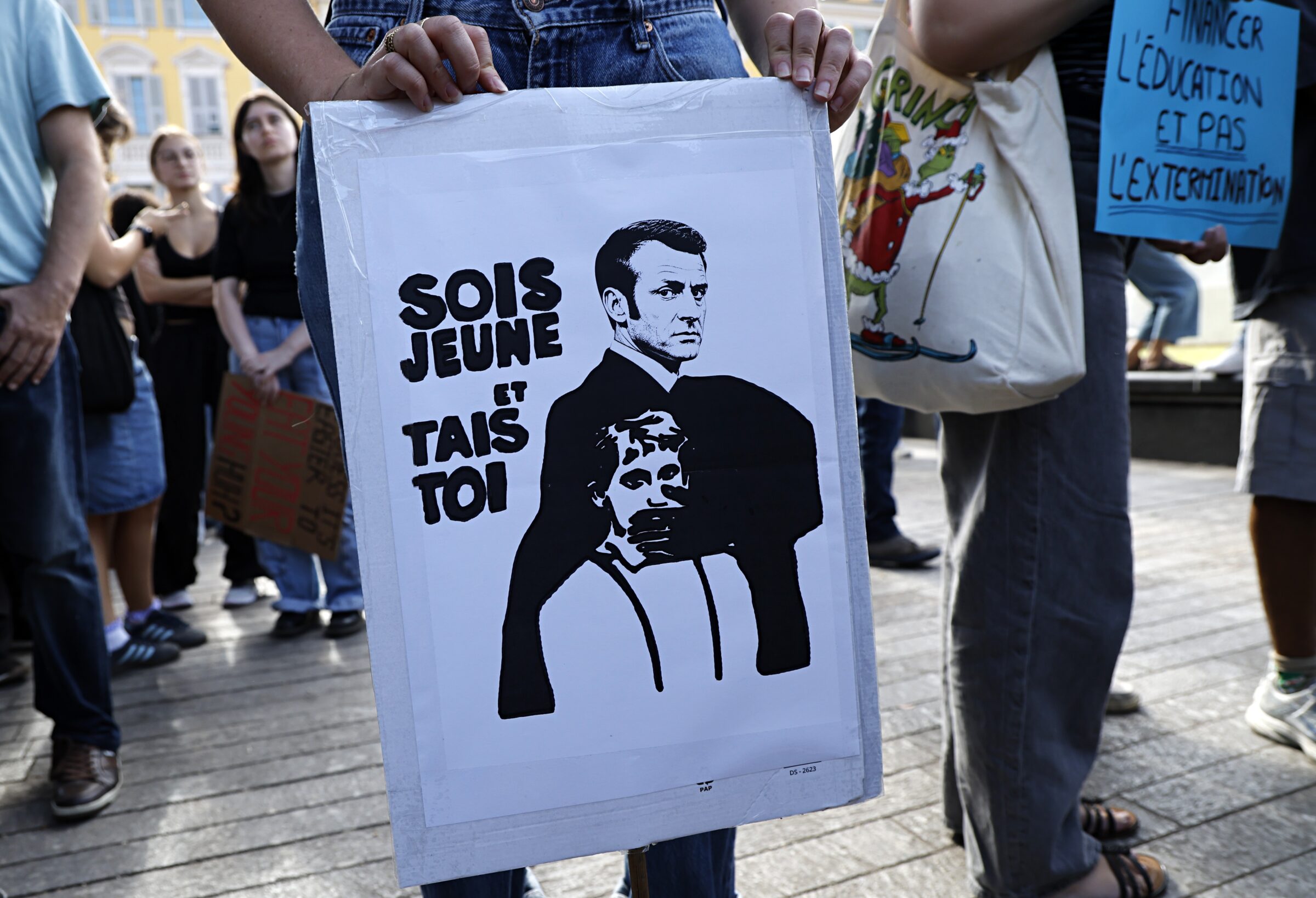
Production: By Europod, in co-production with Sphera Network. EUobserver is proud to have an editorial partnership with Europod to co-publish the podcast series “Briefed” hosted by Léa Marchal. The podcast is available on all major platforms. Find the full transcript below: France has been seeing growing protests by high school and university students in recent weeks. The movement is continuing today with a fourth day of mobilisation. According to the government, the far-left opposition party is fuelling the protests. For Donald Trump, the movement is the result of mass migration and the presence of Islam. But what are young people actually protesting about? High school students’ anger has been building for some time. One of the tipping points came in June, when temperatures inside many schools rose above 35 degrees. Many classrooms had no fans, let alone air conditioning. And this happened in buildings that were already often in poor condition. Add to that the fact that absent teachers are frequently not replaced. The result was what you might call a general overheating — both literally and politically. The government, meanwhile, has accused the left-wing party La France Insoumise (France Unbowed, or LFI) of fuelling the protests. Some commentators have even suggested that the movement was orchestrated by the party from the beginning. There is little doubt that LFI is supporting the mobilisation and may be trying to benefit politically from it. But dismissing the protests as political manipulation risks ignoring problems that are well documented. As sociologist and child psychiatrist Laelia Benoit recently told Le Monde, assuming that high school students cannot think for themselves and must necessarily be manipulated by adults or political parties is, in her words, a way of denying them their ability to act politically. And many of their demands are supported by both parents and teachers. Teachers, for example, have long complained about the lack of replacements when they are absent. This is supported by the latest PISA report on France: 87% of French students — as well as school principals — said their school's capacity to teach was affected by a lack of teachers. So young people are increasingly asking to be heard. Earlier this week, they put forward their demands, resulting in 10 concrete measures supported by both high school and university students. Among other things, they are calling for a major programme to renovate schools, more staff, a guaranteed €1 meal at university canteens, and higher housing benefits and grants so that students can live with dignity. So what is the government offering in response? France has opened an online platform in recent days where students can submit their demands. Prime Minister Sébastien Lecornu said yesterday that the platform had already received more than 40,000 contributions. So for now, the government's message is essentially: go back to class and submit your demands online. The prime minister then pointed to the additional €1 billion he has proposed for the education budget next year. And as for more immediate measures, he announced five areas of work that should begin at the end of October. They include tackling teacher replacements, improving schools' material conditions, reorganising school timetables, reforming the university admissions platform which appears to be a nightmare, and thinking about how to give high school students a greater voice. Let's see if that is enough to ease the protests.
Listen: Are student protests in France actually being fuelled by Mélenchon’s party LFI?
Full Article
Original Source
Read the full article at Euobserver →KhanList aggregates and links to publicly available news content. We do not host full articles from third-party sources. Always verify important information with original sources.