
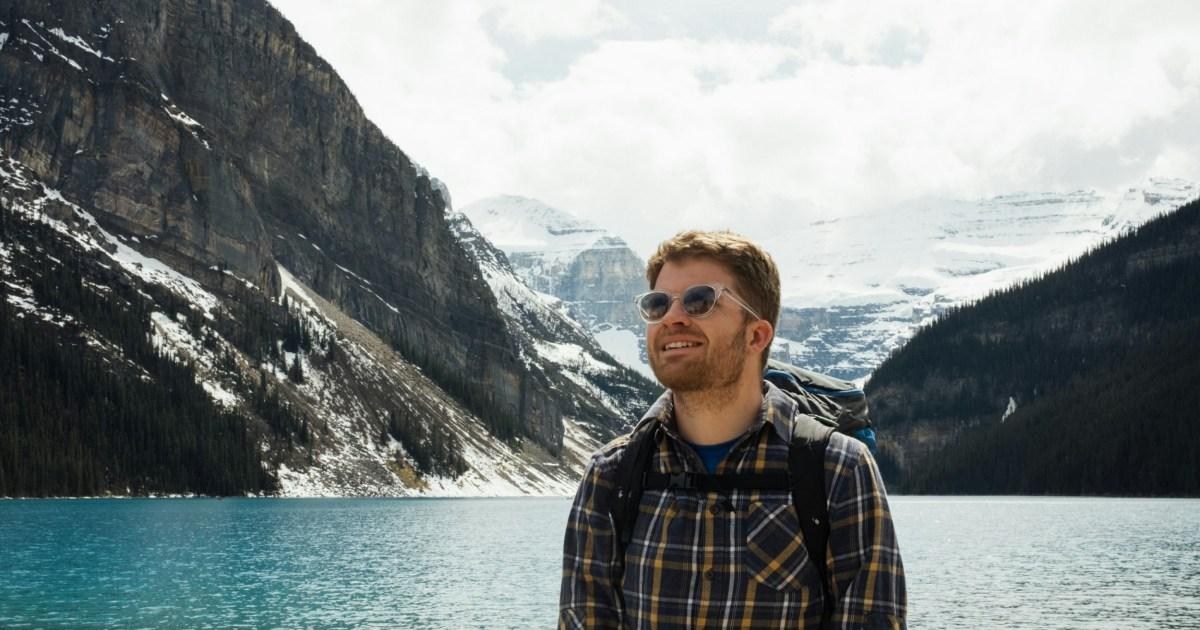
Logan takes a compass and map on his travels, rather than Google Maps and a ChatGPT initerary (Picture: Sarah Stone) Logan Mills may have been born in the wrong century. By the time he arrived on the planet 35 years ago, the world had already been thoroughly charted. The Oxford doctor is a digital minimalist. Surrounded by guidebooks and maps, he takes a compass on holiday rather than relying on GPS and Google. His mobile – a basic brick phone – stays largely forgotten at the bottom of his bag. Logan has relished exploration since childhood. He planned to study biology at university until, during freshers’ week, the geology department told him that if he switched courses, he could spend weeks on the Isle of Arran in Scotland and, instead of writing a dissertation, ‘you have to make a map’. Most of the time, Logan works in A&E, but when he’s not there he’s usually travelling the world (Picture: Sarah Stone) He switched, later creating a colourful geological map after six weeks happily marching around examining rock formations. Eventually Logan moved into medicine, but when he’s not working in A&E, he explores using as little tech as possible. So far, he has travelled through Argentina, Austria, Canada, Chile, Croatia, the Czech Republic, Hungary, Kenya, Russia, Patagonia and beyond – and, remeniscent of the hit show Race Across the World, he relies on a paper map, rather than the digital conveniences most of us take for granted. ‘I’ve just got back from four days walking and camping in the Lake District navigating entirely by map. I literally used my phone once or twice to tell my wife I was alive.’ Logan, who also uses compasses and guidebooks to help him, says that a trip begins long before he packs his bags. Ask Metro Use AI to go deeper into the stories you care about – powered by Metro and trusted publications. ‘I think it’s really fun planning trips, gathering the information and trying to figure out how you’re going to get to different destinations. ‘Working out how you can get somewhere using a once-a-week ferry is half the fun.’ He cycled from Oxford to Berlin (Picture: Sarah Stone) He still has tiny route cards he drew for a cycle from Oxford to Berlin, outlining roads, cities and rivers in ink, with holes at the top where he attached them to his handlebars with treasury tags. They weren’t particularly detailed, but he never got ‘lost lost’. ‘Maps give you a sense of scale that phones don’t. Plus, you’re not looking at your phone and nothing runs out of battery. ‘By the time you’ve made the route card the night before, it’s already half in your memory. ‘It helps you feel really immersed in where you are. You could snap your fingers at any point and say, “Where’s north?” and I can always point it out because I’m subconsciously mapping things out.’ Logan traces his love of maps back to his grandfather, Ted. Growing up in Canada, Logan would visit Ted’s home where his garage wall held an enormous map of Alberta covered with routes from family trips. ‘When I got older, after one bike trip down through Montana, we looked at his map with every trip he’d taken over the last 60 years on it. We could see where our routes intersected, then look at his old photographs and compare them with mine.’ Logan was inspired to use maps by his grandfather, Ted, and passes the knowledge onto friends he travels with (Picture: Logan Mills) Those maps have become even more precious since Ted died last year. ‘This weekend, walking in the Lakes, I used an old map with a pencil line on it and realised it was a walk I’d done when I was about eight with my parents and grandparents. ‘It was a really nice trigger for those memories. I miss him, but looking at his routes really brings him back.’ Adventure ran through the family. Growing up, rather than taking package holidays, Logan, his parents Rick and Diane and younger brother Christopher embarked on a years-long project to climb every highest mountain in EU countries. ‘They were great fun, and definitely paper-based trips.’ On one cycling journey through Hungary when he was around 10, the family reached a town late in the day with nowhere booked to stay. They followed signs and posters on lampposts in search of a bed. ‘We found a B&B but it was completely full. They said, “There’s nothing else in town, but you can sleep at my sister’s.” ‘We ended up in some corner of this town in Hungary, sleeping on somebody’s sister’s kitchen floor. When my parents later asked what the highlight of the holiday was, I said sleeping on a stranger’s floor. It was very formative.’ The exploring started when Logan was young, and now he loves adventuring with his wife, Sarah (Picture: Logan Mills) Other trips have led to nights in peculiar Soviet-era resorts that appeared more like asylums than hotels. ‘I just love finding different ways of travelling from A to B and discovering something you didn’t expect in between.’ Inspired by the BBC’s Race Across the World, Logan and his wife Sarah recently took advantage of a campervan relocation scheme in South America, driving a vehicle from Santiago, Chile, up to northern Argentina. ‘We thought it would be fun and cheap, and who knows what we’ll find along the way?’ He swears by guidebooks from the library (Picture: Sarah Stone) ‘But when I started researching online, I found all these different blogs and I wasn’t convinced how reliable the content was. ‘Quite a lot seemed to be generative AI or blogs written for ads and products. So we decided to use guidebooks from the library instead. ‘They gave a great sense of where things were and what was worth doing. The editors and people on the ground do a lot of research.’ One led them to San Antonio de Areco, near Buenos Aires, on the day of a local horse celebration. ‘All the farmers from everywhere rode into town on their horses and it turned into a big party. ‘I’d tried to find out online whether it was happening and it was impossible. But we followed the guidebook and they they were – the horses dancing and we did lots of eating. It was great. We were the only non-locals there.’ With his old-fashioned approach, Logan is bucking the trend. New research by Insurance Company Staysure found 69% of 25-to-34-year-olds have used AI to plan a trip this year. By comparison, just 7% say they used a paper map or atlas. Logan warns against using AI-generated travel advice (Picture: Sarah Stone) ’I’m surprised by this. People are also missing out on part of the journey, and it can also be dangerous.’ Logan believes AI-generated travel advice can lack crucial context, particularly in the mountains. ‘Mountain rescue teams are finding people in funny places because they’ve asked technology to find the best walks and the answer isn’t nuanced with reference to the weather or your ability. ‘Recently, there were people rescued from a mountain in California when Google Gemini had recommended a recut that was impassable.’ Logan knows, of course, that paper isn’t infallible either. During a snowy run with Christopher in Canada, the pair reached a fork in the trail and Logan pulled out his map to determine which direction to take. But there was a problem. ‘I said, “Chris, I’m really sorry, but my nipples have sweated through that bit of the map and there’s a hole, so I don’t know.”’ They found their way home eventually. Logan says his analogue habits make him a better travelling companion (Picture: Logan Mills) ‘That’s the thing. People criticise phones because they run out of battery. Clearly, the problem with paper maps is they blow away or get worn out.’ His friends and family have learned to embrace his analogue habits, and Logan believes they make him a better travelling companion. ‘On a phone, I can get very distracted and not be a very good conversationalist. I think I’m better company if all I have is a brick and a paper map.’ When travelling with his wife, Sarah, they record their adventures in paper diaries and notebooks, while she takes photographs. ‘I love using maps over GPS. It brings absolute joy. You feel integrated with your surroundings when you know how everything fits together. ‘You’ll be walking along, see a mountain and know what’s on the other side. Then a river or forest emerges just where you think it should. Our Top Shopping Picks This Hoover vacuum is a game-changer for pet owners and muddy homes See London's Christmas lights from an open-top double-decker bus this winter My skin always suffers when the heating goes on but this serum changed that The skincare formula that finally took the guesswork out of my routine Families can save up to 20% on summer 2027 holidays in Club Med's four-day sale ‘There is order in the world because everything is where you think it should be. It’s calming. Like bringing structure to chaos.’ Arrow MORE: Finland is offering singles a free trip to potentially find love Arrow MORE: Benidorm to ban popular holiday activity and tourists are calling it ‘absurd’ Arrow MORE: I spent £10,000 to build a mini Greece in my back garden The Getaway Expert Your exclusive seven-day guide to travelling with confidence from Metro's resident travel expert, Alice Murphy.
Like Race Across the World, I only travel analogue – it’s the best way
Full Article
Original Source
Read the full article at Metro →KhanList aggregates and links to publicly available news content. We do not host full articles from third-party sources. Always verify important information with original sources.