
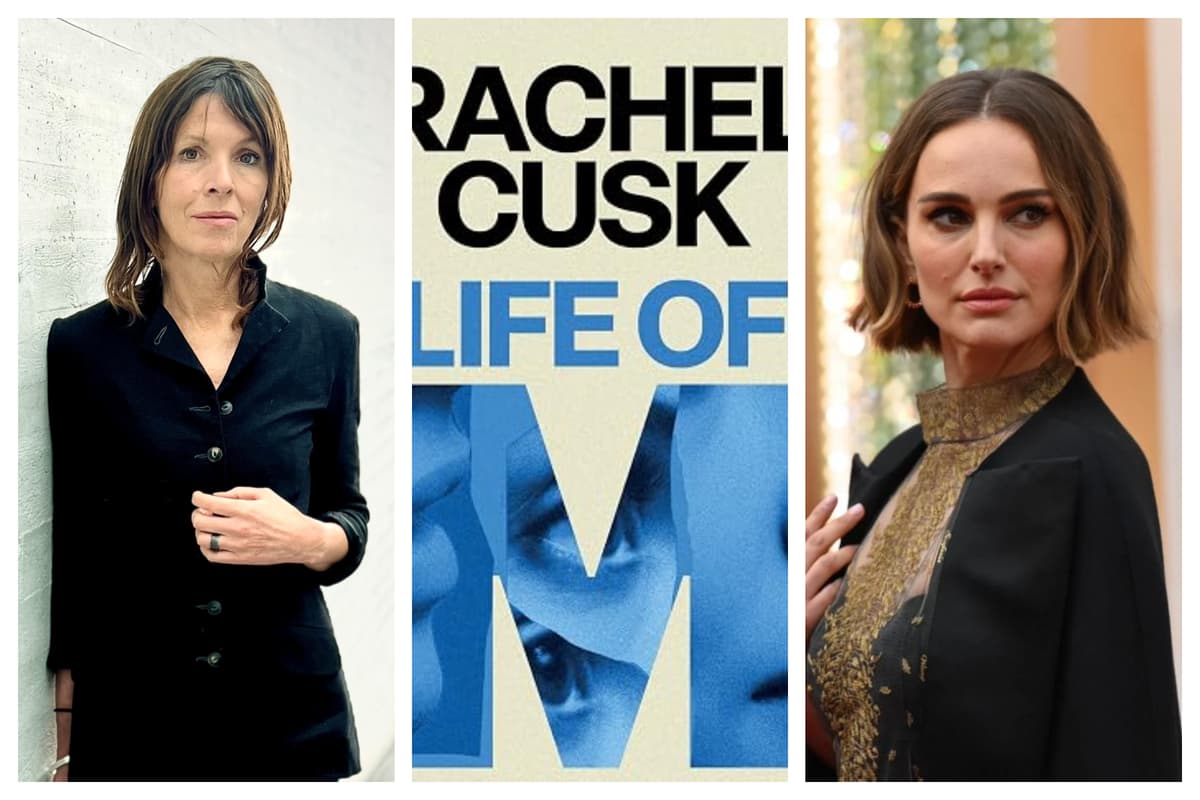
Rachel Cusk’s new novel attracted a lot of pre-publication publicity as soon as it was realised that, although she is never named, it is unmistakeably about Natalie Portman, a friend or former friend of Cusk’s.There is no question about the identification. The novel definitely describes key aspects of Portman’s career, such as her debut as a child actress in Léon and her roles in Black Swan and Vox Lux, and the ubiquity of her image as the face of a major brand, Dior. Yet by never naming her, the novel assumes the right to fictionalise her, to write about her without the responsibilities that would be involved in a factual account.That’s a common enough dodge for novelists. But for Cusk it is just part of an advanced strategy of asserting herself as a writer while dismantling the existence of others. After her ferocious memoirs of childbirth, A Life’s Work of 2001, and divorce, Aftermath of 2012, she wrote three remarkable novels, Outline, Transit and Kudos, in which the narrator becomes little more than a negative space into which others speak, exposing their own banality.Rachel CuskSiemon Scamell-KatzHer work has increasingly disdained the usual structures that sustain not just fiction but common life — character, story, location and identity — preferring instead abstraction and stylisation. In 2018, she actually stated: “I don’t think character exists any more.”Is Life of M about Natalie Portman?Life of M is an elaboration on that theme, portraying Portman (let’s not fudge) as somebody without identity or integrity, not out of specific malice towards her but as a test case for Cusk’s overarching belief that everybody is inauthentic, everybody is playing a role.She’s perfectly explicit about the challenge: “I realised that I could not be myself around M. She was friendly, generous, disarmingly modest, yet everything I did or said in her company was false. It was as if I was acting, while M came across as authentic and real. It was as if she was the only one good enough at acting to attain reality.” The novel revenges that.AmazonIt begins seductively, nonetheless. A straightforward first person narrator, “I”, tells us she met M in a bookstore and they found they had things in common. M tells her about the end of her childhood when she made her first film, the narrator reveals that her partner suddenly had to go into hospital.Cusk’s sentences remain exhilaratingly clear and precise, every word chosen and placed with lapidary decision. It’s only the reader’s pleasure in this that makes her refusal to stoop to ordinary facts and details tolerable.Natalie Portman GettyFor this is the frustration she imposes throughout as a form of authorial control. It is not only Portman and her films that are not named but everything else that Cusk writes about here, however recognisable — the city (Paris), the films (Truffaut’s The 400 Blows, Kurosawa’s Drunken Angel), the exhibitions (Francesca Woodman’s photographs), the books (by Neige Sinno and Édouard Louis), the restaurants and hotels. Instead she offers a repetitive deadening formula for physical description: “It is a terrace… It is the interior of a limousine… It is a hotel room…”Reality is dispensableAs the novel progresses and loses its way, even the “I” of the narrator disappears, to be replaced by an undefined “we”, serving only to multiply the preposterous solipsism: “There was a time, a long time, in which reality served to delight and astonish us… Now, it feels as if an intrusion could only signify violence.” An intrusion! Reality is not up to Rachel Cusk’s mark.At the end M protests that she doesn’t like the hurtful way she is portrayed as lacking in humanity and unable to love. The narrator, suddenly collapsed back to “I”, retorts in a sentence of unusual ungainliness: “But you’re just playing a character, I said. The character was invented by me. So if what you say is true, then it’s me that it’s true of.” Just so, alas.Life of M by Rachel Cusk is out now (Faber & Faber, £18.99)David Sexton was the literary editor of the Evening Standard from 1997 until 2020
Life of M by Rachel Cusk: A frustratingly precise character assassination
Full Article
Original Source
Read the full article at Standard →KhanList aggregates and links to publicly available news content. We do not host full articles from third-party sources. Always verify important information with original sources.