
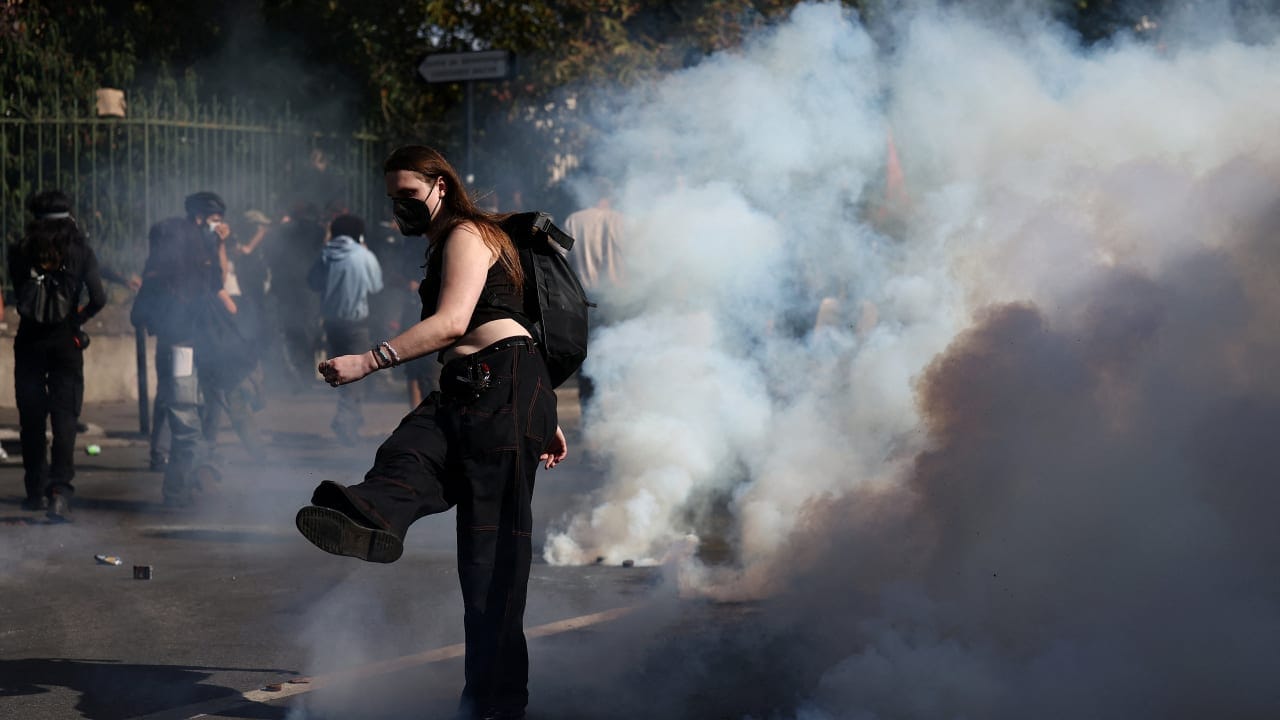
OCTOBER 21, 2026 14:00Updated: OCTOBER 21, 2026 14:03There are moments when you wish you had been wrong.Watching the images coming out of France since Saturday, October 17, has been one of those moments. And it has been painful.What was meant to be a nationwide mobilization against the rising cost of living turned, in several cities, into a day of riots and looting. Streets ransacked, businesses plundered, buildings and cars set ablaze. It leaves a feeling hard to put into words.Sadness, first. Shame, too. And above all, one question: How much longer will it take France to stop downplaying what is happening, acknowledge how serious the situation has become, and act accordingly?This did not come out of nowhere. For years, voices have warned of the normalization of violence, the radicalization of rhetoric, the erosion of authority, and the growing reluctance of France’s leaders to draw clear red lines out of political calculation.Masked protesters react through tear gas amid clashes with the French riot police during a demonstration , France, October 17, 2026. (credit: REUTERS/Jack Taylor)Those warnings were ignored, and those who voiced them were stigmatized. French Jews know this better than anyone: they were often the first to see those lines recede, and the first to be accused of overreacting.Saturday’s scenes of chaos are what happens when those in charge refuse to listen, understand, or respond.As a French woman living in Israel, I do not write these lines with the satisfaction of someone who has been proven right. There is no victory in watching my native country tear itself apart.What is most alarming is no longer the violence; it is the way a society ends up getting used to it. Each new episode becomes one more crisis, a few days of outrage, then nothing. And it all starts again, in a spiral that keeps intensifying.And always the same question: How far is France willing to go in accepting it?When red lines disappearA society does not slide into violence overnight. Limits shift. Words harden. Threats become slogans, intimidation is played down, and people sometimes end up working harder to justify the violence than to state that it is unacceptable.In September 2024, Elias d’Imzalène, an Islamist activist described by French media as close to the Muslim Brotherhood, called on a crowd to “lead the intifada in Paris, in our banlieues, in our neighborhoods.”“Intifada” is not an innocent word: it refers to a history marked, among other things, by deadly attacks against Israeli civilians.In December 2024, he was given a five-month suspended sentence for public incitement to hatred or violence. That such calls can echo through France should make us ask what we have become capable of tolerating.Then it was Gaza; on Saturday, the cost of living. The cause changes. The logic remains the same.Responsibility does not end with those who call for violence or carry it out. It also lies with those in the political far-left who have spent years fueling confrontation, normalizing radical rhetoric, and excusing violence whenever it serves their ideological and political struggle.When Ersilia Soudais, a lawmaker from La France Insoumise, visited d’Imzalène in police custody to express her “full support,” when her colleague Éric Coquerel called him more “respectable” than then-interior minister Bruno Retailleau, and when another La France Insoumise figure, MEP Rima Hassan, went on trial in Paris on October 19 for glorifying terrorism, the line between radical activism and elected office was not blurred. It was erased.This is called islamo-gauchisme, the alliance between Islamist activists and parts of the radical Left. Shared enemies unite them: the Republic, the West, and, first in line as always, the Jews.Words have consequences. When political leaders support those who demonize opponents, excuse extremist rhetoric, or legitimize violence in the name of a cause, they do more than express a political position: they help make that rhetoric acceptable.They shift the boundaries of what can be said, justified, and ultimately tolerated. And when violence follows, those who helped create the climate in which it could be excused cannot claim innocence because they did not carry it out themselves.The far-left is not the only one at fault. The responsibility also belongs to those whose job it was to stop it, like President Emmanuel Macron, who attributes the violence to “factions from ultra-left groups, joined by many delinquents.”For years, successive governments have let the situation fester, condemning in words while rarely following through. When a call to “lead the intifada in Paris” ends with a suspended sentence, impunity itself becomes the message.There is a bitter irony in all this. Macron and his ministers rarely miss an opportunity to lecture Israel on how it should fight its wars, govern its territory, and contain violence.Yet those so eager to tell Israelis how to manage their society have presided over the unraveling of their own.Watching from Israel, one cannot help but wonder whether France would be better served if its leaders devoted to its own streets a fraction of the attention they devote to ours.The price of surrenderThe question now is who is still willing to defend the rules of the Republic, and who pays when no one does.France built part of its identity around a republican ideal: liberty, equality, and fraternity.It was never perfectly realized, and it would be absurd to claim that the France of yesterday was free of injustice or tension. But it was the France I grew up believing in.This weekend, that ideal was put to the test, and the first to pay were the shopkeepers.Over 3,000 businesses were hit. Behind each one is someone who gets up every morning to go to work, pays ever-higher taxes year after year, and trusted that in return, the state would protect what they built.In a single day, many of them lost everything. And the state that takes its share of their work every year failed to protect them.There is something painfully familiar in their sense of abandonment. French Jews have lived with it for 20 years.From Ilan Halimi to the Toulouse school shooting, from the Hyper Cacher to Sarah Halimi and Mireille Knoll, they sounded the alarm again and again. And that was before October 7.Since then, France has recorded over a thousand antisemitic acts every year. French Jews no longer felt safe in their schools, synagogues, and streets. They were met with statements, vigils, and promises, rarely with action.History offers a lesson France seems determined to forget: when a country lets its Jews feel threatened and does nothing, it is rarely the Jews alone who pay the price. The Republic is usually next.On Saturday, the Republic paid.The freedom to demonstrate does not grant the right to destroy. Anger does not excuse violence. And understanding why people are angry never exempts the state from holding accountable those who break the law.This is not a radical position. It is the bare minimum a state owes to those who keep it running.The sadness of having seen it comingI watch these images from afar, like many others. It would be so much easier to keep that distance, as if France has become a problem that no longer concerns me. But one does not so easily detach oneself from a country that is part of who one is.The revolting part is seeing a country that hesitates to defend what defines it, as if standing by its values had become riskier than letting them erode.Nowhere is this clearer than in its foreign policy. In September 2025, the same president who now denounces the ultra-left recognized a Palestinian state. France called it a step toward peace; Hamas welcomed it as a victory.It came as calls to “lead the intifada in Paris” still echoed in French streets, and as the Palestinian flag had become a fixture at protests where solidarity too often blurred into intimidation.Perhaps he believed it would ease tensions at home. Saturday showed otherwise.Of one thing I am certain: France has not finished paying the price.Beneath the anger, there is something deeper: grief. Grief for a country that still proclaims “liberty, equality, fraternity” above the doors of its town halls, even as rioters set one of those very buildings ablaze in Limoges.A Republic cannot survive on the words carved into its stone if it no longer has the resolve to defend what they stand for.This spiral is not inevitable. But a state that cannot protect its shopkeepers, its Jews, its streets, or even its own buildings will not be saved by speeches.France is quick to preach values to Israel. Israel, at least, knows which ones it is willing to fight for.There are moments when you wish you had been wrong. Lately, France keeps giving me more of them. And the saddest thing of all would be if one day we reached a point where none of this made us sad anymore.The writer is a public diplomacy consultant and content creator who explains Israel to French-speaking audiences on Instagram. A former Breaking News editor at The Jerusalem Post and adviser at Israel’s Permanent Mission to the United Nations, she recently launched Israel Compass, a nonpartisan platform for the Knesset elections.Follow us on Google
Liberty, equality, impunity: France ignored the warnings. Now it’s paying for it - opinion
Full Article
Original Source
Read the full article at Jpost →KhanList aggregates and links to publicly available news content. We do not host full articles from third-party sources. Always verify important information with original sources.