
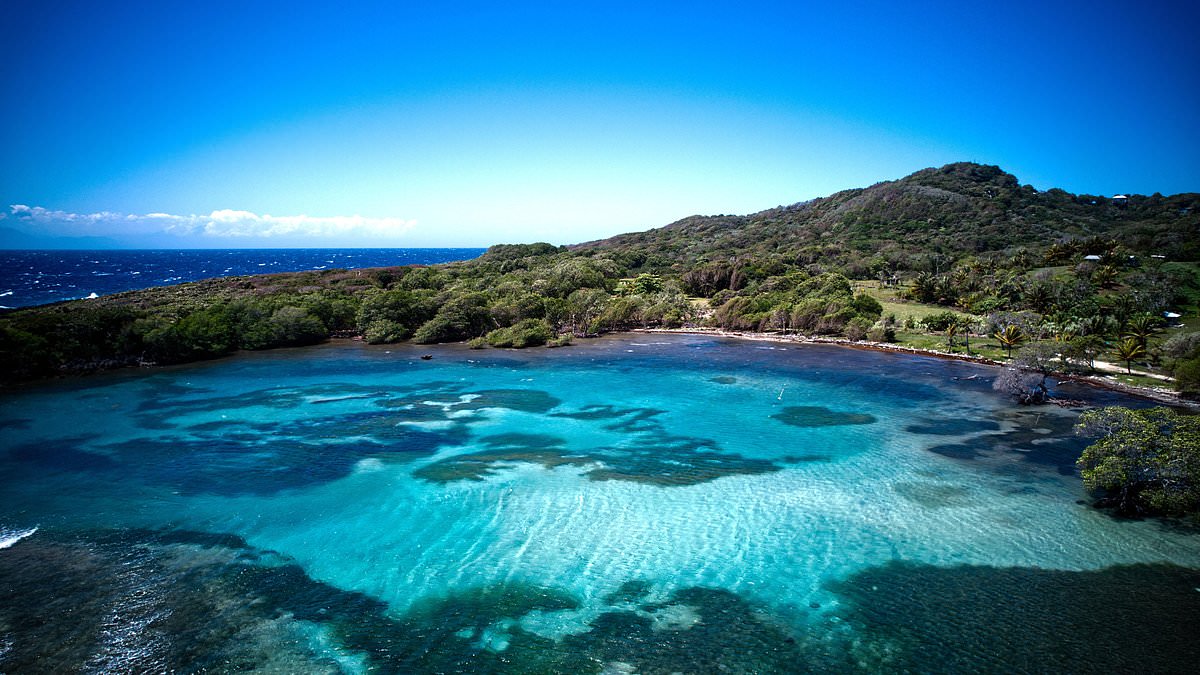
Surrounded by the planet’s second biggest coral reef, the Caribbean island of Roatan attracts most of its tourists by offering world class diving.But turn off the main road, a 25-minute drive northeast from the airport – as I did last week – and visitors will discover another, rather more controversial feature of the Honduran island that has put it on the map.Armed guards man a barrier gate beyond which Honduras in many ways ceases to exist and the private city-state of Prospera begins.Once a guard has made sure a visitor has signed a ‘temporary touristic access permit’ and ‘agreement of co-existence’ – in which they agree to be bound not by Honduran law but by Prospera’s legal codes – the road surface miraculously improves as they enter a controversial community which has been described as a country within a country.The billionaire Silicon Valley backers pouring hundreds of millions of dollars into Prospera and other so-called ‘special economic zones’ around the world – more of which later - believe they are creating the future blueprint for human society.Or more accurately their idea of society – lightly regulated, minimally taxed and super high tech: a libertarian utopia in which governments have as little power and individuals as much freedom as possible. For some it’s a matter of survival as they believe the world is descending into anarchy.Palantir and PayPal founder Peter Thiel, Open AI boss Sam Altman and venture capitalist Marc Andreessen are among those who have ploughed at least $200 million into Prospera, which extends – for now – to just over 1,000 acres.The enclave follows in an eccentric tradition that goes back at least as far as the Principality of Sealand, a ‘micronation’ set up by a British pirate radio operator on an offshore fort in the North Sea, which he declared independent in 1967. The billionaire Silicon Valley backers pouring hundreds of millions of dollars into a private, for-profit charter city Prospera believe they are creating the future blueprint for human society Surrounded by the planet’s second biggest coral reef, the Caribbean island of Roatan attracts most of its tourists by offering world class diving But turn off the main road, a 25-minute drive northeast from the airport and visitors will discover another, rather more controversial feature of the Honduran island that has put it on the mapBut while Sealand has never been accepted by any country, Prospera’s existence is officially recognised by Honduras.Not that it is allowed to fly its own flag, nor can it divert from Honduran foreign policy and criminal law (although Prospera insists local police cannot enter unless they are shadowed by its own officers).But in many other ways, the impoverished Central American nation has relinquished its territorial sovereignty to an enterprise that bills itself as ‘the future of human governance, privately run and for profit’ - a situation that has incensed many Hondurans who question how much they’ve benefited.Supporters of private cities insist these glossy communities will draw entrepreneurs there who, unfettered by choking regulations and high costs, will make important scientific and technological breakthroughs, which will lift many local people out of poverty and encourage talented Hondurans not to leave a country beset by corruption and crime.As part of a 2017 agreement, Prospera passes 12 per cent of the taxes and fees it collects to the Honduran government. Ninety per cent of its jobs must go to Hondurans.Venezuelan fund manager Erick Brimen says he founded Prospera eight years ago as a ‘poverty relief initiative’.Prospera levies an effective business tax rate of just one per cent, personal income tax of 5 per cent, 2.5 per cent VAT, and no capital gains tax. Businesses based there can choose their own regulations from a ‘menu’ of options selected from more than 30 countries – and if they don’t like any of them, they can create their own.People wanting to live or work in Prospera don’t have to show any minimum level of wealth or income but foreigners must pay an annual fee of $1,300 (£960) if they want to live there permanently.Prospera’s owners – an American company – hope eventually to attract thousands of entrepreneurs who will not only base their businesses there but move in their families and inhabit a perfectly designed and beautiful city built by robots and giant 3-D printers.Critics, however, counter that the noble intentions behind these ‘charter’ or ‘start-up’ cities has been warped by wealthy and powerful investors who simply want to get richer and more powerful – in Prospera’s case, the ‘tech bros’ determined to flee woke politicians and expensive red tape.In places like Prospera, say cynics, these people want to play God. Given most of the firms who sign up with Prospera aren’t actually physically there at all, opponents also claim that Prospera has become a haven for tax evasion.Paul Romer, a Nobel Prize-winning former chief economist at the World Bank, has backed private cities in principle but subsequently condemned Prospera. To him it is little more than a gated community for rich people who are ‘just trying to isolate themselves and do what’s best for them’. Living in a ‘libertarian fantasy’ of being free of the government, he warned, is ‘not gonna turn out well’. View of vacation homes and resorts along Coxen Hole, Bay Islands The Carnival Vista, the largest cruise ship from the Carnival Cruise Line, docked at Mahogany Beach in Roatan Visitors relax and stroll along the shoreline at West Bay, Roatan, with small boats anchored in the shallow turquoise water on a sunny Caribbean day A worker at La Catrachita bar in the town centre holds up a menu and poses with the peace signSituated along a picturesque coastal strip of sandy beaches and jungle-covered hills where bright green hummingbirds and huge butterflies flit among the kapok trees and coconut palms, Prospera has its own currency, the cryptocurrency Bitcoin. It also has its own courts – presided over by a group of retired judges in Arizona who hear non-criminal cases online.Its founders say some 500 companies – mostly tech ones – have invested in Prospera although only 30 of them are physically present there.Its biggest asset is a budding bio-tech industry led by a clinic tucked away in a quiet corner of the fiefdom (Prospera actually occupies four sites around Roatan), which is conducting research unauthorised in the US and other countries.Much of it is focused on human longevity - a particular obsession among the higher echelons of Silicon Valley. In 2024, Prospera hosted a convention - ‘Make Death Optional’ – for scores of such people.Among various treatments, the Prospera-based clinic has developed a ‘follistatin’ gene therapy that involves the injection of DNA molecules that encourage the body to repair itself. Tests on mice show it can extend their lifespan by nearly a third.While the therapy is illegal in the US, the clinic’s clients include Khloe Kardashian (who received ‘follistatin’ in Mexico) and Bryan Johnson, an eccentric tech billionaire who has been attempting to defy death by scientifically experimenting on his body but who has now developed an incurable chronic condition in his stomach lining.Prospera is keen to encourage such ‘medical tourism’, says spokesman Ricardo Gonzalez, who adds that it’s just one example of community’s ‘amicable’ ethos towards business.Yet despite Prospera’s idyllic, sun-drenched setting, it’s doubtful any Silicon Valley billionaire would want to flee there quite yet. Prospera doesn’t even have a supermarket.If you want to buy even a bottle of water from the only shop – and you may want to buy a lot as Prospera, almost on the Equator, is ferociously hot - you have to pay in Bitcoin.Prospera’s bosses believe the population of thrusting young business entrepreneurs and their families could reach 100,000 in 20 or 30 years, and they showed me an impressive AI-created video of a $60 million plan to turn it into a real city.But with few amenities, let alone citizens, Prospera is definitely a work in progress.Its business district extends to only a handful of buildings including a small factory where $100,000 robots make trendy-looking furniture. Prospera also boasts a beachside luxury resort with golf course surrounded by expensive-looking villas (almost entirely owned by rich Hondurans) but the road linking it to the business district still hasn’t been built. The main street and busy shopping district of Coxen Hole in Port Roatan Seen on the island is a small barbershop building with a teenager entering Street scene near the Half Moon Bay Beach at Roatan Island, HondurasYet members of Prospera’s 200-strong permanent population told me they believe they’re working for a better world.They may be sincere but that doesn’t mean to say they’re necessarily sane. In the 14-floor ‘Duna’ tower is biohacker Alice Chen who has created a disgusting-sounding drink made from live algae which she claims could add 20 years to someone’s life expectancy. She says that regulators in her native Canada wouldn’t allow her and her team of volunteer guinea pigs to check it was safe for human consumption.Then there’s Rich Lee, an American ‘grinder’ (a term for someone who performs extreme body modification) who wants to encourage people to implant microchips under their skin.He has seven inside his own body including a tap-to-pay credit card chip in the back of his right hand, Bluetooth headphones in his ears and magnets in his fingertips so he can ‘touch an otherwise invisible world of electro-magnetic fields’. He says the latter is great for impressing people in a bar when he can dangle a bottle top from his finger.Body modification technology is another legal grey area on safety grounds – though not here, of course. And, if anything goes wrong, no, Prospera doesn’t have a hospital either.The futuristic site is not the sole start-up city in the works, even if it’s about the only one that actually exists.Others are dotted around Latin America, the Caribbean, Africa and Asia – significantly, note critics, in struggling countries that are likely to agree to give up sovereignty for the promise of economic benefits.The grandest project is probably Praxis, a prospective city-state whose creator, tech entrepreneur Dryden Brown, sees it as a way of restoring Western civilisation.‘As the warrior-kings once sought the sacred Grail, so too shall we build an empire where true power flows from heroic courage and alignment with the divine order,’ Praxis’s ‘Declaration of Ascent’ reads.It will be a hi-tech Shangri-la where all education will be done by AI and all food prepared by robots. The police could also be robots. A former Praxis employee described Brown’s ideal system of government as ‘authoritarian fascism’.Brown says he has at least $500 million in investment – Peter Thiel is again one of the main backers – and more than 150,000 people interested in living there. But while he has explored sites in the Mediterranean and Greenland, Brown has yet to find somewhere to build his vision.Locals on the small Caribbean island of Nevis, part of the Commonwealth country of St Kitts and Nevis, are currently fighting plans by Belgian crypto billionaire Olivier Janssens to turn a tenth of the island into Destiny, a futuristic community for 10,000 wealthy people. Like Prospera, it will have its own courts and currency. Pictured: A clothing store, souvenir tee shirts that change colour in the sunJanssens boasts it would be the ‘Monaco-Dubai of the Caribbean’ but, given Nevis only has 13,000 people, local opponents fear Destiny would dominate the rest of the island and force secession from St Kitts.In Europe, dozens of tech billionaires are trying to build a self-proclaimed ‘crypto state’ on a muddy stretch of disputed marshland along the River Danube. On the Serb-Croatian border, ‘The Free Republic of Liberland’ was founded by Czech libertarian politician Vít Jedlička who claimed the territory in 2015.Liberland, which is about the size of Gibraltar, has now 200 registered companies but still lacks any proper infrastructure. Unhelpfully for Mr Jedlička, while Serbia and Croatia cannot decide who owns it, they’ve at least agreed to keep him out.Even British actor Idris Elba is involved in setting up a ‘special economic zone’, in his case an ‘international city’ on Sherbro Island in Sierra Leone, his father’s homeland. The culturally diverse ‘eco-city’ will be powered by a wind farm and ‘blends African tradition, dynamism and pride with state-of-the-art infrastructure and service,’ says Elba.If none of these cities gets off the ground, there are plenty more ideas on the table and many of them were thrashed out when Prospera hosted the annual Free Cities Conference last week.Some 260 delegates - libertarians and anarcho-capitalists (a more extreme version who don’t want to just to cut government to the bare minimum but abolish it entirely) - wilted in the heat as they earnestly discussed the merits of ‘seasteading’, tax nomadism and other novel ways of avoiding governments and their pesky taxes.Seasteading involves living in international waters, either on specially adapted yachts or on communities of floating platforms – something which international maritime law currently prohibits.Becoming a ‘tax nomad’ – or as tax avoidance advisers prefer to call it, ‘internationalising your living’ - boils down to never staying long enough in the various homes you keep around the world for any country to be able to tax you.But for all the fevered talk of independent living, the conference and indeed Prospera itself might have been cancelled had Honduras’s previous Left-wing government had its way.Declaring Prospera an insult to national sovereignty that had offered little benefit, the administration moved to renege on the deal with the crypto-state’s US owners.That was until the rival conservative party, which originally struck the deal, regained power – with the help, some believe, of Donald Trump.Critics whisper that Prospera’s backers – big donors to Trump – leant on his administration to make sure their project survived. Which might explain why the US President pardoned the Honduran party’s former leader from a 45-year prison sentence he’d received in the US for taking millions in bribes from drug cartels and helping smuggle over 400 tons of cocaine.It’s hardly the sort of scandal that is going to encourage other governments to give the green light to private cities.With almost nowhere on Earth genuinely up for grabs for anyone wanting complete independence, some libertarian dreamers wonder ruefully whether they might have to wait until Elon Musk builds the city he has planned - on Mars.
Libertarian utopia or tech bro nightmare? Inside the private city where billionaires are free to try and live forever, play God... all while paying one per cent tax
Full Article
Original Source
Read the full article at Dailymail →KhanList aggregates and links to publicly available news content. We do not host full articles from third-party sources. Always verify important information with original sources.