
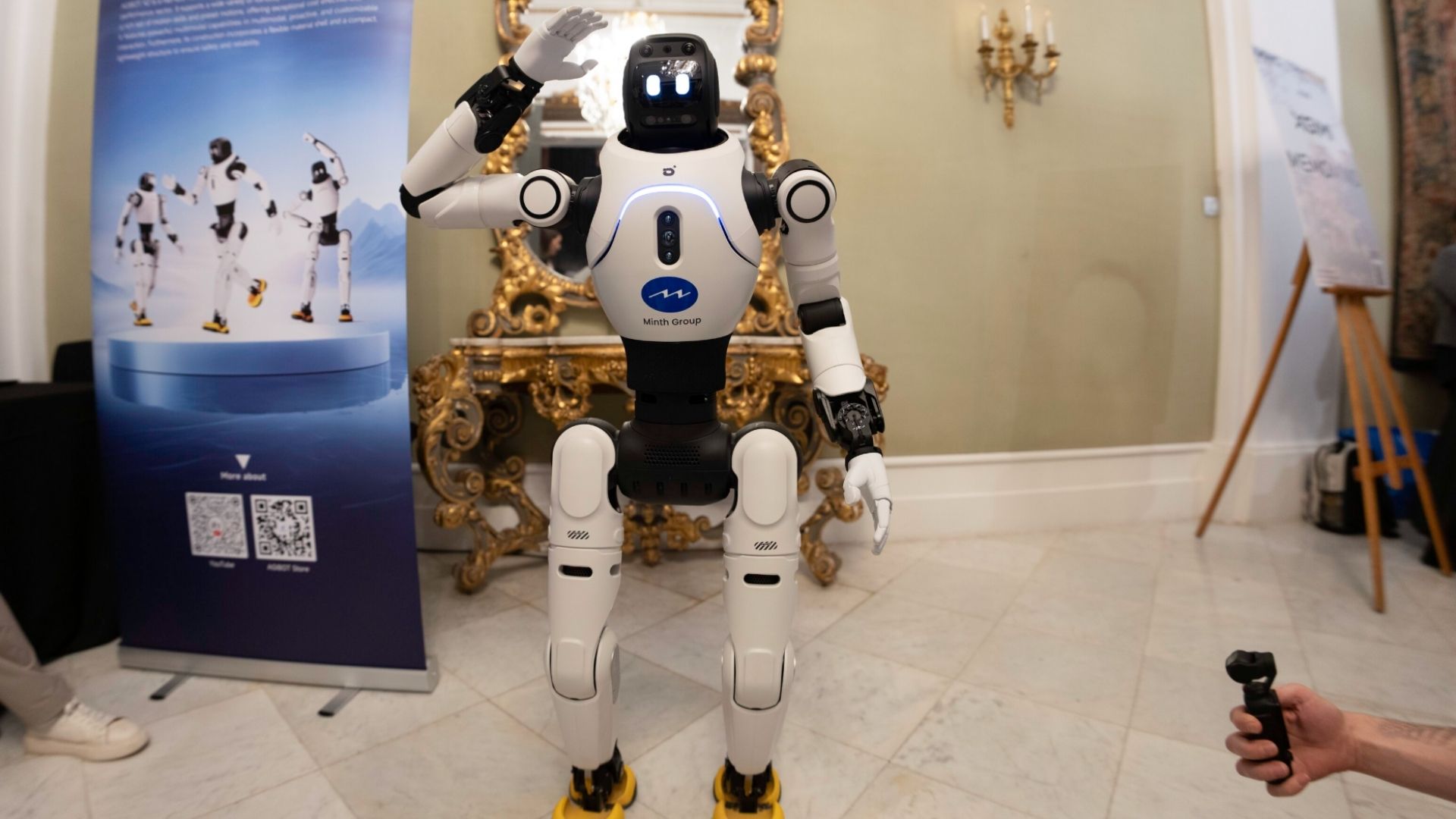
South Korea’s LG is deepening its collaboration with U.S. chipmaker NVIDIA to develop humanoid robots, establish AI factory infrastructure, and build next-generation autonomous vehicle systems. The companies signed a memorandum of understanding at NVIDIA’s headquarters in Santa Clara, California, on August 13. Their plans include unveiling a bipedal humanoid in the first quarter of 2027 and completing an 80-MW AI factory in Cheonan, South Korea, by the first half of 2028. “As our discussions have moved fast, our tasks and goals in AI Factory and Physical AI have become clear. We will accelerate the spread of AI by building industry-leading references,” said Kwang Mo Koo, Chairman and CEO of LG Corp. 80-MW facility to advance physical AI LG plans to establish an initial AI factory reference site powered by NVIDIA’s Vera Rubin computing platform in the first half of 2027. The project will combine NVIDIA’s DSX AI factory architecture with LG’s expertise in power systems, thermal management, data center design, and operations. Experience gained from the reference site will inform the construction of the larger 80-MW facility in Cheonan. Scheduled for completion during the first half of 2028, the AI factory will support the development of physical AI systems and robot foundation models. LG intends to validate an end-to-end AI factory package covering design, construction, and operations. The company could then offer these turnkey infrastructure packages to global technology customers looking to build large-scale AI computing facilities. Humanoid robot targets 2027 unveiling Alongside the computing infrastructure, LG is developing a next-generation bipedal humanoid powered by NVIDIA Jetson Thor for onboard processing, reasoning, and motion control. It is being built using the Isaac GR00T humanoid foundation model and NVIDIA’s Halos robotics safety system. LG Electronics, LG Innotek, and LG Energy Solution will contribute technologies including actuators, sensors, and batteries. The robot is expected to make its first public appearance in the first quarter of 2027. “The defining opportunity of physical AI is to give every machine the ability to understand the real world, reason and act safely alongside people — reshaping everyday life from the home and factory floor to the road,” said Jensen Huang, founder and CEO of NVIDIA. LG will also deploy its wheel-based CLOiD robots at a washing machine factory in Tennessee before the end of 2026. Data from the production-line trials will be used to improve robot performance before deployments expand to other factories, commercial facilities, and homes. Partnership reaches future vehicles The companies will also develop an on-site robot data factory using LG CNS’s PhysicalWorks platform. It will continuously collect operational data, generate synthetic datasets, and support robot training, testing, and verification. In the mobility sector, LG plans to build a high-performance computing platform for AI-defined vehicles, powered by NVIDIA DRIVE Hyperion. The platform will combine autonomous driving functions with LG’s infotainment and automotive software. A joint task force of technical and business specialists will oversee research, factory validation, and commercialization across the three areas.Get the latest in engineering, tech, space & science - delivered daily to your inbox.Atharva is a full-time content writer with a post-graduate degree in media & amp; entertainment and a graduate degree in electronics & telecommunications. He has written in the sports and technology domains respectively. In his leisure time, Atharva loves learning about digital marketing and watching soccer matches. His main goal behind joining Interesting Engineering is to learn more about how the recent technological advancements are helping human beings on both societal and individual levels in their daily lives.
LG plans to unveil bipedal humanoid robot with NVIDIA in first quarter of 2027
Full Article
Original Source
Read the full article at Interestingengineering →KhanList aggregates and links to publicly available news content. We do not host full articles from third-party sources. Always verify important information with original sources.