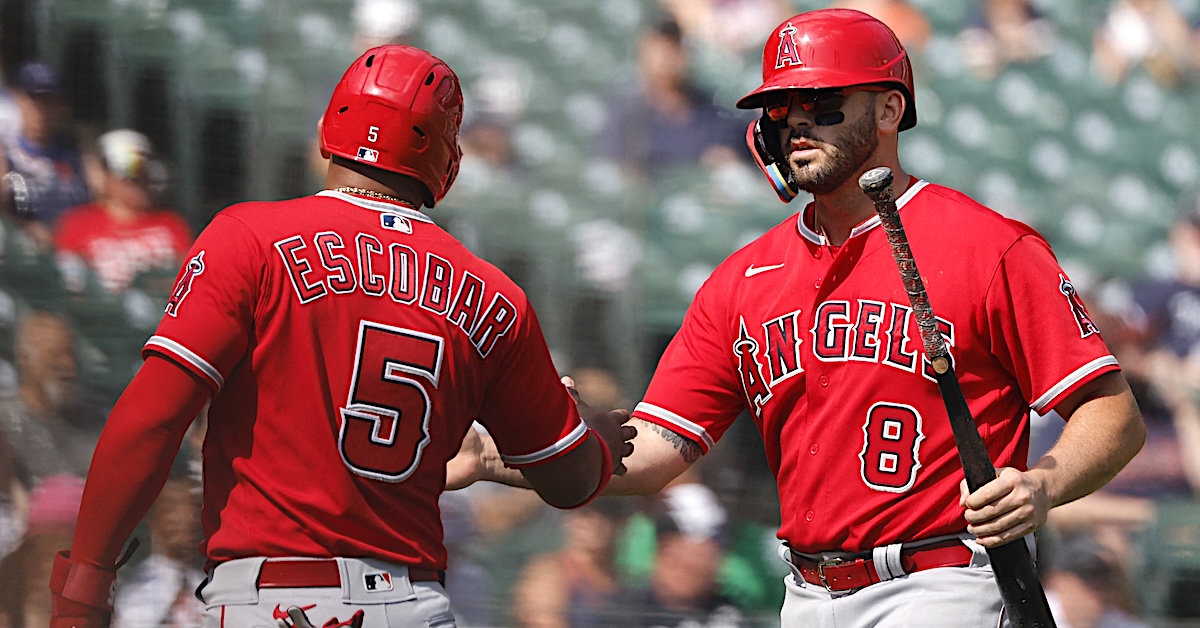
Rick Osentoski-USA TODAY Sports Over the weekend, the Red Sox decided to go for it. They traded exciting young pitcher Connelly Early to Washington in exchange for less-exciting, less-young, but playing-very-well-right-now infielder Curtis Mead. The move elicited strong reactions. Early is a genuinely promising lefty starter who will be under team control until 2032. Mead is only one year older with one less year of team control. He’s had a wonderful breakout season at the plate, and his offensive profile fits Fenway Park beautifully. But he’s a poor defender whose track record of success at the plate is extremely short. Even Boston’s chief baseball officer Craig Breslow went out of his way to spell out exactly why the team pulled the trigger, telling reporters, “Our goal wasn’t to win the trade. It was to make the team better.” I had my own strong reaction to the deal, but that was mainly because I really wanted to be the one to write it up so I could title the article, “Red Sox Go For It Now by Giving Up Early.” But the reactions to the deal are now more or less irrelevant. Mead did make the team better, but for a very, very short time. He struck out in his first plate appearance with the Red Sox, then got hit by a pitch and broke his wrist in his second. According to Baseball Prospectus’ Recovery Dashboard, the average recovery time for a fractured wrist is 52 days and the median is 47. Mead may or may not return before the regular season ends, but he’s certainly not going to be powering the Red Sox down the stretch, and they’re already out looking for more infield help. You have to feel for Mead. He was in the midst of a true breakout season. After putting up a combined 0.1 WAR in his first three major league seasons, he was already at 1.6 this year. He was traded to a contender that also happened to be the hottest team in baseball. What an exciting time for the 25-year-old, and then one pitch took it all away. You can also imagine how Boston’s front office must feel after putting in all the work to make this trade happen. Breslow stuck his neck out for this high-risk, win-now move, and just like that, it’s gone. I don’t think there’s much I could do to cheer up Mead right now, but I can take a crack at cheering up Breslow. I’d like to remind him that although this may seem like the worst case scenario for his bold challenge trade, things could have gone much, much worse. In order to see that, you just have to look at things like a chief baseball officer, removing the human element and focusing solely on pure, unadulterated on-field production. Let’s lift our spirits by acting like soulless robots. Mead lasted four and a half innings before the injury forced him from the game. He went 0-for-1 with a strikeout and, of course, a hit-by-pitch. A .500 on-base percentage meant that he left the game with a 131 wRC+ as a Red Socker. He played second base, a premium defensive position, and fielded a grounder and received a toss for a force out at second. That’s not a ton of time or chances to accrue value, but it’s not nothing either. According to our numbers, Mead was worth 0.668 runs on offense, and, including his positional adjustment, 0.007 runs on defense. Put it all together, and he accrued 0.0147 WAR in his half a game with the Red Sox. That’s one-68th of a win. (Just for fun, if you double it and then prorate it to a 150-game season, it works out to a 4.4-win pace. Pretty good for half a game’s work.) The Red Sox traded away a promising young pitcher and got a rounding error in return, but at least it was a rounding error in the right direction. I started wondering about teams that got even less from their big deadline acquisitions. Every year, contenders trade future value for present, trading prospects for players who can help them win right now. But not every player who can help you win right now actually does so. Some guys play badly with their new team. In 2016, Andrew Cashner was the headliner in a deal that sent Josh Naylor, Jarred Cosart, and Carter Capps from Miami to San Diego. Cashner went 1-4 with a 5.98 ERA in Miami, and the Marlins missed the playoffs. Nelson Cruz, who had a 142 wRC+ with the Twins in 2021, was traded to the Rays at the deadline (for Joe Ryan!), then put up a 95 wRC+ down the stretch with Tampa. That’s the kind of trade we’re looking for. You Aren't a FanGraphs Member It looks like you aren't yet a FanGraphs Member (or aren't logged in). We aren't mad, just disappointed. We get it. You want to read this article. But before we let you get back to it, we'd like to point out a few of the good reasons why you should become a Member. 1. Ad Free viewing! We won't bug you with this ad, or any other. 2. Unlimited articles! Non-Members only get to read 10 free articles a month. Members never get cut off. 3. Dark mode and Classic mode! 4. Custom player page dashboards! Choose the player cards you want, in the order you want them. 5. One-click data exports! Export our projections and leaderboards for your personal projects. 6. Remove the photos on the home page! (Honestly, this doesn't sound so great to us, but some people wanted it, and we like to give our Members what they want.) 7. Even more Steamer projections! We have handedness, percentile, and context neutral projections available for Members only. 8. Get FanGraphs Walk-Off, a customized year end review! Find out exactly how you used FanGraphs this year, and how that compares to other Members. Don't be a victim of FOMO. 9. A weekly mailbag column, exclusively for Members. 10. Help support FanGraphs and our entire staff! Our Members provide us with critical resources to improve the site and deliver new features! We hope you'll consider a Membership today, for yourself or as a gift! And we realize this has been an awfully long sales pitch, so we've also removed all the other ads in this article. We didn't want to overdo it. To be clear, we’re not talking about the worst trades ever. The Red Sox definitely regretted trading away Jeff Bagwell in 1990, and the same goes for the Tigers and John Smoltz in 1986, but the players they traded for actually helped them win right then. Down the stretch with the Red Sox in 1990, Larry Andersen ran a 1.23 ERA and an even better FIP. Doyle Alexander went 9-0 with a 1.53 ERA for the Tigers in the regular season after the trade in 1987 (though he did turn into a pumpkin in the postseason). We have transaction logs going back to 2020, so I went through them looking for players traded in June, July, or August who put up the most negative value with their new clubs. I should clarify that we’re looking specifically for win-now acquisitions. For example, over the past five seasons, no player put up as much negative value after a deadline trade as Miguel Vargas, who went from the Dodgers to the White Sox in a three-way trade in 2024. Vargas got into 42 games with the White Sox, and in that time he put up an astounding -1.16 WAR on the back of a 17 wRC+ and poor defense. He batted .104 in Chicago! Over 162 games, that works out to -4.5 WAR, which would be the worst season in major league history, and not by a small amount. However, Vargas doesn’t really count for our purposes. The White Sox were sellers at the deadline; they were one of the worst teams in major league history. Vargas wasn’t a prospect anymore, but he was still a young, promising player (and he is now realizing that promise in a breakout All-Star season). He wasn’t there to help those White Sox win now, then. We’re interested in players like Mead, who were brought in specifically to improve a team that considered itself a playoff contender. The list of prospects (or older throw-ins who helped to get a deal done) is a separate list, and it’s interesting enough that I’ll show it to you below, but it’s not what we’re after today. Win-Later Deadline Acquisitions Who Won the Least Now I’m sure the Marlins didn’t love it when Joe Panik ended his career by batting .172 across 53 games while wearing teal, but I don’t think they lost too much sleep over it either. The same goes for Korey Lee, who went from the Astros’ minor league system to the White Sox’ in 2023, then put up a -27 wRC+ when the White Sox called him up, and for Trayce Thompson, who posted a 40 wRC+ for the White Sox in the same season. The Marlins, White Sox, and Rays show up on this list a lot, and that’s not an accident. They do a lot of selling (though the Rays often sell for very different reasons than the Marlins and White Sox). Perhaps the most interesting name on this list is Josh Bell, who went from Washington to San Diego in the Juan Soto trade in 2022. You might recall that Soto caught a lot of flack because his production took a dip after the trade, but that was only by his absurdly lofty standards. He still ended up with a 130 wRC+ and 1.2 WAR for the Padres that year. However, Bell’s wRC+ dropped from 145 with the Nationals to just 79 with the Padres. He batted .192 and cost the Padres -0.7 WAR, coming shockingly close to negating Soto’s value down the stretch. Now that that’s out of the way, let’s get to the real list. Here are the win-now players who lost the most for their new teams over the past five years. Win-Now Deadline Acquisitions Who Won the Least Now Now I’m not really sure what the Pirates were thinking in 2024. They had a complicated trade deadline, but I think this was their version of going for it. On the day they traded for Bryan De La Cruz, they had a 17.2% chance of making the playoffs. It was the first time in eight years that their Playoff Odds had been so high at the deadline. In the first half, their outfield had put up a combined 77 wRC+ and -1.5 WAR, the worst and second-worst marks in baseball, respectively. The 93 wRC+ and 0.0 WAR De La Cruz had put up in Miami that season must have looked like manna from heaven, but that’s not what they got. Across 44 games in Pittsburgh, De La Cruz batted .200 with a 38 wRC+. His power dried up. His walk rate dropped by more than half. His strikeout rate jumped by five percentage points. His defense actually got slightly better, which is to say that it went from really bad to regular bad. The fact that I needed to spend a paragraph explaining why De La Cruz belongs at the top of this list is somewhat damning. Truthfully, this list is nowhere near as exciting as I’d hoped. None of these players was a star at the time he was traded. Not all of them actually went to contenders. More than a couple simply had their contracts purchased for cash. If you’re looking at the list and trying to decide who was viewed as the most impactful piece moved at the time of the trade, I think you’d have to go with Willi Castro, a superutility man who put up 1.1 WAR and a 109 wRC+ for the Twins in 2025. The funniest entries are probably Eduardo Escobar and Mike Moustakas, whom the Angels brought over at the deadline in 2023 to help out their infield, and who instead combined to cost the Angels -1.6 WAR. It turns out it’s actually very rare for a team to go for it in a big way at the deadline only to have a player bottom out and accrue a ton of negative value. What you will find, if you include the players traded to win-later teams and dig down a handful more spots, is Curtis Mead. Just last year, the Rays traded Mead to the White Sox in a deal headlined by pitcher Adrian Houser. Mead ran a 64 wRC+ in Chicago, putting up -0.3 WAR in 41 games. I’m not sure that’s going to make Craig Breslow feel any better.
Let’s Make Craig Breslow Feel Better
Full Article
Original Source
Read the full article at Blogs →KhanList aggregates and links to publicly available news content. We do not host full articles from third-party sources. Always verify important information with original sources.