
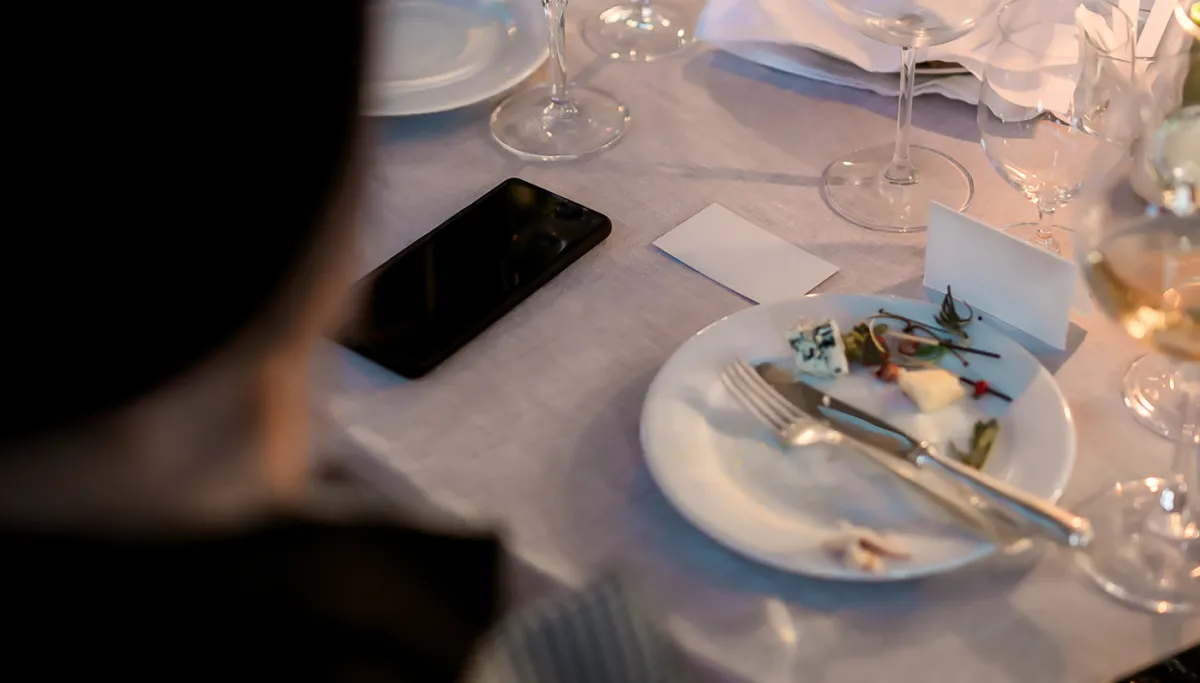
Here’s what usually happens at lunch with an old friend. I sit down across the table from the old friend, we make the usual “Hello, how are you? What’s new? This traffic, huh?” small talk, and I remove my phone from my pocket and place it face down on the table, usually directly across from his phone, which is also face down. The rule is that face down is polite, while face up is rude.They’re both rude, of course. Or at least, leaving your phone on the table indicates an imbalance in one’s life and an inability to mark off certain times and places, and, by extension, certain people, as important enough to deserve undivided attention.But, you know, whatever. He’s an old friend and, honestly, this is how we sometimes treat old friends — with the half-interested disdain earned over the years. I like to think that if he were a new friend, or, I admit with shame, a really rich friend, I’d leave my phone in my pocket and lean in, eyes bright and engaged, even during the “Hello, how are you? What’s new? This traffic, huh?” small talk. (Getty Images) But with an old friend, here’s how it goes: The conversation is rolling along, then it hits a lull, and both of you feel the tug of the phone sitting next to the bread plate. But neither of you wants to be the first to pick it up. Picking it up first is rude. Picking it up second is polite.So you wait for the lull, for the moment in every conversation when there’s a pause, and the instant the other guy glances down — the second his thumb grazes the screen — you’re free. You grab yours like it’s a $20 bill you saw on the sidewalk.It was during one of the stretches between phone checks, sometimes referred to as “human conversations,” that my friend told me about his daughters. Both are in their 20s, and both have given up their smartphones. No scrolling, no posting, no answering texts within the 30 seconds that civilization now requires. No social media. No games. No geo-tracking apps.He wasn’t thrilled. He’d feel a lot better, he said, if there were some way for them to reach him and for him to reach them. Which makes sense because he’s a father and they’re his daughters. Somewhere out there are two people he loves, and he can’t find them on a map.He said this, I should note, while looking at Instagram.WHEN NOT TO STEW OVER THAT UNEARNED B-PLUS Everyone complains about the younger generation — well, at least I do — and everyone thinks they’re smartphone addicts and social media victims, but the truth is, when these phones came out in the early years of this century, we jumped at them. Not the young people. Most of them were still in car seats. It was my generation, the people who are now getting direct mail from AARP, that stood in line overnight outside the Apple Store. We upgraded every year, because the new one had a slightly better camera and came in a color called midnight. We loaded our music into them — Spin Doctors! Counting Crows! — then our contacts, then our calendars, our photographs, our bank accounts, our boarding passes, leading, finally, to the need to put them on the table in front of us — face down, face up, doesn’t matter — during a conversation with an old friend in which, often, we complain about how addicted young people are to their phones.But we’re the ones who got addicted, and then we got our children addicted, and now the children, if my friend’s daughters can be counted as data, are kicking the habit. Of course, when they put down their phones, they’re heading back to a world they’ve never actually lived in — the one where you couldn’t text if you’re running late, or leave the house without a map and directions. We lived in that world for decades. We know it was, probably, better in some way, despite the benefits of a smartphone, to sit across the table from someone, and if we’re bored for a moment, to be bored. And now some (probably) annoying and (definitely) smug young people are going to teach us what we used to know but have forgotten: something simple like how to have lunch with an old friend.Rob Long is a television writer and producer, including as a screenwriter and executive producer on Cheers, and the co-founder of Ricochet.com.
Let’s learn from the younger generation on ditching smartphones
Full Article
Original Source
Read the full article at Washingtonexaminer →KhanList aggregates and links to publicly available news content. We do not host full articles from third-party sources. Always verify important information with original sources.