
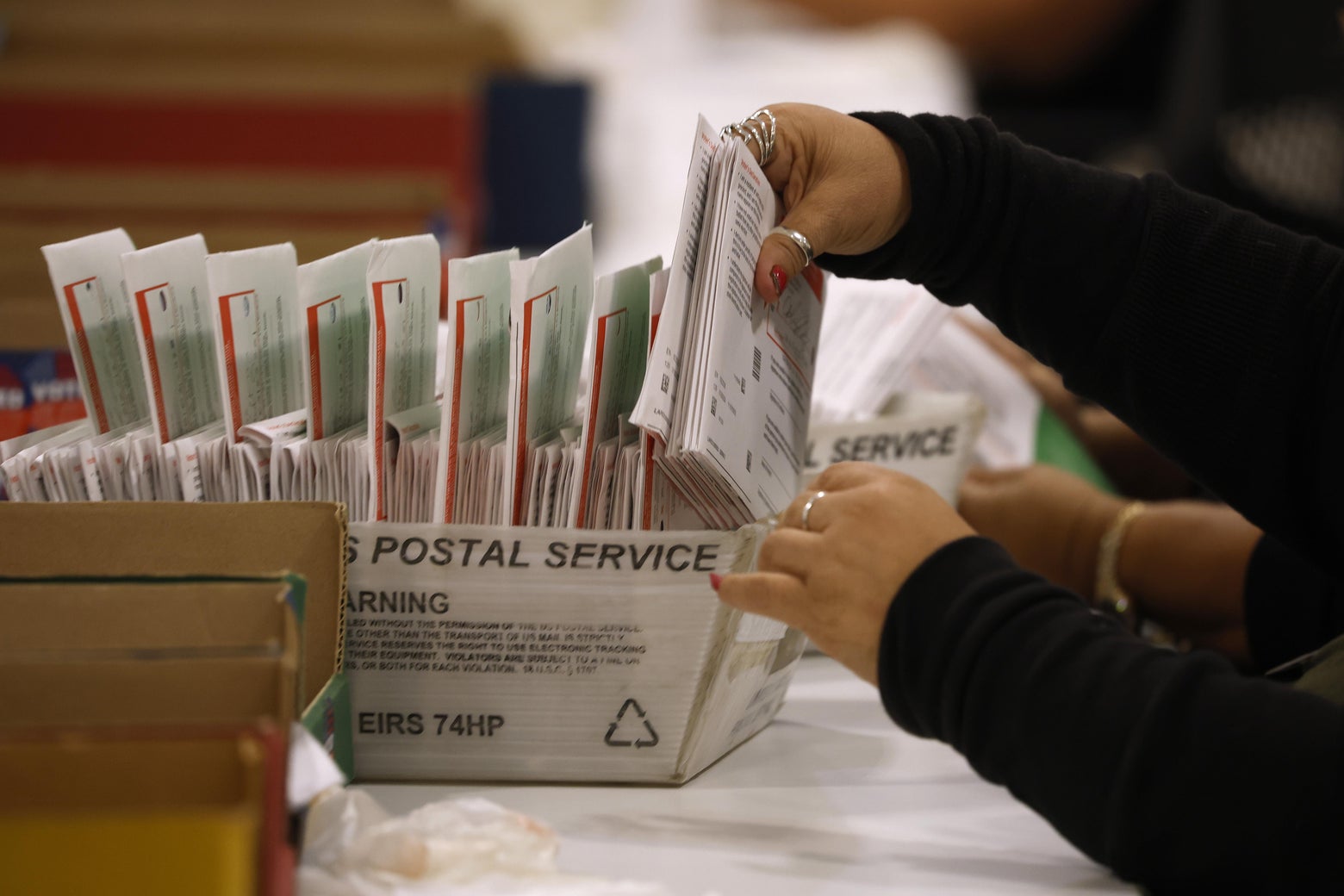
Jurisprudence An election worker processes mail-in ballots for the California state primary election at the Los Angeles County Ballot Processing Center on June 05, 2026 in City of Industry, California. Justin Sullivan/Getty Images Sign up for Executive Dysfunction, a weekly newsletter that highlights one under-the-radar story about how Trump is changing the law—or how the law is pushing back—and keeps you posted on the latest from Slate’s Jurisprudence team. There are two ways of looking at the Supreme Court’s three-sentence ruling in USPS v. California Monday evening that put an end to Donald Trump’s attempt to disenfranchise millions of elderly, disabled, military, rural, Native American and other voters in the 2026 midterm elections who depend upon vote by mail as their only viable option to cast a ballot. The first is to lament that the government pushed this case to the limits—going not once or twice, but three times to the Supreme Court—and that two Justices, Samuel Alito and Clarence Thomas were willing to simply ignore mass disenfranchisement and side with Donald Trump’s bogus voter fraud crusade. The second is to note that the court’s conservatives and liberals came to the brink, saw that ruling the other way risked serious election subversion, and said “No.” For the time being, let’s celebrate that the center of the court did hold, even as dangers remain ahead in both 2026 and 2028. Slate readers are already familiar with this long saga, so just a very brief review is necessary. Back in March, President Trump put out an executive order on voting (his second since returning to office in 2025) that among other things directed the post office set up a new rule imposing a set of requirements for states that wanted to continue to have their ballots delivered by mail. USPS’s rule issued in late August required that states get USPS approval for new envelope designs with intelligent bar codes on them, to put those bar codes on each envelope, upload a list of the state’s voters to a USPS portal, and to submit the ballots for the post office to check the names encoded in the bar codes against the voter list. The rule further required the USPS to reject an entire batch of ballots if there was one potential mismatch. In the brief moment when courts did not block the rule from going into effect, USPS rejected Leon County, Florida’s ballot design because its required printed notation about return mail was 0.014 of an inch too close to other information on the envelope. Now complying with all these new rules sounds pretty hard for election administrators to do with lead time and practice. But the government tried to impose these rules for the already ongoing midterm elections. Envelopes have already been loaded with ballots and addressed. Indeed, North Carolina began mailing ballots on September 4, and other states are doing so now. Even as of Monday’s Supreme Court’s ruling, USPS did not have a working portal for states to upload their voter lists, not even on a voluntary basis as USPS had said would be possible by last week. The upshot of USPS’s administrative failure is that the rule would have stopped the agency from accepting ballots from all states because there could be no matching between the envelope and the portal. That means that the most vulnerable voters who depend on vote by mail around the country would have been disenfranchised, including core Republican constituencies. The federal district court issued a preliminary injunction partly on this basis, noting the burdens on election administrators were high and the public interest costs dire. The district court also found that the rule exceeded USPS’s authority to issue. The Supreme Court’s terse order agreed on both points. It held that the government was likely to lose on the legal question of USPS’s authority. And it held that the “equitable factors”—that is, the burden on election administrators and the voting public—outweighed the government’s purported interest in stopping voter fraud. White hot fury that the government tried so hard to get this rule in place for the 2026 elections, knowing full well the consequences had it been successful at the Supreme Court, is the correct emotion. A good legal brief takes on the strongest argument of the other side and deals with it head-on. In this case, the government had to overcome the district court’s factual findings about the unfairness of the rule. But the government’s brief in this case simply ignored the mass disenfranchisement point, one flagged by the states and voting rights organization plaintiffs as well as in a professors’ amicus brief that the Safeguarding Democracy Project filed in this case. The failure to address the mass disenfranchisement point essentially conceded it, and that was enough for the court majority. But it was not enough for Justice Samuel Alito, dissenting along with Justice Clarence Thomas. Alito first concluded that the U.S. was likely to win on the merits. When he turned to the equities, he parroted the empty and unsupported claim that the USPS rules would stop fraud. On the other side of the ledger, he said that states were divided on the equities because some Trump-supporting state attorneys general filed a brief siding with the government; never mind that some of those states’ chief election officers filed on the other side. In any case, he went on to blame the states for litigating the case so hard that it somehow stopped the government from getting its rule and portal up and running, and he once again implicitly blamed Justice Ketanji Brown Jackson for slow-walking the case when it first came before the justices in July. Totally absent from Justice Alito’s balancing were the voters. They weren’t an afterthought; their interests were not considered at all. This is unsurprising, coming from the justice who has done more to hurt the cause of voting and voting rights than any on the court in at least a century So there are good reasons to be furious, and worried about what this portends for the future. But let’s not be all gloom and doom. We know that Justice Kavanaugh, who agreed in a separate concurrence that the government might win on the merits, saw that the equities favored the voters this time around. And we can be sure that at least two of the court’s other conservatives agreed too, along with the court’s three liberals on both the merits and the equities. A third conservative justice either agreed with the majority or did not see fit to side with either Alito’s dissent or Kavanaugh’s concurrence. That ain’t nothing. Just as in the period after the 2020 election, when Donald Trump tried to subvert the outcome of the presidential election with bogus legal arguments and conspiracy theories, the Supreme Court again stood firm and said “No.” Back then, it rejected without comment an original petition from Texas’s Attorney General Ken Paxton to throw out the results from some states that voted for President Joe Biden. Now, it failed to countenance a mass disenfranchisement just weeks before a critical midterm. The Supreme Court has been terrible on voting rights, but so far it has held the line on actual election rigging. Let’s celebrate that, even as we gird for more battles to come. Donald Trump Jurisprudence Voting Voting Rights Samuel Alito 2026 Midterms
Let’s Celebrate the Supreme Court Not Outright Rigging the 2026 Election
Full Article
Original Source
Read the full article at Slate →KhanList aggregates and links to publicly available news content. We do not host full articles from third-party sources. Always verify important information with original sources.