
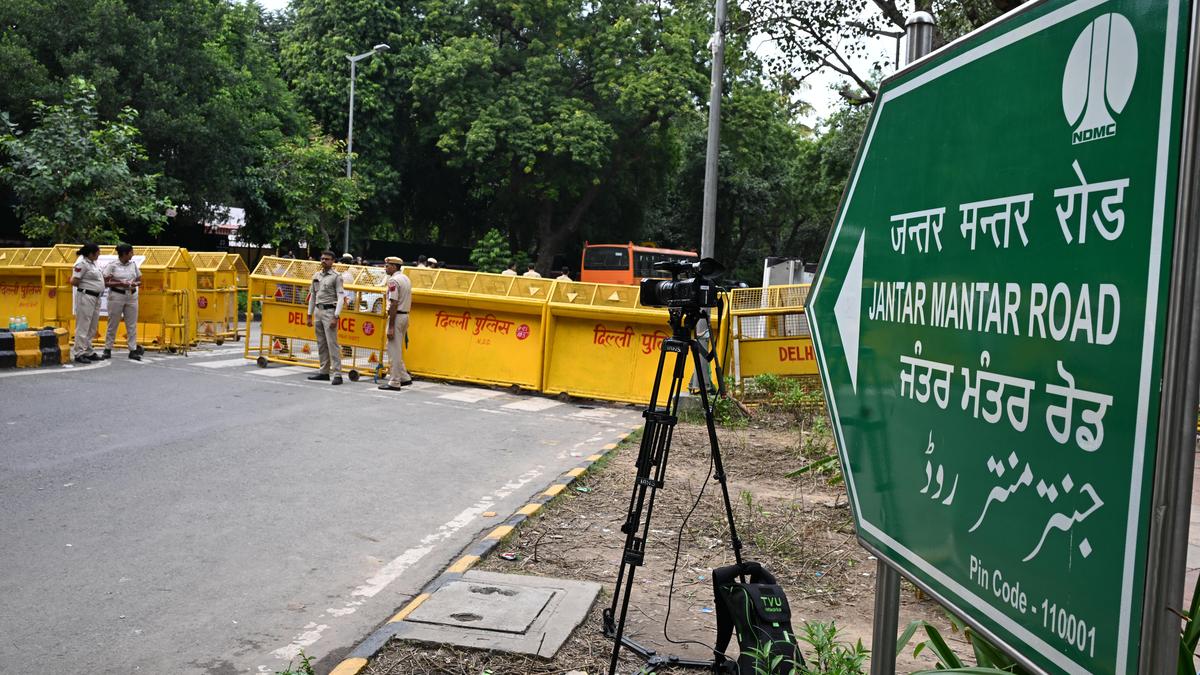
Security personnel keep vigil at Jantar Mantar as the Delhi Police on October 12, 2026 denotified Jantar Mantar as a designated venue for protests and demonstrations, replacing one of the capital’s longest-established sites of public dissent with three alternative grounds farther from the seat of power. | Photo Credit: Sushil Kumar Verma Lately, the streets of Delhi have been tense with protests against the Central government. The large-scale exclusion of voters in the Special Intensive Revision (SIR) has led to protesters demanding the resignation of Gyanesh Kumar, the Chief Election Commissioner. The government responded with a heavy hand, deploying police and military personnel. This has led to questions regarding suppression of protests and how it offends the constitutional rights to expression and assembly.The right to dissent and protest is integral to any liberal democracy. Holding rallies and demonstrations have a rich legacy in India, traceable back not only to the independence movement, but also to agitations by trade unions, farmers, social activists, and many more. A democracy that believes in the Constitution must treat any protest as important and address concerns.Unfortunately, over the past years, one has increasingly observed the emergence of a culture of suspicion. The sentiment —popular among the right-wing — of distrusting any disagreement with the government has a pre-democratic character. The immediate questions regarding ‘permission’ for protests, or ‘funding’ of the protesters is predicated on this view. It refuses to see citizens as autonomous agents with a right to protest for what they believe in. It considers the state as the provider of resources and citizens as passive recipients. The heart of the constitutional right to protest lies in not treating protesters with suspicion. Editorial | Rights and wrongs: On the fundamental right to peaceful assembly and protestArticle 19(1)(a) guarantees all citizens the right to free speech and expression and Article 19(1)(b), the right to assemble peaceably without arms. Fundamental rights operate as limits on state action. In any democracy, there is tension between the exercise of rights and the state’s authority. Hence, any restriction on the right to assembly must be subject to Article 19(3). It says that the state can make a law in the interests of sovereignty and integrity or public order, and impose reasonable restrictions. Here, we see a fundamental gap between the liberal state’s constitutional spirit and an executive that constraints this right. First, there is a disproportionate invocation of preventive laws. For instance, Section 163 of the Bharatiya Nagarik Suraksha Sanhita (BNSS), 2023 was invoked in the capital immediately before the protests. This law is inherently problematic as it gives wide discretion to the executive to direct the removal of persons to prevent the disturbance of public tranquillity, among other grounds. This is coupled with a disproportionate use of force on peaceful protesters, long detentions without disclosing whereabouts, preventing access to lawyers or necessities, and issuance of deportation notices to Overseas Citizens of India who participate in the protest. The government routinely creates a chilling effect on freedoms of speech and assembly.As stated by the Supreme Court in Himmat Lal vs Commissioner of Police (1972), reasonable regulation of assembly is different from arbitrary exclusion. While reasonable ‘time, place and manner’ restrictions can be imposed, the top court said that if the state …“can constitutionally close both its streets and its parks entirely to public meetings, the practical result would be that it would be impossible to hold any open-air meetings in any large city.” It cautioned that state monopoly on public places cannot defeat the right to assembly. Unfortunately, when the constitutional validity of the predecessor provision of Section 163 of the BNSS was challenged, the court in Babulal Parate vs State of Maharashtra (1961) refused to interfere. But it said that the provision is ‘attracted only in emergencies.’Designating protest sitesIf any meaningful right to assembly is to exist, public places must be easily accessible and available. This is why the denotification of Jantar Mantar as a protest site assumes serious relevance. Moving protests to distant areas renders the purpose of protests meaningless.On October 9, when the top court heard petitions challenging the blanket transport ban to Delhi, the court directed that ‘suitable alternative sites’ for protest must be designated. When the Delhi High Court was met with the denotification challenge, the Additional Solicitor General informed the court that that this was pursuant to the Supreme Court’s earlier order.Crucially, no interim orders were passed by the top court in the cases challenging denotification. Thus, Jantar Mantar remains inaccessible as a protest site. The court must reconsider extending legitimacy to a government that strips the people’s right to assembly. It must aspire to close the gap between constitutionalism that prioritises the right to assembly and conservatism which does not.Thulasi K. Raj is a lawyer at the Supreme Court of India Published - October 26, 2026 01:46 am IST
Lessons on the right to assembly
Full Article
Original Source
Read the full article at Thehindu →KhanList aggregates and links to publicly available news content. We do not host full articles from third-party sources. Always verify important information with original sources.