
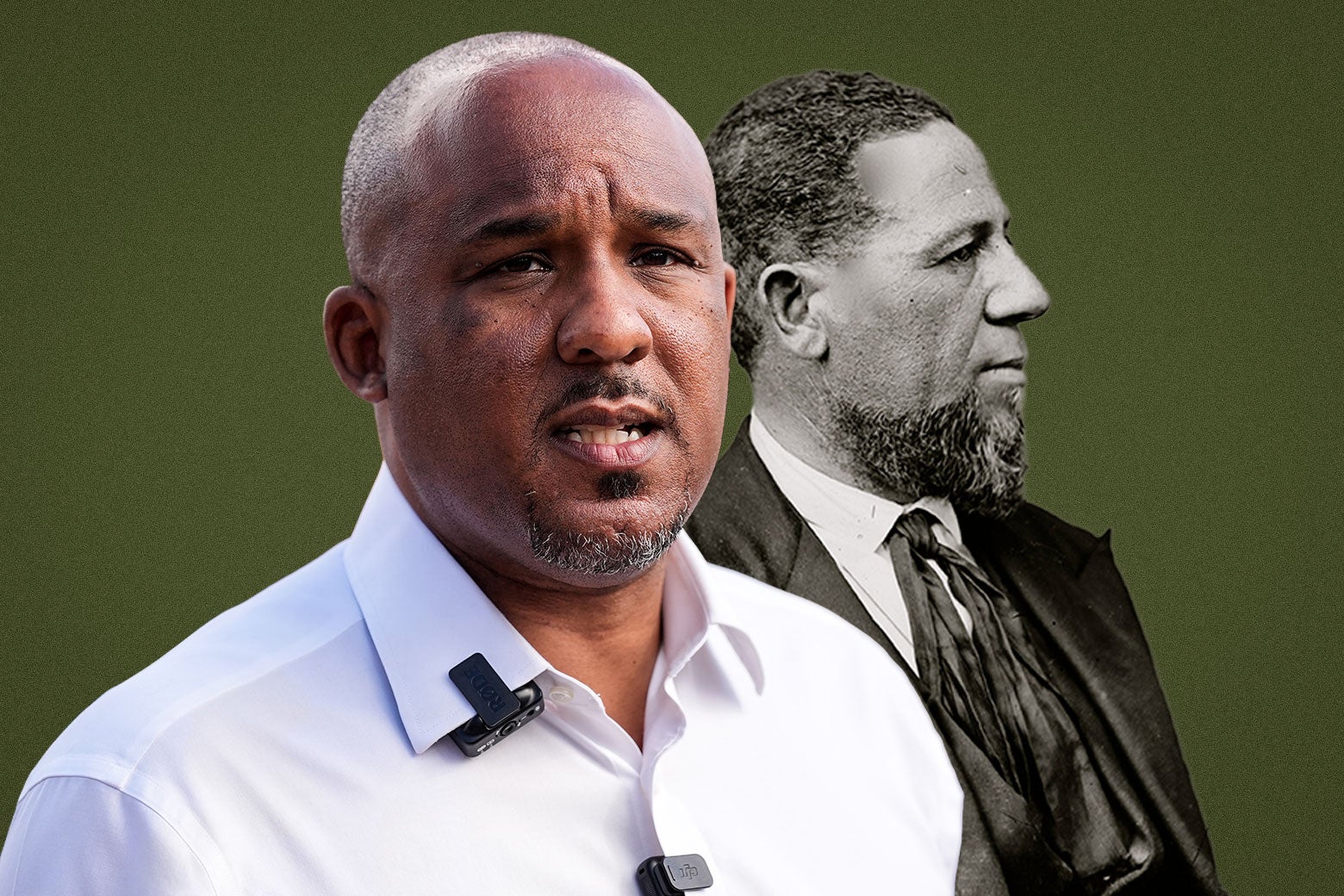
Jurisprudence What the Astonishing Story of Mississippi’s First Black Senator Teaches Us About Scott Colom’s Road to Victory Mississippi Sens. Scott Colom and Hiram R. Revels. Photo illustration by Slate. Photos by Rogelio V. Solis/Getty Images and Buyenlarge/Getty Images. Sign up for the Slatest to get the most insightful analysis, criticism, and advice out there, delivered to your inbox daily. On Wednesday, the Associated Press called Mississippi’s outstanding Senate race, and Scott Colom claimed victory to become the state’s first Black U.S. senator since Reconstruction. In the wake of that historic win, it is a good time to reflect on the remarkable life and legacy of his predecessor in that role. In January 1870, the Mississippi Legislature elected Hiram R. Revels to take the seat vacated when Albert Gallatin Brown had resigned from the Senate to join the Confederate army. The next month, Revels would become the first African American sworn in to either the Senate or House of Representatives, but there was still an obstacle to overcome. Upon arriving in Washington, Revels found his credentials challenged by Democratic senators from Maryland, Delaware, and Kentucky. The challengers claimed that, as a Black man subject to the Dred Scott decision, Revels had not become a U.S. citizen until the ratification of the 14th Amendment in 1868. Thus, they argued, he lacked the constitutionally required nine years of citizenship. The dominant Republicans rallied behind Revels, and the Senate voted 48–8 to seat him, with an assignment to the Committee on Education and Labor. Revels soon established himself as a champion of African American rights. In his maiden speech, delivered to a packed gallery, he unsuccessfully objected to a proposed new constitution for Georgia that restricted Black politicians from holding state office. “We ask but the rights which are theirs by God’s universal law,” he said. Throughout his tenure in the Senate, according to the Senate Historical Office, Revels continued “speaking out against racial segregation, and fighting efforts to undermine the civil and political rights of African Americans.” During the debate over enforcement of the 15th Amendment, which invalidated racial restrictions on voting rights, the fiery abolitionist Wendell Phillips invoked Revels as “the Fifteenth Amendment in flesh and blood.” Revels’ background had well prepared him for the role he played in the Senate. Born free in North Carolina in 1827, he was the descendant of free Blacks, whites, and Croatan Indians. One of his great-uncles was a free Black man who fought and was wounded in the American Revolution. As a young man, Revels became an ordained minister in the African Methodist Episcopal Church. In the 1840s and ’50s, he traveled both sides of the Mason-Dixon Line, preaching to Black audiences in Illinois, Kansas, Kentucky, and Tennessee, as well as Missouri, where he was once arrested for preaching to enslaved people. He was consequently cautious when visiting plantations, avoiding the appearance of incitement so that “even slave holders were tolerant of me.” In the North, however, “I always assisted the fugitive slave to make his escape.” The beginning of the Civil War found Revels living in Baltimore, where he helped recruit two Black regiments for the Union army. In 1864 he entered active Union service in Vicksburg, Mississippi, as the chaplain for a Black regiment. Revels was not the only member of his family who battled slavery. His cousin Lewis Sheridan Leary, a harness-maker in Oberlin, Ohio, had joined John Brown’s 1859 raid at Harper’s Ferry and died fighting to free the enslaved people of Virginia. In an interesting historical twist, Revels’ relationship to Leary would come full circle decades later. Leary’s widow, the former Mary Patterson, later married an Oberliner named Charles Langston, a leading Black abolitionist in Ohio. Charles and Mary Langston relocated to Kansas, where they had a daughter named Caroline. She entered into an unhappy marriage with a man named James Hughes that produced a son whom she named for her father. After Caroline and James divorced, Langston Hughes was raised by his grandparents, who shared with him stories of Lewis Leary’s bravery and dedication. As a poet and playwright, Langston Hughes became a central figure in the Harlem Renaissance. And this brings us back to Hiram Revels, whose own grandson was the pathbreaking University of Chicago sociologist Horace Cayton, co-author of the seminal 1945 ethnography Black Metropolis: A Study of Negro Life in a Northern City. Cayton and Hughes were close friends in the 1930s and ’40s, when Chicago experienced its own Black literary renaissance, each making his own contribution to Black advancement. As far as I can determine, however, neither man was aware of the other’s connection to Lewis Leary. There is no mention of it in their memoirs. In 1870 U.S. senators were still chosen by state legislatures; direct elections would not come until 1913, with the ratification of the 17th Amendment. The Mississippi Legislature that convened to fill Brown’s empty seat had only a minority of Black members, with many white candidates vying for the job. Having been elected to the state Senate the previous year, and as an ordained minister, the little-known Revels was asked to provide the benediction. He led the prayer with such power and eloquence that he emerged as a “compromise candidate in a contentious field.” The Black legislators coalesced around Revels, and he was eventually elected after three days and seven ballots. Sometimes virtue prevails, even though the counting may take some time. Democrats Jurisprudence Senate Mississippi 2026 Midterms
Lessons on Scott Colom’s Win From Mississippi’s First Black Senator
Full Article
Original Source
Read the full article at Slate →KhanList aggregates and links to publicly available news content. We do not host full articles from third-party sources. Always verify important information with original sources.