
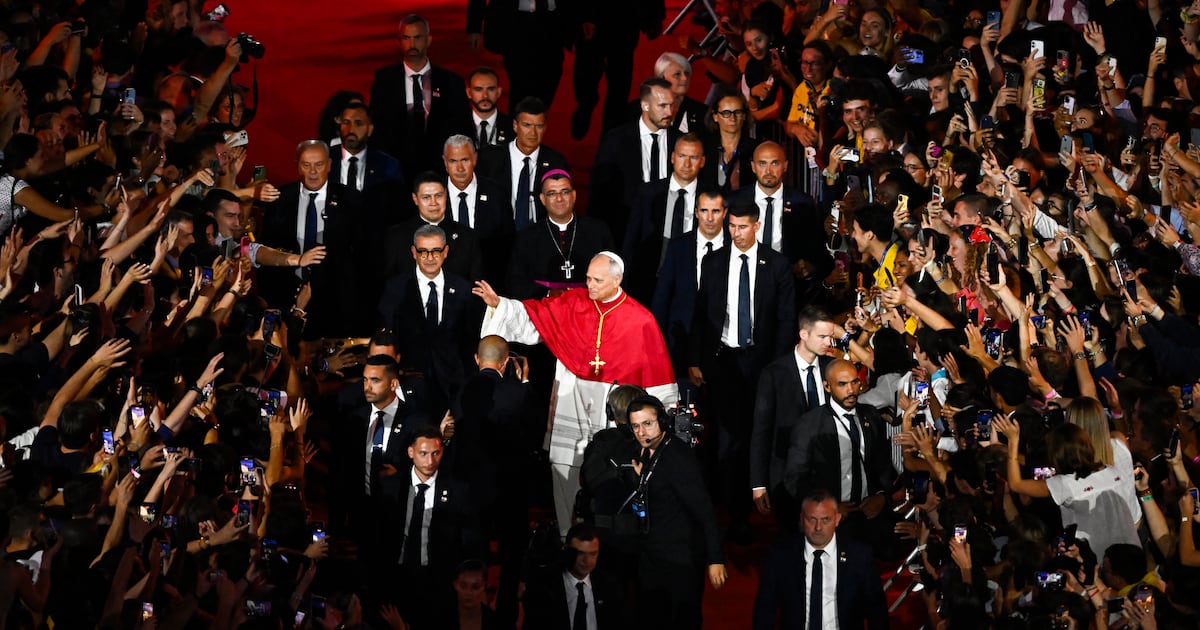
In college I read the arch-conservative Joseph de Maistre. He wrote at a time when French revolutionaries were renaming the months “Brumaire” and “Thermidor” according to “rational principles”, and banning religious festivals in favour of civic ones such as the “Cult of Reason”.De Maistre argued that this would fail. The crowds would not come. No secular festival would ever have the pull of the sacred.I couldn’t help but chuckle to see staff at the Élysée Palace – usually hardened to the appearance of dignitaries in the court of honour, which happens every week – crowded around a small window to catch a glimpse of the arrival of Pope Leo XIV.It was quite an image for a state founded in opposition to Catholicism. De Maistre was having the last laugh.READ MOREThe pope has been an unexpected hit in secular France.Regional daily La Dépêche described “a surge of popular jubilation” accompanying the pontiff’s itinerary through Paris and Lourdes.“Some talk of a ‘Leomania’ that has gripped the capital, not to say the whole country ...” reported the broadcaster RTL.The insidery political newsletter Playbook Paris titled its Sunday edition “Pope star”, and reported that Leo’s open-air Mass for hundreds of thousands in the Place de la Concorde was “the place to be for much of the political class”.Hundreds of thousands gathered on the Champs-Elysees avenue for the Pope's outdoor mass at Place de la Concorde in central Paris last weekend. Photograph: Sameer Al-Doumy/AFP via Getty Images Souvenirs marking the pope's visit to France. Photograph: Jean-Christophe Verhaegen/AFP via Getty Images Attendees were advised to start queuing at 11am for the 3pm Mass. I took a “boat bus” down the Seine, evading security cordons that blocked off a large chunk of central Paris. The crowds lined the bridges and the quays for miles. Priests took confessions along the Champs-Elysées.France’s famous laïcité, or state secularism, was set down in a 1905 law that ended state subsidies for any religious group and transferred Church property to the state.Nowadays, debates about the display of religious symbols and clothing in public settings are all about Islam, but they have their origins in fierce anticlericalism directed against the Catholic Church.Both Macron and Leo reflected on this history when they met at the Élysée.A true secularism “consists not in excluding religion from the public sphere or from education, but in striving to ensure that the state and religious institutions maintain dialogue and join forces in the service of the common good”, the pontiff said, mentioning the state-subsidised restoration of Notre Dame.France’s laïcité is “in no way the negation of religion”, Macron said, adding that all were free to worship.[ Pope Leo’s family secret: a birth in a mother and baby homeOpens in new window ]Yet the protocol over which events the French president can attend during a papal visit is delicate.In 2023, president Emmanuel Macron caused a minor furore and was accused of disrespecting his office by attending a Mass by Pope Francis in Marseilles, the first time a president had done so since 1980.This time, however, it was Macron’s absence from the huge Mass in Paris that was noticed, especially when a good number of next year’s presidential election hopefuls were there.France's president Emmanuel Macron and Pope Leo in Metz. Photograph: Benoit Tessier/AFP via Getty Images Close to midnight before Leo’s final day in France, Le Monde and Le Figaro reported a sudden change to the president’s agenda.“In a surprise move, contrary to the original schedule,” Le Monde wrote, “Emmanuel Macron will in the end be attending the mass celebrated by Pope XIV in Metz cathedral.”The local mayor slated to be the official host was bumped. Macron was getting in on the popular feeling.There was an official explanation. Courtesy demanded it, and Macron hoped to continue his “fruitful” discussions with Leo about peace and artificial intelligence, Élysée sources briefed. There were legal technicalities to draw on too. When the separation of church and state was introduced in 1905, Metz was part of Germany. It means an older “Concordat” signed under Napoleon in 1801 is still in force there. Schools include religious education. The clergy of the officially recognised religions – Protestant ministers, Jewish rabbis, but mostly Catholic priests – receive salaries from the state. This is a less secular part of France.Jordan Bardella and Marine le Pen attending a papal event in France. Photograph: Aurelien Morissard/AP Now that Leo has departed, France is taking stock of its moment of fervour.For some, it is part of a broader conservative turn, as polls show the far-right Marine Le Pen as the clear front-runner for president in advance of an election due next year.However, Leo doesn’t fit neatly into a right-left divide. He spoke forcefully against abortion and euthanasia, while also making a point of visiting an assistance centre for migrants.Europe’s Christian heritage provides the template for managing “the arrival on the Continent of so many men and women fleeing war and persecution or seeking a better life far from poverty and hardship”, he said in Metz.“Human dignity demands legal and safe pathways,” he said – but this is not enough. “To welcome a person means to integrate them as if they were part of one’s own family.”Some point to an appetite for a figure who shows moral leadership, and the appeal of authenticity in an age when democratic representation has become professionalised.The pontiff, who was visibly moved at a spectacular celebration of faith attended by 80,000 young people at the Stade de France, had his own explanation, reflecting after his visit that: “especially young people ... are obviously searching for something”.Souvenirs magnets for papal visit for sale in a shop in Metz, eastern France. Photograph: Jean-Christophe Verhaegen/ AFP via Getty Images
‘Leomania’: How secular France fell for the Pope
Full Article
Original Source
Read the full article at Irishtimes →KhanList aggregates and links to publicly available news content. We do not host full articles from third-party sources. Always verify important information with original sources.