
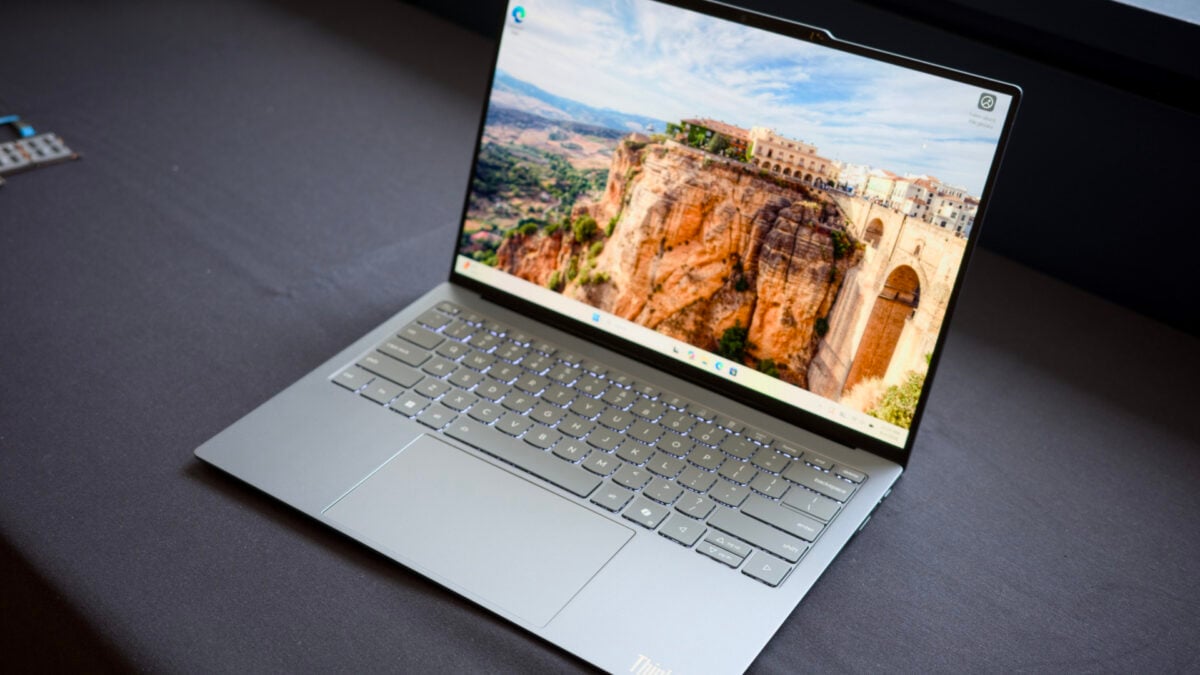
Nobody can say they’re a big fan of fans. The noisy spinning blades inside our laptops are a trade-off between performance and receiving annoyed looks by fellow students in the college library. Announced at IFA 2026, Lenovo’s “AeroBlade” concept laptop promises to offer a super-light device that can push performance and still keep its internals cool. Compared to lightweight machines like a MacBook Air with its fully passive cooling capabilities, the AeroBlade uses what Lenovo calls “Active Flow.” It’s a concept that’s been cooked up for a while by Swedish company Frore Systems, a solution it calls “AirJet.” Think of this solid-state cooling solution with two membranes like the fins on a whale that connect to the PCB (printed circuit board) using an array of heat pipes. These fins fluctuate at a minimal level, essentially running at near-silent while pushing warm air out of the system. The ‘Active Flow’ solid-state cooling mechanism pushes warm air out of the laptop without a fan. © Kyle Barr / Gizmodo The AeroBlade is indeed light in the hand. If you have fond memories of the long-defunct 12-inch MacBook or enjoy modern devices like the 2.2-pound Dell XPS 13, then you should know the AeroBlade concept is as light as an average hardcover novel at 1.83 pounds. It’s so thin at 10mm when closed up that the twin USB-C ports, digital webcam switch, and power button sit on a shelf that’s nearly the full thickness of the laptop itself. Lenovo is running an Intel Core Ultra Series 3 processor inside AeroBlade, which means the laptop has access to Thunderbolt 4 USB-C ports. It also has a 14-inch OLED display, making it a rather premium device. At 10mm thin and under two pounds, the AeroBlade concept is one of the lightest laptops I’ve ever held. © Kyle Barr / Gizmodo This is only a concept, though Lenovo is prone to turning its weirdest imaginings into a reality. For instance, it took an early ThinkBook concept with a rolling screen and turned it into the ThinkBook Plus Gen 6 Rollable. AeroBlade is more standard than any rolling device, so you shouldn’t have to pray to whatever laptop deity you worship to eventually find it in stores. Speaking of rolling laptops, Lenovo’s other big concept for IFA 2026 is yet another expanding design, though one it has tested before. Project Swan is like the Lenovo ThinkBook Plus Gen 6 Rollable, though its screen expands sideways from 14 inches to 17 inches, running at the common ultra-wide 16:9 aspect ratio. Lenovo’s Project Swan is a play on the similar Legion Rollable with a screen that extends horizontally from 14 to around 17 inches. © Kyle Barr / Gizmodo Lenovo previously ruminated on this concept back at CES 2026 with a Legion Rollable gaming laptop. That design could take an 18-inch screen and alternate between a 21-inch and 24-inch ultrawide. The problem with that is bulk and durability, especially with the two wings of the laptop unfurled. Project Swan is a more conservative laptop compared to the excessive wingspan of the Legion Rollable. Still, the ThinkBook Rollable worked for productivity because having a longer screen makes it easier to code, type, or simply read a website without having to scroll past an avalanche of ads. The widescreen rolling laptop would be better geared to creatives or—dare I say it—gamers who want the extra screen width real estate. © Kyle Barr / Gizmodo © Kyle Barr / Gizmodo In either case, at least these concepts give us more ammunition to fight off not-too-undeserved claims that laptops are boring. But for the sake of pure practicality, the thin AeroBlade may be the design that will win in the end.
Lenovo’s Fanless Concept Could Bring Us Laptops That Weigh Way Less Than Two Pounds
Full Article
Original Source
Read the full article at Gizmodo →KhanList aggregates and links to publicly available news content. We do not host full articles from third-party sources. Always verify important information with original sources.