
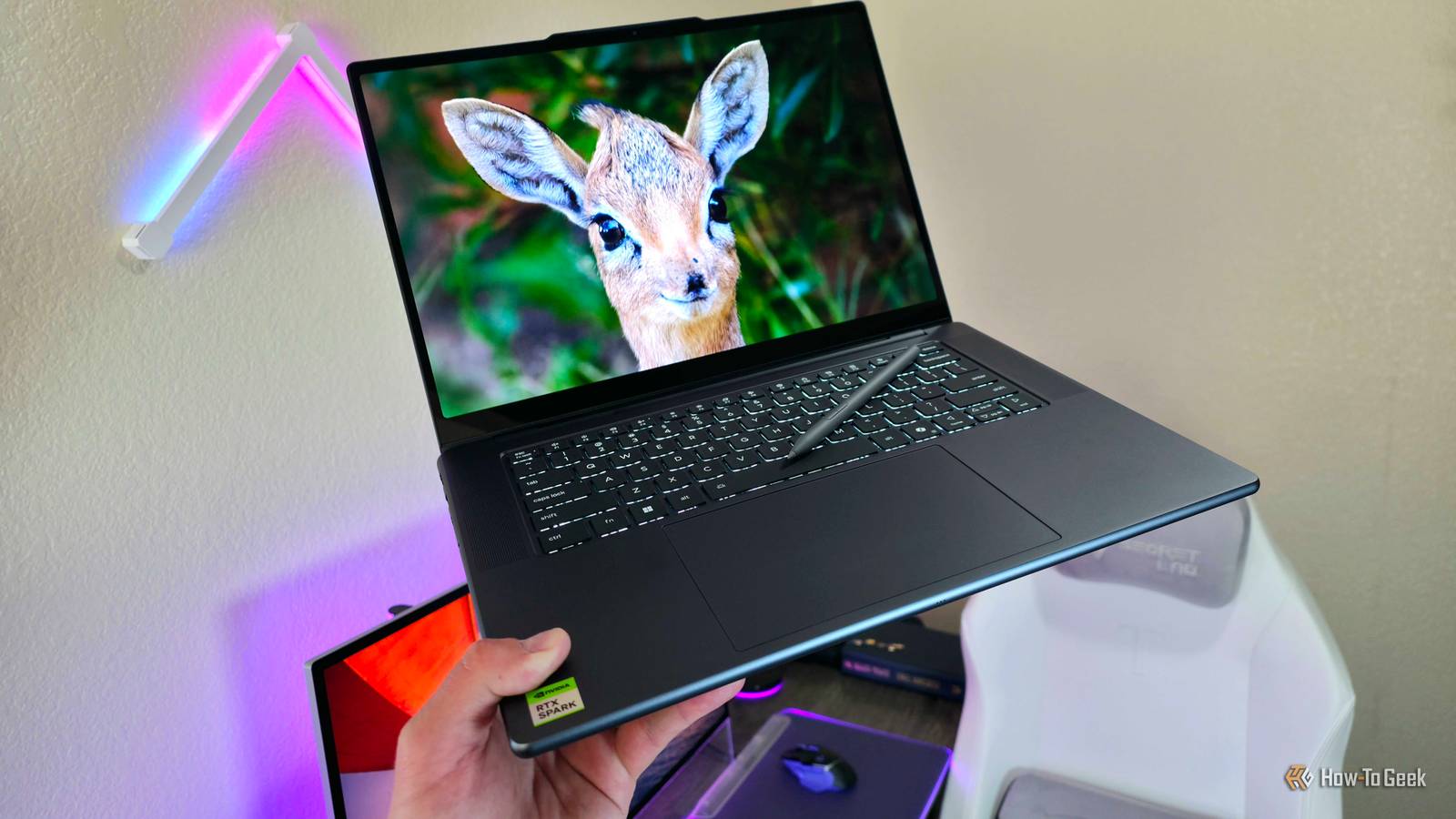
Published Nov 2, 2026, 11:30 AM EST Even it's not the laptop for you, the Lenovo Yoga Pro 9n 15 is a great showcase for NVIDIA's latest tech. Only a few should consider Lenovo's first RTX Spark laptop, but those people will love this Competition in the PC silicon industry has heated up the last few years with the arrival of Apple and Qualcomm on the scene. Now, NVIDIA has joined the fray with its new RTX Spark platform, pairing a beefy Arm64 CPU with NVIDIA's industry-leading Blackwell GPU. It's no wonder the Yoga Pro 9n is among the first to showcase RTX Spark's undeniable power, as Lenovo knows how to make a killer laptop. Between the sky-high pricing and the RTX Spark specializing specifically in artificial intelligence, though, there's only a small group of people that should realistically consider buying this laptop. On the bright side, those people should be happy. Lenovo Yoga Pro 9n 15 Gen 11 7/10 Operating System Windows 11 Home/Pro CPU NVIDIA RTX Spark N1X (18-core) GPU NVIDIA RTX Blackwell (5,120-core) RAM 32GB LPDDR5X @ 9,400MT/s NVIDIA's ambitious RTX Spark computing platform has arrived, and the beastly Lenovo Yoga Pro 9n 15 Gen 11 is one of the first laptops to showcase it. It's an impressive first-generation offering, pairing superb hardware, a smooth OLED display, and a ridiculous amount of power—especially for AI workloads that take advantage of the NVIDIA tech stack. A high price, limiting starting memory, and other compromises mean the list of people who should consider this laptop is actually quite small, though. Pros & Cons Premium hardware across the board Responsive haptic touchpad with unique pen support Awesome performance on and off the charger RTX Spark is great for AI workloads... if you have enough memory 32GB of starting memory limits you CPU emulation can hamper app/game performance Crazy expensive (especially if you need more memory) Price and availability The Lenovo Yoga Pro 9n 15 Gen 11 starts at $3,000 direct from Lenovo, but that starting price is a little misleading, as the entry-level configuration is equipped with the 18-core NVIDIA RTX Spark N1X and its 5,120-core Blackwell GPU, which caps out at a maximum 32GB of unified memory. If you need more memory (and those looking at RTX Spark laptops probably do), the next configuration is $4,250, a $1,250 increase that gets you two additional CPU cores, 1,024 additional GPU cores, 32GB of additional RAM, and 1TB of SSD storage (up from 512GB). One more step, and you're paying $6,100 for 128GB of unified memory and 2TB of PCIe Gen5 storage. There's also the similar Lenovo Yoga Pro 9n 16 2-in-1, an alternative for those who prefer a convertible laptop with a 360-degrees hinge. Specifications Operating System Windows 11 Home/Pro CPU NVIDIA RTX Spark N1X (18-core) GPU NVIDIA RTX Blackwell (5,120-core) RAM 32GB LPDDR5X @ 9,400MT/s Storage 512GB/1TB M.2 2242 PCIe Gen4 / 2TB M.2 2242 PCIe Gen5 Battery 92.5Wh, 140W Rapid Charge Display (Size, Resolution) 15.3-inch, 16:10, 2560 x 1600 Speakers 2x 2W woofers, 2x 2W tweeters, Dolby Atmos Colors Thunder Grey Ports 2x USB-C 4.0 (40GBps, DP 2.1, PD 3.0), 2x USB-A (10GBps), 1x HDMI 2.1, 3.5mm audio, 1x SD card (UHS-II) Dimensions 347 x 242 x ⁓16.7mm Weight ⁓1,650g Form Clamshell Display type OLED, 48-165Hz, 1,100 nits HDR brightness, Dolby Vision, 100% DCI-P3, multi-touch, glossy Audio 3x noise canceling microphones Webcam 9.2MP, IR, e-shutter Connectivity Wi-Fi 7 2x2, Bluetooth 5.4 Box contents Lenovo Yoga Pen Gen 2, 140W USB-C Charger Starting Price $3000 Unapologetically dense and undeniably premium Lenovo nailed the hardware? What a shocker If you're going to charge a minimum of $3,000 for your laptop, you better deliver high-end hardware that matches. Lenovo is no stranger to this challenge, though, and the Yoga Pro 9n 15 sticks the landing with a seriously well-built (and familiar) design. Every millimeter of the aluminum chassis is immaculately machined and pieced together. The Yoga Pro 9n 15 leaves no room to doubt that this is a luxury machine, but it's also clearly not meant to be a showpiece. For one, you still have easy access to the internals through the bottom panel, perfect for repairs or making use of the two user-upgradeable M.2 SSD slots (one of which supports PCIe Gen5). Lenovo's claimed 16.7mm thickness is certainly optimistic, as a thermal shelf and thick rubber feet add a fair amount of vertical height—but help guarantee class-leading performance. Even all those powerful components doesn't make this 15.3-inch laptop unreasonably heavy at around 3.64lbs, but it does feel dense and reassuringly tank-like. Look at the lovely curved edges, and you'll find plenty of ports to cater to every need, including two Thunderbolt 4-compliant USB4 ports, two USB-A ports, HDMI 2.1, and even a full-sized SD card slot. No Kensington Nano Security Slot may disappoint those who will look at this as a business workstation, though. The hinge is smooth, balanced, and surprisingly stiff in the middle, greatly reducing screen wobble if you choose to use the touchscreen. Of course, you'll probably be glued to the typically excellent Lenovo keyboard, which is intuitively laid out, spacious and comfortable to type on, and has a soft, yet satisfyingly tactile, typing action. Below is the massive, glass haptic touchpad; I am genuinely so happy to see more Lenovo Yoga laptops embrace haptic touchpads, and this is a fantastic example with a unique feature I'll talk about later. Before I get to the rest of Lenovo's hardware, though, let's talk about the heart of the Yoga Pro 9n 15: the RTX Spark N1X chipset. NVIDIA RTX Spark is (mostly) the real deal Performance on and off the charger is awesome, with caveats Before I kick off this section, my colleague's review of the HP OmniBook Ultra 16 includes plenty of in-depth information on the benchmark performance and local AI capabilities of NVIDIA RTX Spark (especially with only 32GB of memory), so I'll be focusing on my own observations of the Lenovo Yoga Pro 9n 15's performance. First, my review sample is powered by the 18-core N1X chipset, supported by the headlining 5,120-core GPU and the mysterious NPU that, at least right now, isn't contributing a ton (especially since RTX Spark laptops won't even get basic Copilot+ PC features until a future update arrives). For my own tests, I ran the Yoga Pro 9n through Geekbench 7, where it scored 2,599 (Single), 21,581 (Multi), and 115,017 (GPU), in addition to Cinebench 2026, where it scored 541 (Single), and 6,543 (Multi). This is right in line with other RTX Spark laptops, and within a stone's throw of the most powerful silicon from Intel, AMD, Qualcomm, and Apple—but in terms of raw CPU performance, the N1X does fall behind the competition's best, especially Apple. Performance is expectantly excellent, with the Yoga Pro 9n flying through everything I threw at it with ease. Thermal management is fantastic, too, as I never experienced noticeable throttling or excessive heat (although these fans do get loud). The real star of the show is the GPU, and NVIDIA's claim of "RTX 5070-like performance" isn't outlandish, even with the entire chipset having an 80W TDP. I averaged 68 FPS running Forza Horizon 6 at the max 1600p resolution and High settings with NVIDIA DLSS enabled, and Cyberpunk 2077 was even more impressive with a 75 FPS average with High settings, or 46 FPS with the Ray Tracing: Medium preset. The most impressive thing about RTX Spark, though, is how well it performs when it's unplugged. Running the same games on and off the charger, I detected no meaningful change in performance, which is a major plus for those that demand peak performance at all times. The downside is absurd battery drain with the GPU on full blast; while testing games, I was on track to completely kill the Yoga Pro 9n in around 50 minutes. The battery fares much better with normal CPU-focused usage (browsing, email, streaming, light photo editing, etcetera), but I still averaged 5-6 hours—longer than most gaming laptops, but not what I'd call "all-day battery life." RTX Spark has one other major downside, too: the Arm64 CPU. Windows on Arm has come a long way and is genuinely amazing for most people (some of my favorite laptops ever are powered by Snapdragon), but there are still legitimate compatibility and performance concerns, especially with video games and many powerful creative apps—the exact areas NVIDIA claims RTX Spark excels. I absolutely ran into crashes, compatibility issues, and frequent stutters and dropped frames in my game testing, challenging the Yoga Pro 9n's "gaming laptop" credentials. Living with the Yoga Pro 9n reveals some truths Pleasant surprises and unfortunate compromises alike The Yoga Pro 9n is an interesting size with its 15.3-inch display, and the panel itself is also fascinating. It's 1600p rather than the 1800p standard in other 14-to-16-inch laptops, but boasts a smoother 165Hz refresh rate. In general, it is an awesome screen, getting plenty bright while staying accurate, punchy, and responsive. On the other hand, it is ridiculously reflective (taking pictures was a nightmare), and it doesn't support the stylus that comes in the box. That's because of the Yoga Pro 9n's most unique feature: the haptic touchpad that supports up to 8,196 levels of pressure sensitivity with the Lenovo Yoga Pen Gen 2. It effectively turns your touchpad into a bonafide drawing tablet, something we've only seen in a handful of other laptops. I'm no digital artist, but I think this is incredibly cool. The stylus also magnetically attaches to the lid for storage, like we've seen Samsung and Surface tablets do. Moving on, the Yoga Pro 9n's quad speaker system is among the best I've heard from a Windows laptop. It gets way louder than I ever needed, with consistent depth, fullness, and clarity throughout—i had zero issues listening to music for hours while testing this laptop. Speaking of audio, the triple microphone array is also great, even if the 9.2MP webcam it supports is average. Windows Hello facial recognition is here, of course, but the Yoga Pro 9n oddly doesn't have a fingerprint sensor, despite this being a $3,000+ laptop. You should buy the Lenovo Yoga Pro 9n Gen 11 if: You'll actually take advantage of the RTX Spark chipset You're willing to shell out a lot for more memory You need consistent, great GPU performance even on battery power You should not buy the Lenovo Yoga Pro 9n Gen 11 if: You're planning on doing a lot of gaming You aren't invested in AI development, models, or tools You need enough memory for local AI on a budget The first generation of NVIDIA RTX Spark is genuinely impressive, and the Lenovo Yoga Pro 9n 15 Gen 11 is a lovely showcase for its strengths and weaknesses. This laptop starts at $3,000, though, and the people that benefit most from an RTX Spark laptop and its NVIDIA tech stack are the exact people that need more than 32GB of unified memory, which immediately and massively increases the cost. If you're looking for a gaming laptop that also handles AI workloads, then you're probably better off with a traditional gaming laptop, with dedicated GPU memory. For the handful of people that need the best mobile AI workstation and are willing to pay for it, though, this RTX Spark laptop is great. Lenovo Yoga Pro 9n 15 Gen 11 7/10 Operating System Windows 11 Home/Pro CPU NVIDIA RTX Spark N1X (18-core) GPU NVIDIA RTX Blackwell (5,120-core) RAM 32GB LPDDR5X @ 9,400MT/s NVIDIA's ambitious RTX Spark computing platform has arrived, and the beastly Lenovo Yoga Pro 9n 15 Gen 11 is one of the first laptops to showcase it. It's an impressive first-generation offering, pairing superb hardware, a smooth OLED display, and a ridiculous amount of power—especially for AI workloads that take advantage of the NVIDIA tech stack. A high price, limiting starting memory, and other compromises mean the list of people who should consider this laptop is actually quite small, though.
Lenovo Yoga Pro 9n 15 Gen 11 review: The few who should consider this will love it
Full Article
Original Source
Read the full article at Howtogeek →KhanList aggregates and links to publicly available news content. We do not host full articles from third-party sources. Always verify important information with original sources.