
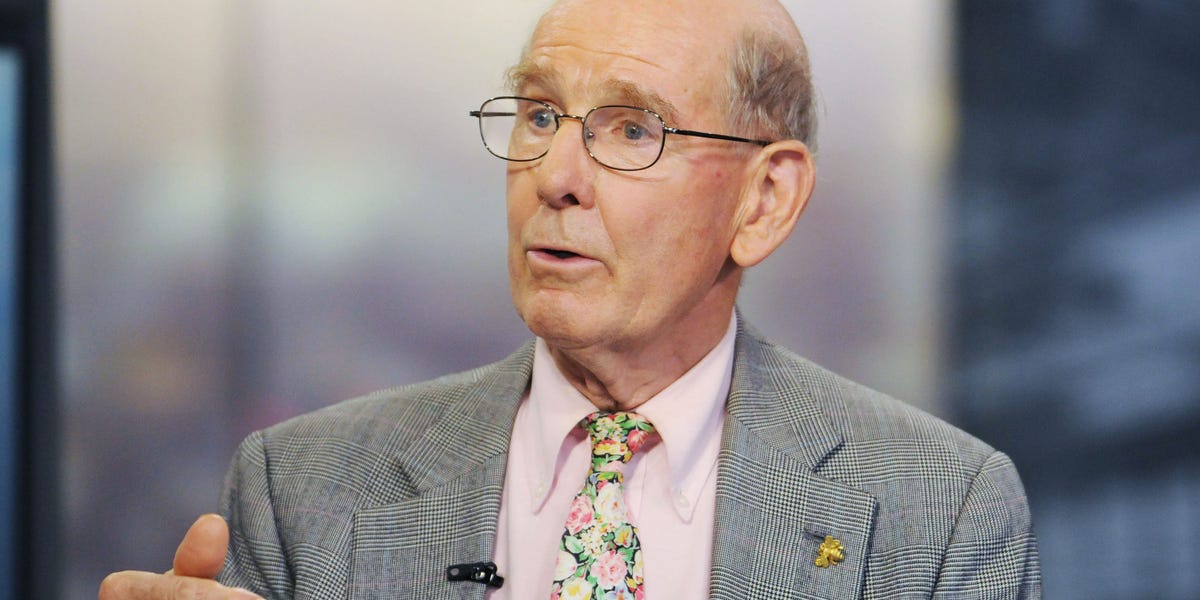
Legendary economist Gary Shilling says consumer signals point to a recession in the next 12 months Top economist Gary Shilling says he sees a 60%-70% chance the US enters a recession in the next year. Bloomberg/Getty Images American shoppers are waving some red flags that hint at a recession in the next year, one legendary economist is warning.Gary Shilling, the Stanford economist and Merrill Lynch alum best-known for calling the dot-com bubble and 2008 housing crisis, is doubling down on his view that the US will likely enter a recession sometime in the coming 12 months.In a note this week, Shilling pointed to one particualr area of concern in the economy: the US consumer.Households are flashing warning signs as energy costs remain elevated and interest rates look poised to remain higher for longer."Consumers are signaling that all is not great with the economy," Shilling wrote. "We continue to think there's a 60% to 70% chance that a recession unfolds in the next year. We also don't rule out a period of stagflation with high inflation, elevated employment and slow economic growth," he later added.Stagflation, a worst-case scenario for the economy where growth slows while inflation remains high, is thought to be even harder for policymakers to deal with than a typical recession, as high inflation prevents the Fed from lowering rates to boost the economy as it would do in a typical recession.Consumer spending is a major growth engine in the US economy, accounting for around two-thirds of GDP. The upper tier of earners in the US continues to spend, but the fear has been that lower- and middle-income households are pulling back as they feel the pressure of a higher cost of living on multiple fronts. Here are the consumer warning signs that Shilling sees:1. Retail sales have dropped off a cliffRevised retail sales data showed that Americans pulled back significantly on spending in July. Retail sales declined 0.6% for the month — the worst monthly decline recorded in nearly a year, according to Census data. "A big factor in July's weak numbers was the fading of federal tax refund money, which in recent months has likely been spent not so much on discretionary purchases as on more-expensive, and non-discretionary, gasoline and groceries," Shilling said.2. Consumer sentiment is in the dumpsConsumers are pessimistic about the state of the economy. The University of Michigan's consumer sentiment gauge dropped for the first time in three months in August, with the index down sharply from its peak in early 2020.Some of the pessimism has to do with higher inflation expectations. Year-ahead inflation expectations clocked in at around 4% in August compared to 3.4% in February, before the start of the Iran war, per UMich's survey.71% of middle-income Americans said they believed they were falling behind the cost of living, according to a second-quarter Primerica survey. 59% said they believed the economy would be worse off over the next year.3. Consumers under mounting debt pressuresConsumer credit liabilities among households and nonprofit organizations grew to a record $5.1 trillion at the end of the first quarter, according to Fed data.32% of middle-income Americans said their credit card debt grew over the last quarter, according to the Primerica survey.Bankruptcy filings are also rising. The number of Americans filing for bankruptcy rose 12% in the 12 months leading up to the end of June, Shilling said.4. The personal savings rate has fallenThe personal savings rate, a reflection of how cash-strapped Americans are, has dropped significantly over the last five years. Americans socked away an average 3% of their disposable personal income in July, down from a personal savings rate of over 9% in July of 2021, according to BEA data."Strapped consumers, digging themselves deeper into debt, are draining their piggybanks," Shilling wrote.5. Retailers are downSome mega-retailers are struggling. Shilling pointed in particular to Walmart, which has seen its stock price crater 20% from its peak in May of this year.The latest decline for the stock was triggered by its second-quarter earnings report, which showed signs that more shoppers are pulling back. Comparable sales, a measure of current revenue that accounts for factors like new store openings, grew at its slowest pace in six years. Average spending per transaction also slowed sharply to 1.1%, down from 3.1% a year ago.6. More Americans are shopping at dollar storesDollar stores and other discount retailers, on the other hand, are thriving. Comparable sales rose 3.7% at Dollar Tree, 3.5% at Dollar General, and 14.1% at Five Below over the last quarter."The move to these types of outlets has been going on for several years as inflation spiked, first in 2021 and 2022 in the aftermath of the pandemic and then again starting last year amidst Trump's tariffs and the effects of the ongoing war in Iran," Shilling added. Read next Jennifer Sor is a senior reporter at Business Insider. She covers financial markets and the economy, with a focus on retail investing, job trends, and the pursuit of wealth. She regularly speaks to famed forecasters and top investors in markets, and her work has been referenced in outlets such as CNN, Forbes, and Bloomberg Opinion's "Money Stuff." She also regularly appears on television and radio to speak about markets and the US economy.Prior to her time at Business Insider, Jennifer covered tech and business news at the San Francisco Chronicle and Los Angeles Business Journal. She graduated from the University of California, Santa Barbara with a bachelor's degree in economics and English.Have an interesting story to share? Please reach out to her at jsor@businessinsider.com or @jennreports.81 on the encrypted messaging app Signal. Recession Consumer spending
Legendary economist Gary Shilling says consumer signals point to a recession in the next 12 months
Full Article
Original Source
Read the full article at Businessinsider →KhanList aggregates and links to publicly available news content. We do not host full articles from third-party sources. Always verify important information with original sources.