
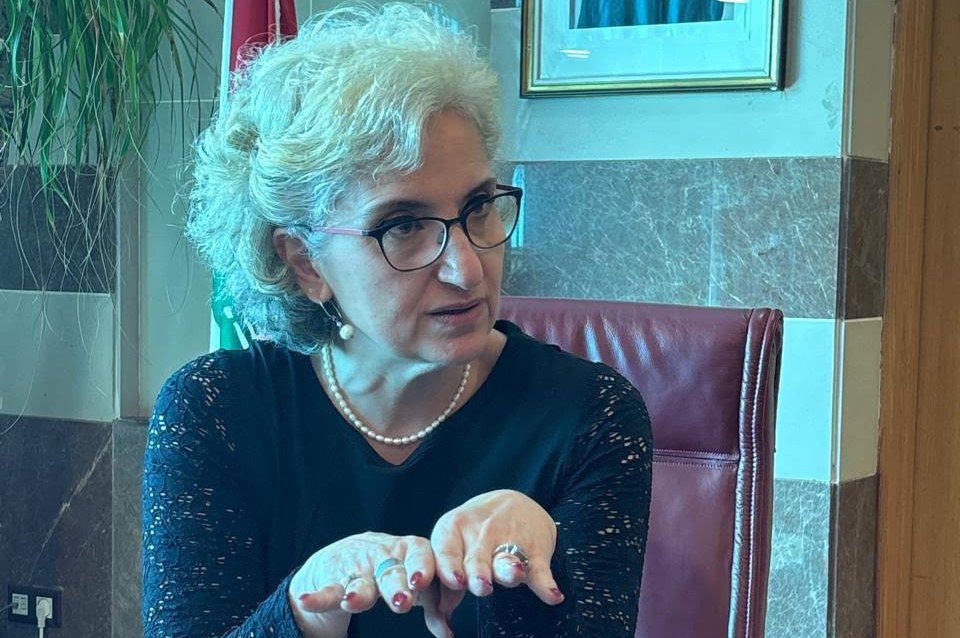
Lebanese Education Minister Rima Karami describes what it will take to put the country's educational system back together. Photo courtesy of Lebanese Education Ministry. BEIRUT, Lebanon, July 21 (UPI) -- Lebanon's education sector, which has been in a protracted crisis since the country's 2019 financial collapse, and further damaged by nearly three years of the Israel-Hezbollah war, would need 10 to 15 years to recover, Education Minister Rima Karami said. The greatest challenge will be re-establishing state control over the sector and restoring Lebanon's once-leading role as the region's education hub. The war between Hezbollah and Israel, which broke out Oct. 8, 2023, has further strained the country's already fragile education system, which had suffered significant setbacks due to the decade-long presence of Syrian refugees, the country's financial collapse and the COVID-19 pandemic. Corruption, political interference and patronage-based appointments also have undermined the quality of education over the years. Karami said in an interview with UPI that the sector had taken "a very strong hit" from the recent escalation of hostilities, which resumed in March and led to the displacement of 1.2 million people, widespread destruction and extensive damage to educational institutions, particularly in southern Lebanon. "It would need 10 to 15 years to get the education sector out of this crisis state," she said. Students, professors and educational institutions were impacted during the recent war, suffering displacement, losses and disruptions that reduced instructional time and threatened the academic futures of many learners. According to the Education Ministry, 363 teachers and students from private and public schools were killed or injured. Some 26 schools and two public vocational institutes have been destroyed, while aoother 352 schools suffered varying degrees of damage. Moreover, 356 out of the 1,212 public schools, along with several public vocational institutes, were rapidly converted into shelters to accommodate the displaced people forced to flee their homes and villages after the Israeli army issued evacuation orders. The cost of reconstructing and rehabilitating the destroyed schools was estimated at approximately $70 million. Karami said the war affected 25% of Lebanon's students, leaving many under extreme pressure and suffering from trauma. She gave the striking example of students and teachers who, last April, watched the Israeli army blow up their school in the southern border village of Marwahin, "reducing it to dust" while they were attending a virtual class. Beyond the immediate challenge of responding to the war and securing shelters for the displaced, Karami said her main concern was to ensure the school year continued as she pursued long-term restructuring and reviving the education sector. "We succeeded to a large extent this year in maintaining some form of learning continuity despite the situation," she said, noting that the ministry took several steps to ensure free online learning, enroll displaced students in new schools and provide classroom space for every student. However, the number of displaced students and the scale of their needs were far greater this year than in 2024, when the country was emerging from the first phase of fighting. At one point during the war, the ministry was unable to reach 12% of students because of repeated displacement. As hostilities subsided after the signing of a U.S.-brokered framework agreement between Lebanon and Israel on June 26, more than one-half million displaced people returned to parts of southern Lebanon outside the areas occupied by Israeli forces. Karami said that while 50% of the schools used as shelters for displaced families had been vacated, 30% would continue to accommodate people unable to return to their destroyed villages, most of which remain under Israeli control in the border area. Return by these displaced residents could become possible if and when Israel begins a phased withdrawal to allow the Lebanese Army to deploy, as provided for under the framework agreement that starts with two designated pilot zones. If the pilot zones are successfully implemented and verified, displaced residents would be allowed back into their villages and reconstruction could begin, paving the way for further Israeli withdrawals. Karami said that the government was preparing to assume responsibility for any area evacuated by Israeli forces, with the deployment of the Lebanese Army and the designation of "safe areas" as the first steps toward return of displaced residents. "If the situation remains as it is now and the war does not resume, we will have more safe areas. We are planning how to restore electricity, help people rebuild or repair their damaged homes, and secure learning spaces in every liberated area. The learning space is sacred," she said. The government is keen to implement this model, not only to reassert state authority over southern Lebanon, but also to restore residents' confidence in its ability to protect them, provide essential services and oversee the reconstruction of their villages rather than leaving that role to Hezbollah. The militant group, which has been funded and armed by Iran since its establishment in the early 1980s, has over the years built an extensive network of social, health, educational and welfare institutions, providing services to its predominantly Shiite support base, that the state has long struggled to deliver. During the war, however, a broad range of Hezbollah-affiliated institutions -- including schools, medical centers, ambulance services, welfare organizations, financial institutions and reconstruction offices -- were targeted by Israel, causing extensive damage to the group's social service network. Hezbollah's weakening military and its reduced ability to provide funding and services to its followers present an opportunity for the Lebanese state to strengthen its position, particularly if it succeeds in mobilizing international support for the reconstruction of southern Lebanon and other affected areas. "The idea is not only to support the displaced in returning home, but also to ensure that the state is the one providing these services, not Hezbollah," Karami said, adding that the successful implementation of the pilot zones would demonstrate that the government "is leading this effort." She sees this as a hard mission, as the war caused extensive destruction, mass displacement and severe disruptions to economic activity, with initial estimates putting direct and indirect losses at $20 billion to $30 billion. Moreover, the Lebanese government has been documenting what it describes as Israel's war violations, building a case to seek accountability for alleged breaches of international humanitarian law, including attacking civilians, killing entire families, destroying multistory residential buildings and conducting large-scale demolitions in the southern border area that have left large parts of it uninhabitable. Karami said the destruction of schools and other educational institutions was a "major violation" being added to a continuously updated record that also includes hospitals, dispensaries and other infrastructure destroyed by Israel. "We have documented everything, including the killings of students and professors that we have identified," she said. However, the process was put on hold after the framework agreement was reached, which included a clause stating that Lebanon and Israel would refrain from pursuing actions against each other through international legal or political bodies as part of confidence-building measures. Karami said that it was "a way of showing goodwill" to proceed with direct negotiations, but that it did not mean "we relinquished our right [to proceed with the case] and can exercise it at any moment." Read More Iran, U.S. trade heavy fire; Israel continues to bomb Lebanon Lebanon, Israel conclude 'productive' talks in Rome Lebanese President Joseph Aoun to visit White House, ask for help
Lebanon education minister: War-hit sector needs 10-15 years to recover
Full Article
Original Source
Read the full article at Upi →KhanList aggregates and links to publicly available news content. We do not host full articles from third-party sources. Always verify important information with original sources.