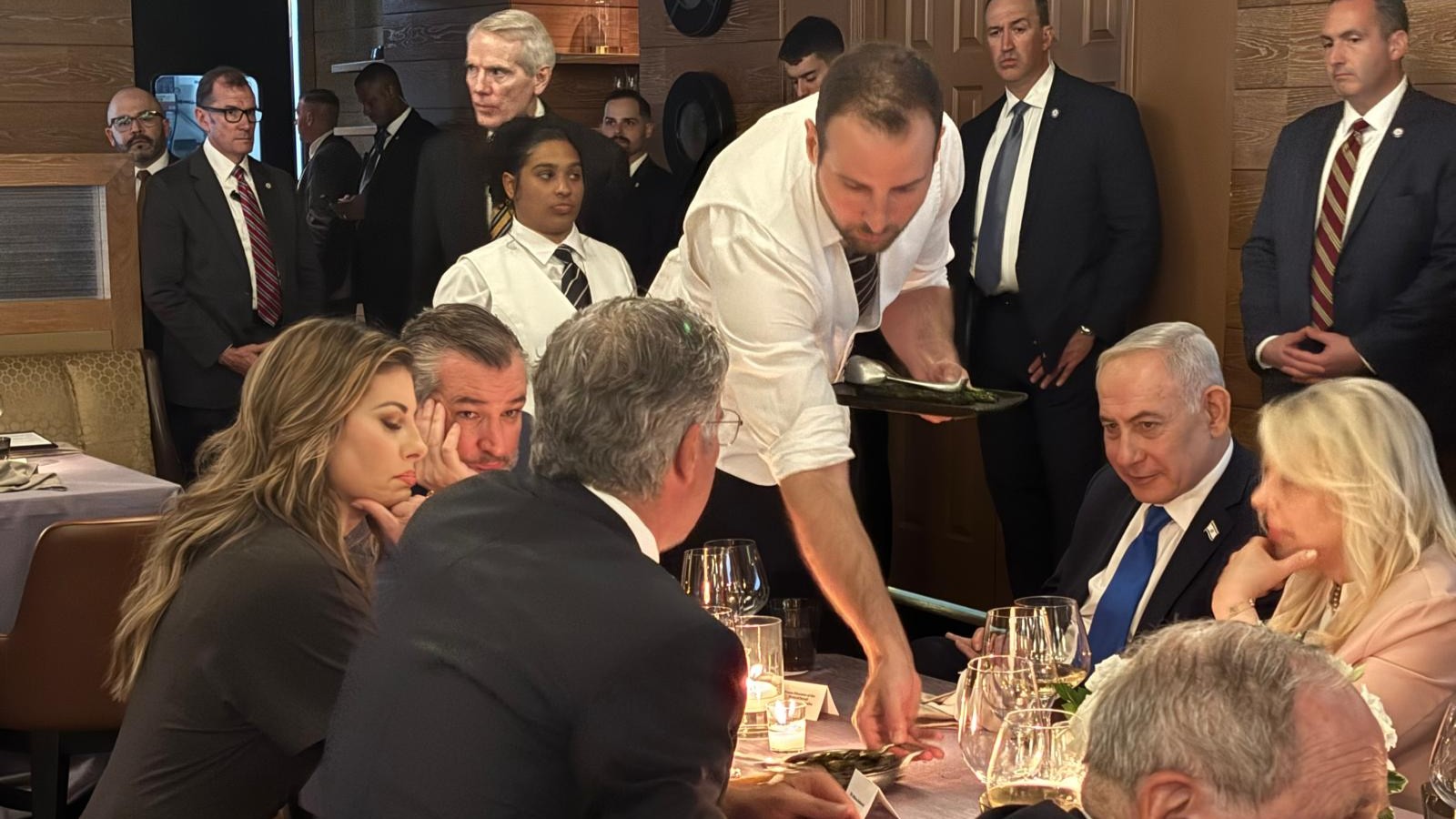
During his visit to Washington last week, Lebanese President Joseph Aoun called for ending the state of hostility between Lebanon and Israel “forever”. He embraced counterinsurgency rather than liberation politics; by identifying sovereignty with disarming non-state actors, rather than freedom from settler-colonialism - and he echoed Zionist claims by situating the root cause of armed resistance in Hezbollah’s religious ideology, rather than Israeli occupation. The promotion of Zionist narratives, and the push for normalisation with the Israeli state, has become widespread in Lebanese media and public discourse. Lebanese banker and film producer Antoun Sehnaoui is playing a central role in pushing this agenda. Sehnaoui dined Israeli prime minister and accused war criminal Benjamin Netanyahu this week in commemoration of the late senator and ardent Zionist, Lindsey Graham. The dinner marked the culmination of Sehnaoui’s concerted efforts to court Zionists, with Lebanese media describing his rising political influence, including his role in negotiations with Israel. Following his entanglement in a shooting incident and the filing of charges against him for alleged money laundering during a countrywide financial crisis, Sehnaoui settled in the US. He went on to finance Israeli cultural propaganda and promote normalisation discourse. In one such event, Sehnaoui’s new partner and former US envoy to Lebanon, Morgan Ortagus, praised him for acts that are “technically illegal in Lebanon”, where citizens are banned from direct dealings with Israelis. She added that he was “trained to be a supporter of the state of Israel” and hails from a family of “committed Lebanese Christian Zionists”. New MEE newsletter: Jerusalem Dispatch Sign up to get the latest insights and analysis on Israel-Palestine, alongside Turkey Unpacked and other MEE newsletters The Sehnaoui family’s generational affinity with Zionism is not an anomaly in Lebanese history. Zionist relations with Lebanese elite families, public figures and religious institutions precede Israel’s creation and Lebanon’s independence. They cut across region and sect. The nature and extent of these relations have varied based on the objectives and priorities of the Zionist movement, whether political, economic or security-driven. Imperatives of settler-colonialism Politically, Zionist leaders sought to break the isolation of their settler colony during the mandate era. They reportedly bankrolled several newspapers in Beirut and forged political bonds with Maronite elites, whom they saw as the powerbrokers in Lebanon. By invoking the logic of an alliance of minorities, the Zionist movement groomed figures such as Lebanese mandate president Emile Edde and Maronite Patriarch Antoine Arida. According to Zionist reports, Edde expressed his willingness to consider settling 100,000 Jews in the Saida-Tyre area. In 1946, the Jewish Agency and the Maronite Church signed a secret pact in which the latter acknowledged the right to Jewish settlement and statehood in Palestine. Maronite leaders who were invested in Muslim-Christian relations, such as independence president Bishara al-Khoury, did not shy away from cooperating with the Zionists in order to maintain a Christian-majority Lebanese state. During the Second World War, Khoury allegedly proposed getting rid of the Shia in the south. The Zionist movement also built longstanding contacts with prominent Sunni political figures, such as prime ministers Khayr al-Din al-Ahdab and Riad al-Solh, who was seen as an important player on the Arab stage. The complicity and emboldening of Lebanese elites to normalise is part of the broader complicity of ruling Arab elites The economic imperatives of settler-colonialism prompted the Zionists to weave contacts across the entire political and sectarian spectrum of Lebanese elites. Lebanese landowning families like the Sursuqs (Greek Orthodox), the Salams and Beyhums (Sunni) and the Asads (Shia) sold large tracts of land to the Zionists. Zionist leaders like Chaim Weizmann and David Ben Gurion were also keen to get their hands on vital fresh water sources, including Lebanon’s Litani River and tributaries of the Jordan River in the Mount Hermon region. Initially, the World Zionist Organization petitioned the Great Powers at the Paris conference in 1919 to include them as part of the proposed Jewish state. But Anglo-French interests set the mandate borders between French Lebanon and Syria and British Palestine further south. As a result, Zionists contemplated - but did not implement - joint hydroelectric and irrigation ventures. One proposal was reportedly based on a study commissioned for the American University of Beirut. It was promoted by Alfred Naccache, a Lebanese architect and businessman, as well as founder of the "Young Phoenicians" society. Zionist security-based relations with Lebanese elites were governed by the demands of securing the colony's frontiers and counterinsurgency efforts. This is why the primary targets were Shia and Druze notables who held sway near the borders with Mandate Palestine. These contacts were operative during periods of military activity, such as the Syro-Arab resistance against French occupation in 1920, the Great Syrian revolt of 1925, the Palestinian uprising of 1936, and the Arab-Israeli war of 1948. Money and threats of military action against notables were used to either defend Zionist settlements from rebel attacks, or to deter them from joining their comrades inside Palestine. Normalisation rears its head Amicable relations with the Zionists, however, did not shield Lebanese elites from Zionist violence. During the war of 1948, Israel’s Ministry of Immigration rejected a request by the Maronite church to send a church envoy to Haifa to attend to church business, citing the lack of arrangements for non-Jews to return. The Zionist leadership was also angered by premier Riad al-Solh’s rallying of Arab armies, and reportedly devised, but did not execute, a plot to assassinate him. Until the 1970s, Zionist ties to Lebanese elites were often clandestine, thanks to popular anti-Zionist sentiments in Lebanon and the wider Arab region. The US-incited civil war, which broke out in 1975, exposed the deepening alliance between Tel Aviv and Lebanese right-wing forces. These included a proxy militia in southern Lebanon and the Phalangist Party based in Mount Lebanon and Beirut. The zenith of Zionist influence in Lebanon was reached after Israel’s 1982 invasion and the signing of a “peace” treaty between the two countries, known as the May 17 agreement. Back then, only two members of parliament, a Christian and a Muslim, voted against it. The treaty’s near-unanimous support reflected the extent to which Lebanese elites of all sects had been co-opted or cowed by Zionism and its Lebanese right-wing allies. Lebanon’s rulers have surrendered the country to Israel - this is no ceasefire Read More » Thanks to an armed uprising the following year, as well as successive and deadly attacks on US and French military bases, the May 17 treaty was never implemented. Israel’s dream of establishing a satellite Maronite state came to naught. Zionist influence in Lebanon did not recover. The subsequent liberation of southern Lebanon by leftist and Islamist forcdes seemed to put the question to rest. But today, more than four decades after the May 17 agreement, normalisation with Zionism has again reared its head. The Trilateral Framework signed in Washington last month effectively surrendered Lebanese sovereignty to Israel. Back in the 1980s, Israel’s military gains were swift and occupation forces reached all the way to Beirut. But geopolitical alignments were not in favour of Lebanese normalisation with Israel. With the exception of Egypt, no Arab country had signed a normalisation treaty, the Soviet Union was still around, and Syria under Hafez al-Assad opposed the prospect, particularly in Lebanon. The leftist and Islamist resistance forces in Lebanon were also in revolutionary mode and did not form part of the state apparatus; this gave them leverage in delegitimating the treaty. Today, Israeli military gains in Lebanon are incremental and have been achieved at high costs. But the Soviet Union is no more, Palestine is post-Oslo, the majority of Arab states have either normalised relations or have secret ties with Israel, and Syria’s new regime is seeking a security treaty with Tel Aviv, rather than supporting resistance groups. The political pressure to normalise in Lebanon is greater than ever. The presence of Lebanese armed resistance, a weak central state, and popular opposition to normalisation is putting brakes on the process, but long-term opposition is equally dependent on a reversal of Israel’s geopolitical gains in the region. That would include undoing decades of normalisation with Egypt, Jordan and the Palestinian Authority, as well as a turnaround in Syria’s position towards Israel. In short, the complicity and emboldening of Lebanese elites to normalise is part of the broader complicity of ruling Arab elites. With southern Lebanon acting as the last active front of resistance against Israeli expansionism outside of Palestine, foresaking anti-normalisation forces in Lebanon is forsaking Palestine. The views expressed in this article belong to the author and do not necessarily reflect the editorial policy of Middle East Eye.
Lebanese elites have a long history of courting Zionism
Full Article
Original Source
Read the full article at Middleeasteye →KhanList aggregates and links to publicly available news content. We do not host full articles from third-party sources. Always verify important information with original sources.