
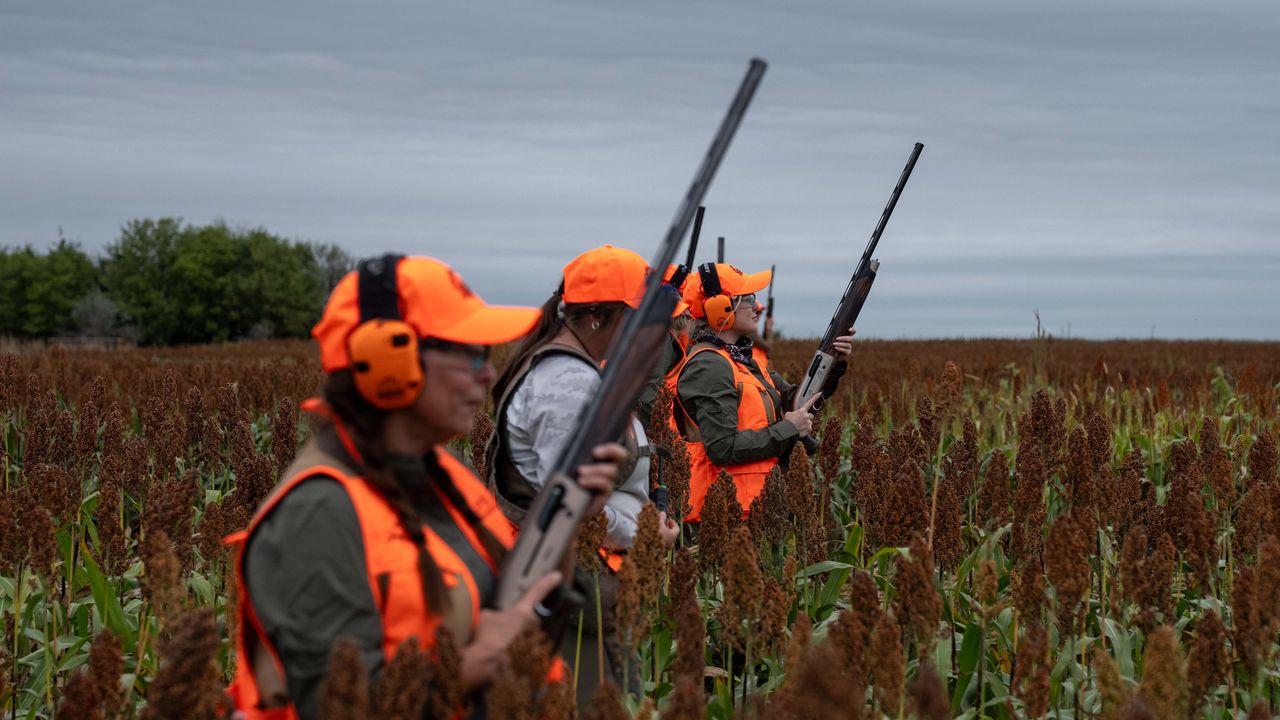
In shooting and harvesting her own dinner, writer Heide Brandes finds community—and reverence—among the sorghum fields of South Dakota.Travel South DakotaThe sorghum hissed when the wind came through it—two years of drought had left the South Dakota ground hard and the dry grass loud. I walked forwards with my 20-gauge Beretta half-raised and my eyes narrowed; the sound of every grasshopper that clattered up out of the stubble made me twitch like a woman with a bad nerve.Pheasant shooting with Hunt Like a Girl in South Dakota Travel South DakotaThen the pheasant rooster came up, multicolored and shining in the sun, trailing a tail of feathers like a kite. I aimed, let loose the shot, and it stopped dead in the air in an iridescent burst.The pride went through me before anything else did. The tears came second, running unexpectedly down my face while a dozen women I had only known for two days hollered happily for me. Laying the rooster across my arm, I petted him and told him I was sorry.After decades hearing about other people's forays into the woods to catch their own meal, without ever pulling a trigger myself, I had come to South Dakota and signed up for Hunt Like a Girl, a three-day long, women-only retreat for first time hunters. Founder Karen Butler started a broader program in 2008 under the moniker Shoot Like a Girl after developing a passion for the sport; Hunt Like a Girl eventually grew out of it, taking women out of the shooting range and into the wilderness with the goal of teaching them how to hunt small game like pheasant, turkey, and duck, safely and responsibly.Guests being briefed at A1 Al's Pheasant Ranch near Emery, South Dakota Travel South DakotaFor my trip, Hunt Like a Girl took over pheasant hunting lodge A1 Al's Pheasant Ranch outside Emery, a blink-and-you’ll-miss-it farm town around 45 minutes from Sioux Falls. The ranch offers an all-inclusive hunting experience across more than 6,000 acres of private wildlife habitat, with guided pheasant hunts featuring trained bird dogs, as well as classes on firearms safety and ethical hunting. There are also opportunities to learn more about how hunting can provide food and help foster regional wildlife conservation courtesy of guest speakers. Bird processing services—in other words, the breaking down of the meat—are also provided, so guests can take their catch home at the end of it.Programs like Butler’s are meeting growing demand: Women make up roughly 22% of American hunters, of which there are roughly 3.7 million total, according to a 2022 federal survey of hunting and wildlife-associated recreation—making women the sport's fastest-growing demographic. The National Shooting Sports Foundation has estimated that close to half of the 11 million Americans who bought a first-time firearm for shooting sports, self-defense, and hunting during 2020 and 2021 were women.The various reasons why a woman may want to learn how to shoot a gun and harvest her own meat vary person-to-person, of course, with self-sufficiency and empowerment among them. Girl & A Gun, a US-based organization that introduces women to firearms and helps them develop shooting skills in a supportive, women-focused environment, surveyed new women shooters for the last five years running and found that 35% now name the social side of learning marksmanship as their main reason for joining.At the all-women-retreat, guests participate in guided pheasant hunts, and take classes on firearms safety and ethical hunting. Travel South DakotaButler, who was in her late 20s and in the middle of a divorce when she first picked up the activity, wants other women to find community through the practice like she did. Amid dealing with a custody battle that cut time with her two small boys down to alternating weeks, says Butler, her friends hauled her camping on the backside of Pikes Peak in central Colorado and introduced her to target shooting during the trip. Butler, who had never fired a gun before, recalls hitting a Gatorade bottle and then asking whether she could try to hit the cap itself. Butler walked away with not just a sense of accomplishment, but one of camaraderie she hoped to find again."At a time when I felt the very worst about myself, shooting sports made me feel the best about myself,” she says. “I want other women to feel that same feeling I have. I found this whole new family of people. It’s a very supportive community.”A trained bird dog meets the guests. Travel South DakotaButler never looked back, eventually learning to hunt and even feeding her two sons meat she carried home herself. “I really look at hunting as nutrition and food, and not necessarily a sport,” she says, noting that many women who sign up for her retreat are looking to feel more connected with their food sources, and to experience firsthand how it is grown, raised, and brought to the table.In light of this, most meals during my stay were centered around what we were hunting: cold pheasant salad on soft rolls, for example, and pheasant pasta, slow-braised in white wine and butter. Butler also walked us through how to break down the bird ourselves—find the breastbone with your thumb, run the knife along the keel, and the breast comes away in one clean piece the color of a dark plum. Throughout the lesson, she emphasized if something had died for you, then the least you owed the creature was to use it.We also learned the important role that hunters play in habitat conservation across South Dakota. Second Century Habitat Fund pays South Dakota landowners to maintain sorghum—the preferred environment and food source for ring-necked pheasants—through 10-year contracts, keeping the land productive for both agriculture and wildlife. Roughly 80% of South Dakota belongs to private owners, so every acre of sorghum cover becomes habitat for pheasant and other birds and mammals instead of endless rows of corn. Sorghum also acts as an effective carbon sink and doesn't require a lot of water, making it an all around sustainable crop. Like in many other states across the US, South Dakota hunters and anglers also help finance wildlife conservation through hunting and fishing license fees, as well as federal excise taxes on firearms, ammunition, archery equipment, and fishing tackle.Participants to walk in formation through the South Dakota sorghum. Travel South DakotaOn my first morning, the pheasants were already awake by the time I stepped onto the lodge’s porch at first light. I learned that they do not call so much as announce themselves, a high dry crow of a sound, one bird and then another, and then a third from somewhere far out of sight among the sorghum where they live. Our lessons began across a gravel road from the lodge, where Christa Forrester, the chief of staff at Shoot Like a Girl, ran the safety briefing, covering where to orient the muzzle points, and place an index finger when it is away from the trigger. She didn’t hold back in describing what happens when either lesson is forgotten.For our inaugural hunt, we started with a meditation as we faced the rows of sorghum, gathered in a circle with our shotguns held muzzle high—a ritual we would participate in each morning during our stay. Butler told us to close our eyes and asked us to notice every sound and smell, the feel of the wind, and whatever was moving around inside us. She directed us to feel gratitude for what we were about to do, for the birds we searched for, for the nature that surrounded us. I stood in the grass with my eyes shut, and felt the breeze against my cheek.“This is being in the moment,” she said.During each hunt that followed, the guides kept us in a line, telling us to slow down or speed up so we stayed in formation, each woman at a safe distance from the next with the dogs working out in front. The field underfoot was uneven and seamed with gopher holes, and we were told, more than once, to watch our feet, because the last thing you wanted was to trip and fall with a shotgun in your hand.Most of the walking took place in silence. We held our collective breath between steps, waiting for the flash of black and copper that meant a rooster was coming up out of the cover. I learned to enjoy listening to the dogs as they weaved in and out of the rows of sorghum as they tried to flush the roosters out, and found myself instinctively beginning to track sound the way an animal does. I felt more “in the moment” than I had in years.A trained bird dog on the hunt. Travel South DakotaAnd then, every now and then, the silence would be broken by the sound of fire. One woman turned out to be a sharp shot and brought down more roosters than the rest of us. Another had to be fitted with a smaller shotgun to match her petite frame and struggled through the first two days without making a shot. On the final morning, she took two birds out of the sky back to back so cleanly that the stunned guide beside her just said, “Well, there you go.”For me, I had trouble remembering the order of things when a bird came up. The whole motion is supposed to happen in a second and a half: Gun to shoulder, safety off, then aim and shoot. So I started singing it to myself like a mantra as we walked to keep my hands and my head on the same page.Still, when I shot that first pheasant, the uncontrollable tears surprised me a bit, though I’d expected to feel emotional. When I admitted to the tears, Butler told me what I had felt was “reverence” toward something beautiful and alive. I took his feathers, sparkling violet and jewel green and rusty brown, and promised him I would make something beautiful out of them. And later, I took the breast filets Butler had taught us to cut away from the bone, now vacuum-packed and frozen, and promised I would make something healthy and delicious.For writer Heide Brandes, successfully catching a pheasant came with mixed emotions. Travel South DakotaBack home in Oklahoma, I made a stew out of the breast meat with wild rice and mushrooms, and as I stood at my own stove I thought about the field where my pheasant had been hiding. But it wasn’t about the kill.“I can hunt all day, never pull the trigger, and drive home satisfied,” Butler had told me. “That feeling of being out there in nature and hunting is reverence too.” It was a feeling I’d had to go out and earn myself.
Learning to Hunt Pheasant at an All-Women Retreat in South Dakota
Full Article
Original Source
Read the full article at Cntraveler →KhanList aggregates and links to publicly available news content. We do not host full articles from third-party sources. Always verify important information with original sources.