
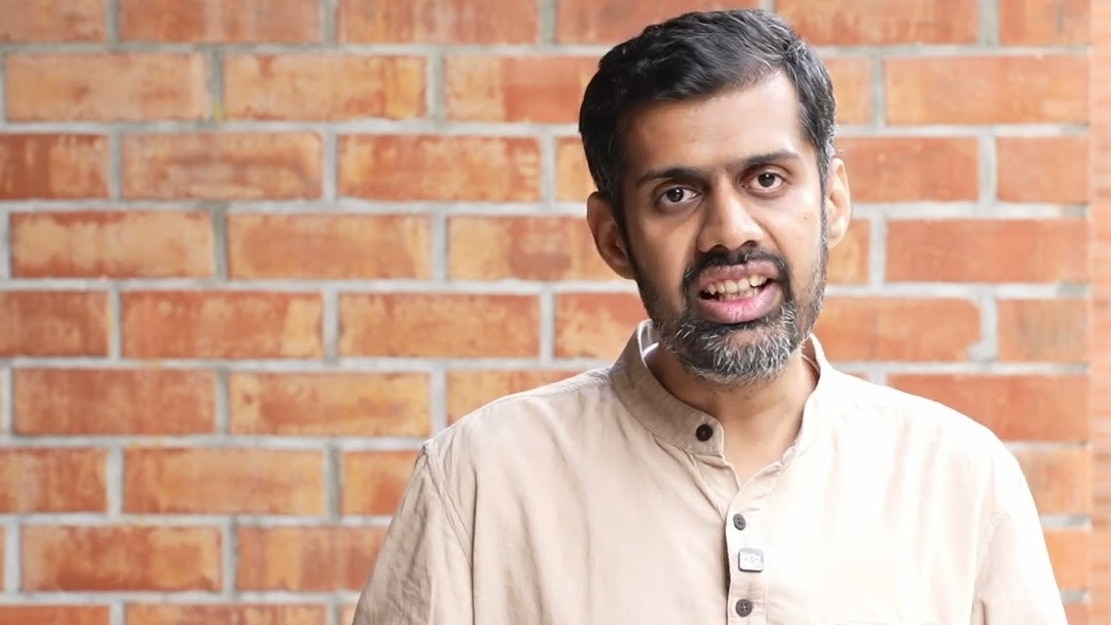
Professor Prathosh AP said in a podcast that students should learn communication and mathematics as two languages. The argument that he made reframes India's school-language debate around clear expression and precise reasoning.New Delhi,Oct 28, 2026 13:52 IST“I believe every student should learn two languages.” As India adapts a new language model in its schools, Professor Prathosh AP, an IISc Bengaluru professor and a voice on engaging public platforms, offers a perspective worth considering. His conversation with the Ground Truth podcast team highlights the role of language in education and how it shapes a student’s ability to think and communicate in life.He explains, “Mathematics is the language that allows us to think precisely, reason logically, and understand the world at a deeper level.” His argument is simple: students need the ability to think clearly, but they also need the ability to share their ideas with others.Professor Prathosh AP makes a distinction between two kinds of languages. “The first is a language that helps you communicate with the world. It could be English, Hindi, or any other language through which you can express your thoughts, explain your ideas, tell stories, and convince people of the value of your work.”He then explains the second: “The second is a language that helps you think precisely. And for me, that language is mathematics.” This distinction matters more when schools are discussing language learning.The debate after NEP 2020 put into focus the importance of learning multiple languages often focusses on which language students should study and generally which languages are best for a young mind, how much time it should receive, and how the new model will affect their education. These are important questions, particularly when students and teachers are already managing academic demands. But Professor Prathosh’s argument invites us to look beyond the choice of language and consider what students need to learn through it.BEYOND WORDS: WHY STUDENTS NEED A LANGUAGE TO THINK, NOT JUST TO SPEAKHe explains why mathematics plays a role beyond examinations. “When we communicate using ordinary languages, we sometimes use words without clearly defining what we mean. We may think we understand a problem, but when we try to reason through it carefully, we discover contradictions or gaps in our thinking.”Mathematics, he says, teaches students to be precise.It helps them define terms, establish assumptions, follow logical steps, and reach conclusions that can be examined and verified. He illustrates this with a simple example: “Suppose you tell an engineer, ‘I want to make this process more efficient.’ What does efficient mean? Does it mean completing the process faster? Reducing its cost? Using fewer resources? Improving its accuracy?”The example shows how a broad idea becomes a problem that can be examined only when its meaning is clear. This kind of thinking is useful not only in mathematics but also in science, research, business, and everyday decisions.However, precise thinking alone is not enough.Professor Prathosh also stresses the importance of communication. “Even if you have brilliant ideas, you need to communicate them effectively so that other people can understand their value.” Students must learn to explain their work, present their arguments, and make their ideas accessible to others.This becomes especially relevant in a world where artificial intelligence can help with writing, coding, and analysing information. Students will need to identify worthwhile problems, reason about possible solutions, and explain their thinking clearly.Professor Prathosh’s advice brings the discussion back to the purpose of education: “Learn to communicate clearly, and learn to think precisely.”As India considers how languages should be taught in schools, this idea offers another way to approach the debate.- Ends
Learn 2 languages: IISc Bengaluru prof urges focus on maths and communication
Full Article
Original Source
Read the full article at Indiatoday →KhanList aggregates and links to publicly available news content. We do not host full articles from third-party sources. Always verify important information with original sources.