
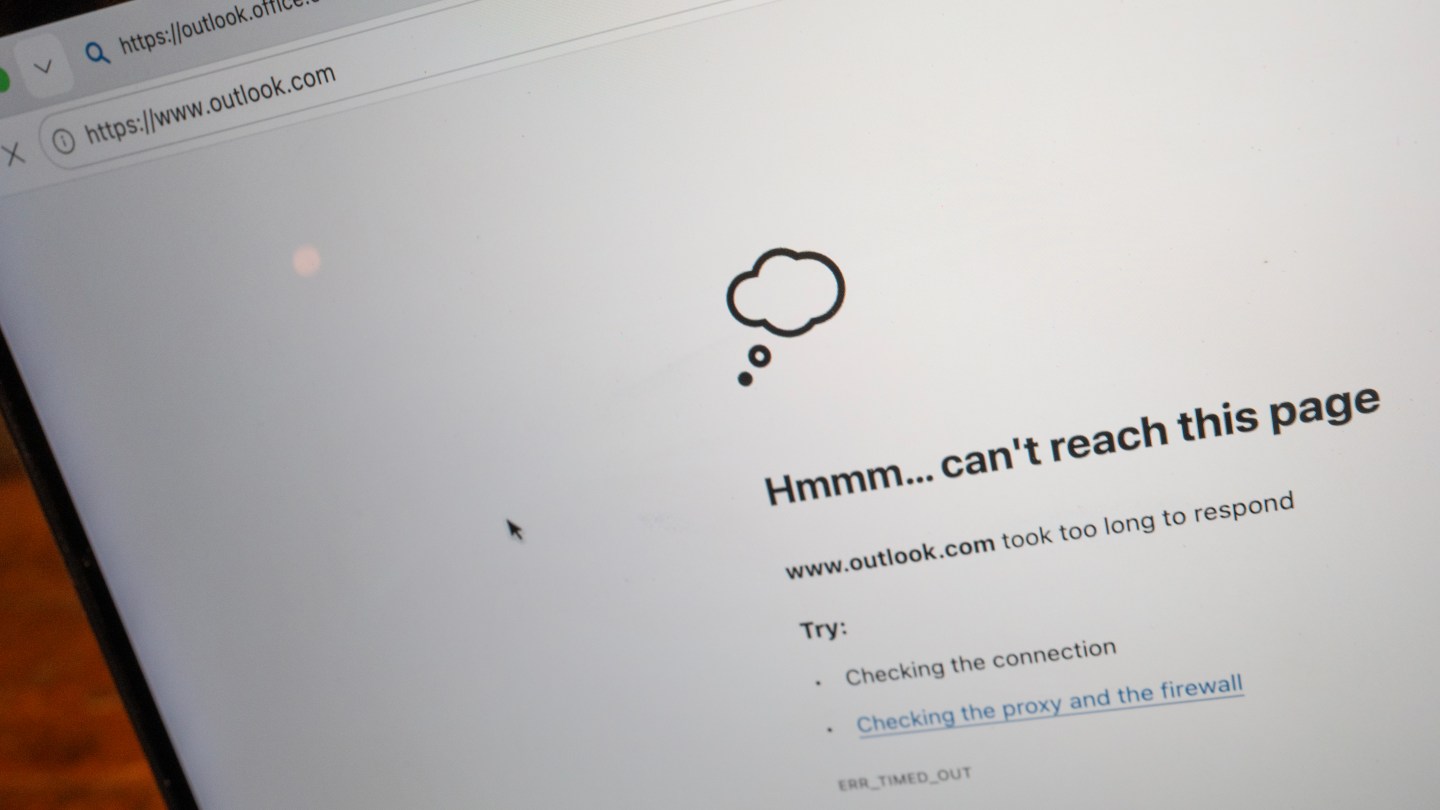
One hallmark of living in late-stage 2026 is the possibility that we’ll wake up and the news site we visit is down, or trying to steal our money.If we muster the courage to get out of bed, we shouldn’t expect to talk to anyone or go anywhere, as chances are that Outlook is offline or the FAA has grounded flights.Perhaps a bleak portrait, but one that has been painted in the past week with a host of cyber-security fails — “an advent calendar of societal collapse,” as Jon Stewart put it on The Daily Show Monday night. A slew of those fails have affected the media and entertainment worlds already, with CNN part of said crypto-swipe Tuesday morning and plenty of executives and workers stuck on the ground Friday. So far cyber experts don’t believe anything coordinated is happening here, even if some cable-news figures aren’t so sure. But even without a single unifying bad actor, the picture is bleak. Fading infrastructure combined with new AI tools that can easily exploit it can only spell trouble.For an industry still scarred by the 2014 Sony hack and all it exposed, the news hits hard. And Hollywood conducts a lot more business digitally these days than it did then, from all the Fandango ticket-ordering to the Spotify-streaming to the Disney+-subscribing. Cyber attacks and a faulty Internet hold the possibility of a major industry disruption. So how worried should the business — and we as individuals — actually be?For that we called Brett J. Goldstein. Goldstein (no relation to the Richmond barker, oi) holds an esteemed perch in American cyber defense, having occupied the role of director of the Defense Digital Service in the DoD under late-era Trump I and early Biden. He’s also a former Chief Information Officer for the city of Chicago and currently holds a professorship at Vanderbilt University in Nashville, where he runs a lab examining such threats. We caught up with him by Signal Tuesday.For anyone looking at all the failures and groundings in the past week, it can be hard not to connect the dots. Do you see them as related in any way or the result of one actor?I don’t know that there’s reason to believe its coordinated but it’s certainly a scary sequence of events which is very troubling. The loss of email or problems with Chase or groundings at United — just because it’s not coordinated doesn’t mean it’s not a cumulative problem.What are the roots of that problem in your view?What we are seeing is an under-investment in our infrastructure that is coming home to roost. You used to be able to hide — it used to take a determined researcher to find a security weakness. But now thanks to AI we can’t really hide. AI can find a needle in a haystack as never before. And so we have weaknesses as never before. Just look at PHP (a failure in Internet code baked-in during the 1990s that has been unearthed by AI). So we have to start fixing all of it, and we can’t put it off even one day.It feels like we have spent decades eating poorly and now, facing a potential heart attack, we’re trying to avoid it with a crash diet. Is this possible to fix quickly?I don’t know that it’s impossible but it’s certainly true we have a lot of sins to pay for. We need to pay our tech debt. There really are only two scenarios: the next few years will be either bumpy or really freaking bad. Everyone needs to change the way they’re thinking to make sure it’s the first one.So a best-case scenario is bumpiness. What does that look like?I think we are entering a period of the flickers and I think this past week has really demonstrated that. My sense is this is the beginning.You wrote in a Washington Post op-ed last week about those flickers. “For you, it looks like this. Your bank’s app is down. The pharmacy cannot pull up your prescription. Your paycheck is late — not stolen, just late because the payroll company unplugged its system to be safe. None of it is a catastrophe on its own. All of it, every week, is a different country from the one we live in now.”That is what will happen and all we can do is start fixing things across various sectors to shorten the period it happens. And [AI] frontier labs need to be a part of the solution too. If we bring quality [solutions] and stability we can make it less bumpy. But I don’t think we can avoid that we are entering the flickers. So we just need to start updating our systems.What does that mean for individuals? This feels like good advice if you run an IT department but what about as consumers? Signal over text, obviously. But what about everything else? Is clicking on CNN actually bad? Is my credit card exposed just because it’s on file at Hulu? Should we all just be moving to clay tablets?I would just say do all the things you’re supposed to do and don’t put it off. If a Chrome update button pops up for the love of Job click the freaking button. If there’s a patch, install it. Two-factor authentication and strong passwords and passkeys of course. If there’s something more complicated in your life consult a cyber expert. You need to do all of the steps, not some of the steps, not most of the steps. Noting is foolproof but there are ways to protect yourself more.Many people in the entertainment industry are especially worried because they still feel the aftereffects of the Sony hack. I talked to someone recently who was exposed and the way they spoke can only be described as a kind of PTSD. How likely is something on that scale happening again?I think there’s a lot of variance in the media sector just like there is in all sectors. Some companies and some individuals are reasonably protected and vigilant. And then with others it’s like “Oh my God, you’re so high profile and you’re not taking care of business.” But if the question is it more likely or less likely, of course it’s more likely. A few years ago when you thought about [a hack] it needed to be an adversary with a lot of tenacity and effort. Now AI-enabled scenarios make it so someone with no scruples can, without much effort, look at 100 things at once.The business side of Hollywood seems at risk as well. Streaming services rely on smooth digital interactions to conduct business; even a few seconds is critical, never mind compromised data or a daylong outage. How vulnerable are all those platforms?This is super-impactful for commerce. My core point if you’re in a position to do something at an organization is to set priorities. Yes you can do all the fancy front-facing AI stuff you’re doing but if you’re not doing the other stuff — if you’re not making sure the underlying platform is fundamentally sound and sustainable — none of that matters.OK, I’ve been putting it off. You’ve gotten into the bumpy scenario. What’s the really freaking bad one?Well, I’ll just say your whole day is tied to a system, and what happens if that system starts to unravel? If you can’t trust it? If it’s not just about a grounded flight which forces you to drive but everything else? But again, it’s an inflection point for us as a society. It’s not too late. We do have a choice.
Leading Cyber Expert: “We Are Entering the Flickers”
Full Article
Original Source
Read the full article at Hollywoodreporter →KhanList aggregates and links to publicly available news content. We do not host full articles from third-party sources. Always verify important information with original sources.