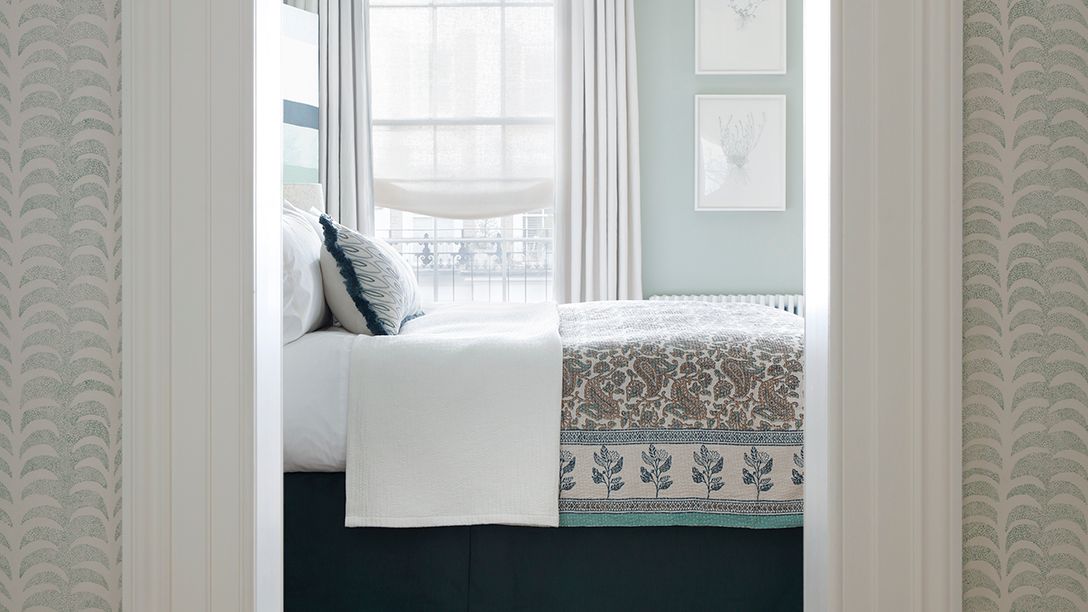
A tasteful set of drapes or a utilitarian set of blinds is the one degree of separation you need to avoid becoming the naked neighbor on your block. Most people don’t need more than that to establish privacy in their home, but the designer trick to creating an atmospheric, aesthetic window treatment is doubling up on drapery or even combining curtains and blinds.“[Layered drapery] adds a sense of depth and visual richness that a single layer might not achieve, without taking up additional square footage,” explains New York–based interior designer Sarah Lederman. Just like five-star hotel rooms, a dual set of curtains provides options for your preferred light coverage, adding privacy, sound absorption, and coziness to an otherwise impersonal room. At home, though, the layered look can keep your room from feeling too one-dimensional.The curtains are of a Clarence House fabric in this Manhattan townhouse decorator Laura Santos designed for her family. Photo: Nikolas KoenigNot just for dramatics, layered drapery also lends versatility to your space. “I always think of it as a solution for spaces that need to transition from airy and bright during the day to cozy and secluded at night,” says Everhem cofounder Haley Weidenbaum. Ideal for media rooms where you need to block a glare, or nurseries that need to adapt to the ever-changing newborn sleep schedule, double layers can create a more flexible environment. She also advises that sheers be placed closest to the glass when you want to bathe a space in light during the day.When combining two different styles of window coverings, architect and interior designer Suzanne Lovell suggests considering each one’s purpose. “Shades and screens address the functional demands of the space, often for limiting portions of sunlight, while drapery is an extension of ceiling height, acting to accentuate or embolden the quality of our architecture,” she says. Placing shades and blinds inside the window trim, and curtains outside, up toward the ceiling, helps to elongate your room’s visual line. This gives the illusion of higher ceilings and more open spaces without blocking your architectural details.A daughter’s bedroom in the Paris home of jewelry designer Aurélie Bidermann is a rhapsody of pretty hues and patterns, with Braquenié curtains over sheer panels and floral wall fabrics. Photo: Matthieu Salvaing; Styling: Ana Cardinale“The materials and opacities do not always need to be dramatically different, but there should be some level of contrast or variation so the layers feel purposeful and harmonious, rather than overly matched,” says Boston-based interior designer Nina Farmer. Consider pairing a woven bamboo shade with an airy, linen drape for a relaxed look. For those in need of more coverage, a thinner cotton layer placed under a heavier velvet or patterned fabric creates balance and lends a sense of formality and structure to your room.When using shades as your first layer, consider a similar light filtration level. “I love a sheer linen to allow light to pass through the Roman blind I set into the window reveal in the day,” says Studio Peake founder Sarah Peake. “I often use a soft fold style so that it feels relaxed and not overly formal, which sometimes layered window treatments can feel. The end result is cozy, full of texture and light.” Whether you’re looking to find a companion for an existing set of drapes or are starting from scratch, we’re highlighting a few pairings below to elevate your windows.When you’re ready to install, Weidenbaum suggests mounting hardware for layered drapery high and wide—perhaps a thin double rod, or an inside mount coupled with an outside mount. “This prevents the fabric from feeling bulky or making the window appear smaller.”Get the Layered Look:West Elm Pleated European Flax Linen CurtainTWOPAGES Cordless Roman Bamboo Shades
Layered Drapery is the Trick to Elevated Interiors, According to Expert Designers (2026)
Full Article
Original Source
Read the full article at Architecturaldigest →KhanList aggregates and links to publicly available news content. We do not host full articles from third-party sources. Always verify important information with original sources.