
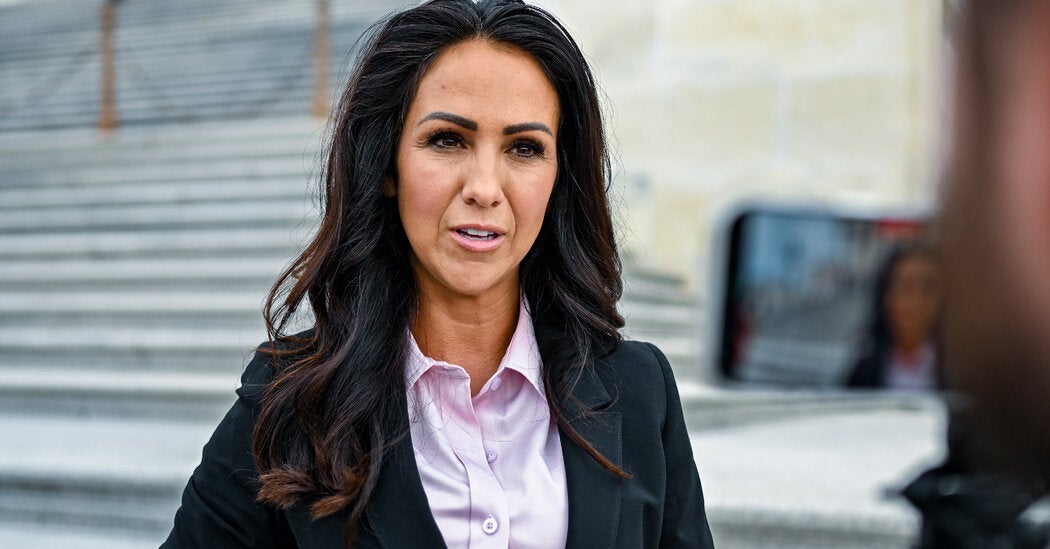
LatestHere’s the latest.The Democratic House majority surged past 250 seats on Thursday as the party seized its biggest majority in nearly two decades by flipping more seats, including in Montana, where a former smoke jumper disrupted decades of Republican dominance. The last time either party held so many seats was 2008, when Democrats swept to power behind Barack Obama.The latest race calls by The Associated Press continued to strengthen Democrats’ hold on the House, though they also hoped to add to their margin in the Senate with seats in Alaska and Mississippi, where their nominees held narrow leads over the Republican incumbents.The political consequences of voters’ rebuke of President Trump and his party were still unfolding. In an interview with The New York Times, Secretary of State Marco Rubio dismissed reports that he was planning to leave the Trump administration. Mr. Rubio, a possible presidential contender in 2028, declined to answer questions about his political future.More than 20 House races were still uncalled, and the Senate contests remained front and center.In Mississippi, Scott Colom, a Democratic prosecutor, slowly increased his lead over Senator Cindy Hyde-Smith, to a little more than 1,800 votes as of early evening. Lawyers for Ms. Hyde-Smith wrote to Mississippi state officials to request “the preservation of all affidavit ballots,” a sign that the courts could become involved in the race. A lawyer for Mr. Colom’s campaign wrote a letter to election officials objecting to aspects of the request from the Hyde-Smith campaign.In Alaska, former Representative Mary Peltola was leading Senator Dan S. Sullivan by a few hundred votes in a race that continued to draw complaints from Mr. Trump, who said the only “fair solution” involved transferring votes from two other candidates to the Republican incumbent. A New York Times analysis of the available ranked-choice data in the state found that Mr. Sullivan would be unlikely to make significant gains if the race advanced to a ranked-choice tabulation, which will take place on Nov. 18 if neither candidate secures 50 percent of the vote. The findings suggest that Ms. Peltola, the Democratic nominee, is on track to eventually triumph in the race.Elsewhere, Republicans managed to flip a House seat in Tennessee, where a Democrat had stepped down after conservatives carved up the city of Memphis, but Democrats continued their run of wins in traditionally conservative areas by capturing seats in Arizona, Virginia and Colorado.In Montana, Sam Forstag, a union leader who used to parachute into remote areas to battle wildfires for the U.S. Forest Service, won a longtime Republican seat by running on a pro-labor platform that earned endorsements from progressives like Senator Bernie Sanders of Vermont and Representative Alexandria Ocasio-Cortez of New York.While House candidates were learning the outcomes of their races, the remaining Senate contests seemed days, or possibly weeks, from being decided.In Mississippi, the vote counts were rising slowly. Mr. Colom’s lead, which had been a few dozen votes on Wednesday, grew as more ballots were tabulated. But an unknown number of provisional and mail-in ballots were still to be counted.Here’s what else we’re covering.Los Angeles mayor: Nithya Raman, a democratic socialist, will be the next mayor of the country’s second-biggest city after ousting the Democratic incumbent, The Associated Press reported. Ms. Raman defeated Mayor Karen Bass by harnessing the frustration of younger voters who have found themselves priced out of the famously expensive city. Read more ›Japan reaction: After Tuesday’s election, pundits and politicians around the world are talking about the “blue tsunami.” But in Japan, the word and its imagery, are complicated, evoking destruction and despair. Read more ›Ballot measures: Voters across the country also weighed in on a range of statewide issues, including abortion, how future elections would be run and how their own votes would be counted. And in Arizona, Nebraska and Washington, voters passed measures restricting transgender girls from participating in girls’ sports.Tim Balk contributed reporting.Lauren Boebert, a MAGA Favorite, Loses Her Re-election Bid in ColoradoImageRepresentative Lauren Boebert, a Republican from Colorado, was seen as increasingly vulnerable as her alliance with President Trump became a liability. Credit...Kenny Holston/The New York TimesRepresentative Lauren Boebert, a hard-line Republican, on Friday narrowly lost her bid for re-election in a conservative Colorado district, according to The Associated Press, an outcome that showed just how deeply Democrats encroached into Republican territory this year.Ms. Boebert, a fiery favorite of the MAGA movement, switched congressional districts a few years ago after her old seat in Colorado grew more competitive. But the change was not enough to keep her from being ousted by Eileen Laubacher, a Democrat and a retired rear admiral in the Navy.Ms. Laubacher declared victory on Monday, and was leading by more than 3,000 votes when the race was called on Friday. Ms. Boebert, who amplified President Trump’s false claims of a stolen election in 2020, has not yet conceded. Her lawyer suggested last week that Ms. Boebert would request a recount.Democrats flooded the airwaves in the district with more than $7 million worth of ads, outspending Republicans by more than 23 to 1, according to the media tracking firm AdImpact. Many of the ads fixed on Ms. Boebert’s polarizing nature and past scandals, with one calling her “uniquely unfit.” Another ad contrasted Ms. Laubacher’s profile as a Navy veteran and mother of five with headlines about Ms. Boebert.“Lauren Boebert flips out over ‘Beetlejuice’ groping footage,’” the chyron read in one clip, referring to Ms. Boebert’s ejection from a Denver theater in 2023. Another showed Ms. Boebert cursing at the person filming.“Like so many of us, Eileen is done with the extremists in both parties,” a narrator said in the ad, which was run by Ms. Laubacher’s campaign. “Maybe the best way to break through the noise is a little less talking and more listening.”ImageEileen Laubacher is a Navy veteran who served in the Biden administration.Credit...Andrew Harnik/Getty ImagesDemocrats had viewed Ms. Boebert as vulnerable in the closing stretch of this year’s race, as her once-close alliance with President Trump became a liability among voters who blamed his administration for high gas prices and other affordability concerns.Ms. Boebert, first elected in 2020, broke with Mr. Trump at times during the past year, particularly over her calls to release files related to the convicted sex offender Jeffrey Epstein. And she drew the president’s anger by campaigning for Representative Thomas Massie, the Kentucky Republican who became a nuisance for Mr. Trump.After the election, Ms. Boebert declined to blame Mr. Trump for Republicans’ blowout losses, though she said she was “very frustrated with the war.” She told reporters this week that the Trump administration should have gone further to deport immigrants who were in the United States illegally and that Republican lawmakers “could have done a lot more.”Ms. Laubacher ran on a centrist platform but hammered Ms. Boebert for her votes against resolutions directing Mr. Trump to end the war in Iran or seek congressional approval. She also centered a promise to protect rural hospitals in the wake of Medicaid cuts.Ms. Laubacher served in the National Security Council for two years during the Biden administration, and earlier in her career she worked as a Navy intelligence officer and served in the Navy Reserves. She was promoted to the rank of rear admiral in 2018.“I don’t answer to a political party,” Ms. Laubacher said in a statement declaring victory on Monday. “I answer to the people of the 4th district and I’ll work with anyone and everyone, including President Trump, Republicans, and Democrats to get things done for Colorado.”VideoThe Voters Who Powered the Blue TsunamiA younger, more diverse electorate than is typical in midterm elections helped drive Democrats’ decisive victory, along with gains among swing voters and support from some Republican voters. Nate Cohn, The New York Times’s chief political analyst, explains.AdvertisementSKIP ADVERTISEMENTDemocrats Hold Kansas Governorship, Retaining Power on the PlainsImageCindy Holscher celebrated her win in the primary election at a watch party in Lenexa, Kan., in August.Credit...Chase Castor for The New York TimesState Senator Cindy Holscher won election as governor of Kansas, keeping the seat in Democratic hands for a third straight term, The Associated Press said on Thursday.She narrowly defeated Ty Masterson, the Republican nominee and the president of the Kansas Senate. Gov. Laura Kelly, the Democratic incumbent, was barred by term limits from seeking re-election.Ms. Holscher’s victory added to a momentous election for Democrats in Kansas and across the country, and it maintained a rare lever of power for the party on the Great Plains.Adam Hamilton, a Methodist pastor, became the first Kansas Democrat to win a U.S. Senate race since the 1930s. In addition, Democrats flipped several legislative seats to break a Republican supermajority in the Kansas House of Representatives, which will make it much harder to override vetoes by Ms. Holscher.Kansans also voted out Attorney General Kris W. Kobach, a Republican who helped elevate illegal voting as a political issue. Republicans prevailed in other statewide races and will still have majorities in both legislative chambers.Though Kansans reliably vote for Republicans for president, they have shown an independent streak in midterm elections, swinging for decades between Republican and Democratic governors. High costs, dissatisfaction with President Trump’s policies and a tangle of challenges facing farmers made the Plains region more winnable for Democrats this year.Both parties spent heavily on the race for Kansas governor. For Republicans, it represented a tantalizing flip opportunity on an otherwise foreboding electoral map. For Democrats, it was a chance to maintain power in a reliably conservative state.Ms. Holscher, a lawmaker from suburban Kansas City, ran on a populist platform that called for legalizing marijuana and placing a moratorium on data centers. She also promised to prioritize funding for public schools and to reduce property taxes. She will be the fourth woman to serve as governor of Kansas.“I stand with the people — not the corporations, not the billionaires,” Ms. Holscher said in a debate at the State Fair.Ms. Holscher emerged from a competitive Democratic primary in which Governor Kelly had endorsed a different candidate. Ms. Kelly had also publicly questioned Ms. Holscher’s ability to win a general election, suggesting that the candidate had positioned herself too far to the left. After the primary, Ms. Kelly endorsed Ms. Holscher.Ms. Kelly said in a post-election interview that she was “more confident now that Cindy will be a good governor.”“You really have to look at things very differently when you’re governing than you do when you’re campaigning,” Ms. Kelly said, “and I am absolutely confident that Cindy Holscher will surround herself with good people, and that she’ll keep things moving forward.”Ms. Holscher will be the first Democratic governor elected to succeed a fellow Democrat in Kansas history. Her running mate, State Representative KC Ohaebosim, is the first Black person to win statewide office in Kansas since the 1880s.Mr. Masterson, a legislator from the Wichita area, emphasized his endorsement from Mr. Trump on the campaign trail. He pledged to lower taxes and cut costs for residents.In a statement on Thursday, Mr. Masterson said it “looks like we will come up just short” and that he had called Ms. Holscher to congratulate her.“This was a hard election for people who share our vision, here and across the country,” Mr. Masterson added.Though not a household name in much of the state, Mr. Masterson amassed considerable power at the Kansas Capitol. During his tenure as president of the State Senate, lawmakers overrode Ms. Kelly’s vetoes to enact dozens of bills, including ones that placed restrictions on transgender people, overhauled election procedures and limited officials’ ability to impose restrictions during public health emergencies.But with Ms. Kelly in office, Mr. Masterson’s power was sometimes limited. Though he and other legislative Republicans wanted to redraw the state’s congressional map last year, he would have needed near-unanimous Republican support to overcome a veto from the governor. That plan unraveled when several Republicans voiced opposition, leaving in place a single Democratic-leaning U.S. House district.Rep. Ken Calvert Wins House Battle Between Two California RepublicansImageRepresentative Ken Calvert won in one of the last remaining Republican strongholds in California.Credit...Caroline Brehman/Associated PressRepresentative Ken Calvert defeated another Republican incumbent, Representative Young Kim, in California’s 40th Congressional District in a rare intraparty contest, according to The Associated Press.The Southern California district, which includes parts of Riverside and Orange Counties, is one of the state’s last Republican strongholds. Ms. Kim had represented the district since 2018. Mr. Calvert ended up running against her after his former district, which encompassed much of Riverside County, including Palm Springs, was carved up and distributed among several neighboring districts.During the nonpartisan primary, Mr. Calvert and Ms. Kim attacked each other as insufficiently supportive of President Trump’s agenda. But the tone shifted this fall as both candidates portrayed themselves as pragmatic, “common sense” politicians, distancing themselves from Mr. Trump.The campaign turned especially negative, in part because both candidates viewed the race as a fight for their political lives.Ms. Kim repeatedly labeled Mr. Calvert corrupt, citing ethics complaints and an F.B.I. investigation targeting several real estate deals. Mr. Calvert has denied any wrongdoing and was never criminally prosecuted.Mr. Calvert focused his attacks on a campaign donation Ms. Kim received from a Chinese American businessman who has been a target of an investigation into Chinese foreign influence. Ms. Kim donated the money from the donation and said she did not know about the allegations against him.AdvertisementSKIP ADVERTISEMENTCalifornia Voters Reject Billionaire Tax That Divided DemocratsImageA rally against Proposition 40 in La Palma, Calif., last week.Credit...Eric Thayer/Los Angeles Times, via Getty ImagesCalifornia voters rejected a billionaire tax, The Associated Press determined on Monday, rebuking a measure that would have created the nation’s first wealth tax by targeting the assets of residents with a net worth beyond $1 billion.Under the tax measure, Proposition 40, the state would have imposed a one-time, 5 percent tax on the personal assets of billionaires and devoted most of the revenue to health care. The Democratic voters who dominate the California electorate generally support the concept of making wealthy people pay higher taxes. But Democratic leaders were divided over the proposal — Gov. Gavin Newsom opposed it while the California Democratic Party endorsed the tax. And some of the California billionaires who stood to pay the tax contributed heavily toward a campaign that slammed the proposal with attack ads on TV throughout October.Proposition 40 also suffered from having a weak coalition of supporters who could not compete with those ads and relied on cheaper methods, such as social media and influencer campaigns, to rally support.The race was not called until almost a week after the election as California counted mail ballots at a deliberate pace. Though the vote gap shrank as more ballots were tallied, the measure ultimately failed to get enough support despite it being a hugely successful election for Democrats and left-leaning candidates.As of Monday night, Proposition 40 had only 47 percent support with an estimated 83 percent of the votes counted.The failure of the billionaire tax in California, a liberal state, is likely to be used as evidence for years to come that Americans will not stomach similar wealth taxes. The concept is expected to come up during the 2028 presidential campaign, and Mr. Newsom has already said he would be interested in a national wealth tax but not one only in his own state.Not only did the billionaire tax fail, but its emergence prompted a billionaire coalition to put a countermeasure on the ballot that could deal a further blow to the wealth tax movement in California. The proposal, Proposition 42, would prohibit future wealth taxes in the state, and that measure was ahead on Monday.The billionaires tried to make the case that voting against Proposition 40 and for Proposition 42 would protect middle-class retirement savings from higher taxation in the future.Supporters of the tax blamed the failure of Proposition 40 on their vast campaign spending disadvantage and considered the initiative’s failure a sign of oligarchic power.During a news conference on election night, proponents pointed to the astronomical spending by the opposition, led by Sergey Brin, the Google co-founder who gave more than $100 million toward defeating the wealth tax. His group has raised more than $300 million this year, based on the most recent campaign finance records.Dave Regan, the head of the health care workers’ union that put the tax on the ballot, said the billionaire-funded attacks produced “a lot of confusion and a lot of second-guessing among people who really in their hearts know what the right thing to do is.”Mr. Regan vowed to pursue another billionaire tax in 2028.His union had argued during the campaign that revenue from billionaires was necessary to offset cuts to health care programs that President Trump signed into law last year. Without the tax, millions of Californians would lose health insurance and hospitals would close, said the union, the Service Employees International Union-United Healthcare Workers West.It garnered support from prominent liberal economists and national progressive leaders, including Senator Bernie Sanders, independent of Vermont, who called Proposition 40 “the most important ballot item in the country.”But the measure divided labor unions and Democratic politicians in California. Mr. Newsom and Xavier Becerra, the Democrat who will replace him, opposed the tax, arguing that it would drive away entrepreneurs, and said a one-time surge in tax revenue wasn’t worth the potential long-term harm to the state budget. Teachers, firefighters and Planned Parenthood Affiliates of California joined them in arguing that the tax would ultimately reduce the money available for many government services.“You don’t pass a landmark progressive tax increase that is a change to how America has historically done anything by dividing up the progressive coalition,” said Thad Kousser, a political science professor at the University of California, San Diego.He noted that the union behind the tax moved ahead with it before securing sufficient support from key allies. “The policy substance was much harder to sell because of this key strategic choice at the beginning to go it alone,” he said.The billionaires have said very little publicly about their ballot efforts and have relied on Democratic-leaning organizations and Mr. Newsom to be the face of the opposition. On behalf of doctors, the California Planned Parenthood branch, school boards and health clinics, opponents said voters made the right decision to protect California’s fiscal health and called the ballot initiative “a reckless experiment conducted on our state’s economy.”Orlando Mayorquín contributed reporting from Los Angeles.Democratic gains could advance an alternative to the Electoral College.ImageVoters casting their ballots in Dearborn Heights, Mich., on Tuesday. A state lawmaker said that after Tuesday’s midterm results, “The time is right” to reconsider the Electoral College.Credit...Victor J. Blue for The New York TimesDemocrats’ midterm victories may raise the chances that enough states sign onto a mechanism that, in theory, could elect the next president effectively by popular vote instead of through the typical rules of the Electoral College.The party’s surge in Tuesday’s elections included gaining a hold on the governor’s office and both statehouse chambers in at least five states, Michigan, Nevada, Pennsylvania and Wisconsin and Arizona. Those states could join an agreement called the National Popular Vote Interstate Compact, which promises that participants would give all their electoral votes to the presidential ticket that wins the national popular vote.But the agreement, which has been more popular among Democrats, takes effect only once signed by states representing a majority of the Electoral College, or at least 270 electoral votes, the amount needed to win the presidency. Eighteen states and the District of Columbia have adopted the compact so far, representing 222 electoral votes.If four of the states with new Democratic control were to join the agreement, it would tip the group over the 270-vote threshold.Lawmakers in key states said on Thursday that they had already begun having conversations this week about introducing legislation to join the agreement in the next session, and were hopeful that they would succeed ahead of 2028. But broadening the compact could present a mighty political lift.“The time is right,” Carrie Rheingans, a Democrat in the Michigan House of Representatives, said in an interview. “This blue tsunami is really going to help push this forward across the whole nation.”Still, Democratic lawmakers “can be apprehensive” with a new majority, said Mattie Daughtry, the Democratic president of Maine’s State Senate. She worked on the compact issue for over a decade before her state joined in 2024.“The biggest roadblock is convincing them to use these majorities to do big things,” Ms. Daughtry said.In 2019, Nevada’s Democratic governor vetoed a bill to join the agreement, saying it could diminish smaller states’ influence in presidential elections.Now, it is unclear whether lawmakers will prioritize passing the compact after running campaigns dominated by other concerns, like easing high costs and imposing guardrails on the Trump administration.“Time will tell,” said Clinton Anderson, a Democratic state assemblyman in Wisconsin, adding that he planned to reintroduce a compact bill. “I want to make it a priority, but it’s not the thing I heard on the doors I knocked.”Kelda Roys, another Democratic lawmaker in Wisconsin, said that her initial attempt to get her state to join the compact in 2009 had been met with hesitancy among people who were unsure exactly what it was. Now, she said, there is a broader public understanding of what problems the Electoral College could present.“National popular vote will be something that we’ll prioritize early in the session,” Ms. Roys said.The idea for a compact among states to bypass the Electoral College gained traction among legal scholars and supporters after 2000, when George W. Bush won the presidency while losing the national popular vote. Momentum grew in 2016 after a second Republican candidate, Donald J. Trump, won despite losing the popular vote.Supporters of the compact said they view the Electoral College as a less democratic mechanism than the popular vote. A YouGov poll conducted in June showed that 56 percent of American adults supported choosing the president via popular vote.The compact is also more practical than amending the Constitution and popular among voters, supporters said.Opponents and legal experts said the compact would face a slew of court challenges. One obstacle is that compacts traditionally require the approval of Congress and the president, said Derek Muller, an election law expert at Notre Dame Law School who has written about the agreement.“It’s a very real possibility that enough states join this compact,” he said. “There will be a lot of challenges.”AdvertisementSKIP ADVERTISEMENTWashington State voters allowed a tax on millionaires to stand, rejecting a ballot initiative that would have repealed a 9.9 percent tax on income over $1 million, according to The Associated Press. The vote isn’t the final hurdle, however. A lawsuit is pending that seeks to block the tax before it takes effect in 2028.In a virtual call with her supporters on Thursday night, Angie Nixon, the Democrat who narrowly lost the Senate race in Florida, announced that she was starting a new political group called Never Scared PAC. The group will try to harness the thousands of volunteers that powered Nixon’s grass-roots campaign to keep them engaged in the state.The first issue it will take on is the implementation of a ballot measure known as Amendment 3, which passed on Tuesday. It would dramatically cut property taxes on primary homes and is expected to cost local governments billions of dollars in revenue and lead to sharp reductions in public services or to new local fees or taxes. Nixon said her group would organize to press state legislators and local leaders to limit the measure’s impact to their communities. ImageCredit...Ruth Fremson/The New York TimesPresident Trump decried the news that stocks, after surging on Wednesday, had their worst day in nearly two years on Thursday, which came amid investors’ concerns about the prospect of tighter regulation in the A.I. industry after Democratic midterm victories.In a series of social media posts, Trump sought to deflect blame from his role in the sweep of Republican defeats across the country, where his party faced challenging races — including his hand-picked candidates— because of his unpopularity, his handling of the economy and his decision to start a war in Iran. “The Stock Market crashed today because the Dumocrats had a big Tuesday — So sad to see, you only have yourselves to blame!” Trump wrote in one post. In another, he reiterated his claim that the outcome would have been different if he had run (even though he pleaded with his base to pretend that he was). “I JUST WASN’T ON THE BALLOT,” Trump wrote. “IF I WERE, WE WOULD HAVE WON IN A LANDSLIDE!”Nithya Raman’s win in Los Angeles adds to the major cities with democratic socialist leaders.Mayor Zohran Mamdani of New York City, Nithya Raman, the new mayor of Los Angeles, Mayor Katie Wilson of Seattle.The New York TimesNithya Raman won the mayoral race in Los Angeles on Thursday, joining the ranks of democratic socialists who have been elected to lead major American cities over the past year.Once she takes office, the mayors in the two most-populous American cities and the nation’s capital will be members of the Democratic Socialists of America, a political group of dues-paying members organized around a broad policy platform.A strong emphasis on expanding public services, such as housing, health care, child care, public transportation and infrastructure, and heavily taxing corporations and wealthy individuals ties together their positions.Here’s what to know:Democratic socialists have been elected mayor in several cities.In New York City, Zohran Mamdani’s election last year made him perhaps the most prominent mayor who is a member of the D.S.A. As part of his progressive agenda, he has pushed through a “rent freeze” for nearly one million rent-stabilized apartments, fought to tax high-end second homes and expanded a free child care program for 2-year-olds in partnership with Gov. Kathy Hochul.In Los Angeles, where the mayor’s race is nonpartisan, Ms. Raman, a city councilwoman, is a member of the D.S.A. An urban planner by training, she promoted an aggressive expansion of the housing supply, advocated zoning changes and called for prioritizing public transit improvements, among other proposals. She will unseat Karen Bass, a more moderate Democrat who has served as mayor since 2022.In Seattle, Mayor Katie Wilson, who was elected last year, has described herself as a democratic socialist but is not a D.S.A. member. In office, she has accelerated homeless shelter openings, led the passage of a major transit service expansion and rolled out new investments in preschool programs.In Washington, D.C., Janeese Lewis George, a district councilwoman who is a member of the D.S.A., was elected mayor on Tuesday. She has called for enacting universal child care, building social housing owned by the city, strengthening tenant protections and lowering rental costs for small businesses. She is set to replace Muriel Bowser, a Democrat who is more moderate and did not seek a fourth term.In Providence, R.I., David Morales, a state lawmaker and former professional wrestler who is also a D.S.A. member, was elected mayor on Tuesday. He easily defeated his Republican opponent, David Talan, after running a campaign focused on capping rent hikes, building affordable homes in vacant buildings and on empty lots and demanding that corporations contribute more to funding city services and public schools.President Trump responded.After Ms. Raman’s race was called on Thursday, President Trump was asked about the election of democratic socialists. He predicted that people would be unhappy with their policies and said, “It’s going to be a disaster.”“Unfortunately, usually that happens so late that you’ll never be able to bring back a city, or a country or a state, when it goes too far,” Mr. Trump told reporters in the Oval Office.AdvertisementSKIP ADVERTISEMENTIn Mississippi, the secretary of state, Michael Watson, said roughly 3,300 absentee-by-mail ballots were still outstanding in the Senate race between Senator Cindy Hyde-Smith, a Republican, and Scott Colom, the Democrat. Those have to be received within five business days of Election Day. He also said that 6,936 affidavit ballots have now been processed and roughly 80 percent have been accepted, though it is unclear how many are outstanding.On Thursday, officials reviewed absentee ballot envelopes in Anchorage as election observers in yellow vests watched. The officials, members of the Absentee Review Board, checked voter information, including addresses that may have changed. Ballots will undergo further review for issues that could affect scanning before being counted.Erin Schaff/The New York TimesCait Conley flips a key N.Y. swing seat for Democrats, ousting Mike Lawler.ImageCait Conley, a Democrat, sought to tie Representative Mike Lawler to President Trump in her campaign to flip New York’s 17th Congressional District, where the president is unpopular.Credit...Dave Sanders for The New York TimesCait Conley, an Army veteran and former national security official in the Biden administration, beat Representative Mike Lawler in a suburban New York swing district, according to The Associated Press, flipping a seat that Democrats had identified as a top target on their path to recapture the House majority.Ms. Conley rode a wave of voter dissatisfaction with the policies of President Trump, whose tariffs and war in Iran have contributed to higher prices on gasoline, groceries and other essentials.“We started this because we knew that America, the land of promise and opportunity, was on the wrong path,” Ms. Conley said late Tuesday at her election night watch party in Pleasantville. “But we knew, if we came together, if we brought people together, that we could fix it. And tonight we show that this fight wasn’t a partisan fight. This was a patriotic fight.”The race, in New York’s 17th Congressional District, was not called until Thursday afternoon, partly because of issues with the processing of ballots in Westchester County. That delayed the counting of tens of thousands of votes.But long before the results were official, Ms. Conley’s strong performance in Mr. Lawler’s home base in Rockland County led the congressman to concede.Speaking at a banquet hall in a Hilton hotel in Pearl River on Tuesday night, Mr. Lawler said that he had called Ms. Conley to congratulate her and that “when all the votes are counted tomorrow in Westchester, it will be pretty clear.”The daughter of a postal worker, Ms. Conley grew up just over the border of the district, which includes the affluent suburbs north of New York City and narrowly favored former Vice President Kamala Harris in the 2024 presidential election. Ms. Conley moved back to run for Congress and talked up her years of military service on the campaign trail, beating two more liberal primary opponents in June.Still, her work in the private sector after leaving government became the subject of attacks from Mr. Lawler and outside groups supporting him. They bankrolled television advertisements that portrayed Ms. Conley, a former U.S. Army special operations leader, as a corporate puppet beholden to her former employers.Ms. Conley made $328,000 in nearly two years of private-sector work, according to financial disclosure reports, but declined to divulge the specifics of what she did for Hidden Level, an anti-drone-systems company, and for Primer AI, the firm where she consulted, citing nondisclosure agreements.The two campaigns and outside groups backing them spent more than $60 million inundating voters with advertising over the course of the campaign, according to AdImpact, an ad tracking firm. About half of that money went to supporting Ms. Conley, with much of it spent on ads attacking Mr. Lawler as a rubber stamp for Mr. Trump. “Mike Lawler votes with Trump 100 percent of the time,” a narrator states in one of the Conley campaign ads. (An analysis by Congressional Quarterly found that in 2025, Mr. Lawler voted yes on bills Mr. Trump approved of 94 percent of the time.)A former state legislator, Mr. Lawler shot to fame when he unexpectedly defeated Sean Patrick Maloney, the chairman of the House Democrats’ campaign arm, in 2022. That victory, and his re-election two years later, distinguished Mr. Lawler as a Republican who could win in a resoundingly Democratic state.The congressman, who flirted with a run for governor last year, went to great lengths to emphasize his independence. He was a lone Republican voice during negotiations over Mr. Trump’s signature domestic spending bill, conditioning his support for the legislation on raising the cap on the state and local tax, or SALT, deduction. (Ms. Conley had argued that there should be no cap on the deduction, and criticized the fact that the legislation that lowered taxes also cut funding for Medicaid.)Mr. Lawler also characterized Ms. Conley as aligned with Mayor Zohran Mamdani of New York City and Representative Alexandria Ocasio-Cortez of New York, both democratic socialists.One exchange during the first debate of the campaign summed up the race’s fault lines. Mr. Lawler called on Ms. Conley to denounce Mr. Mamdani, whom he claimed was encouraging antisemitism.“I absolutely call out my party when I believe that it’s wrong,” she said.“But you don’t denounce Zohran Mamdani,” Mr. Lawler replied.“Have you denounced Donald Trump and the harm that he has caused to our families here in the Hudson Valley?” Ms. Conley said in response.The voting problems in Westchester County were the product of human error, officials said, but they nonetheless unsettled voters and poll workers on Tuesday. It turned out that the county had updated its ballots and the software for its ballot-reading machines to add an omitted race in Ardsley, N.Y. — but the software change had been made only in Ardsley, meaning the machines in the rest of the county were unable to read the updated ballots.Ballots across the county were deposited into orange bags and delivered to a county Board of Elections facility in Ardsley, where a count, under the supervision of lawyers, began late Wednesday morning.At the facility on Wednesday afternoon, a Democratic elections commissioner, Tajian Nelson, declined to give an estimate when reporters asked when the counting would be finished.“We’re not even able to begin with the E.T.A.,” she said.But she added that, by law, the election results must be certified within 25 days. “So based on that, we have to be certified before we have turkey at the end of the month.”Kristi Berner and Wesley Parnell contributed reporting from Westchester County.AdvertisementSKIP ADVERTISEMENTColorado voters have approved a ballot measure restricting transgender girls from participating in girls’ sports, The Associated Press reported. The measure has been widely viewed as a test for efforts to enact such bans beyond the 27 Republican-led states where they are already in place.In Alaska, where tens of thousands of votes are yet to be tallied, a New York Times analysis suggests that Mary Peltola, the Democratic candidate for Senate, is on a path to victory. Her campaign manager just released a statement arguing the same: “The numbers are clear: when every vote is counted, Mary Peltola will be elected as Alaska’s next United States Senator.” We may not get a race call until next week or later, and the campaign of Senator Dan S. Sullivan, the Republican incumbent, released a memo on Wednesday arguing that he was the one who was favored to win.Around 1,000 more votes were just reported from eight counties in Mississippi, increasing the lead of Scott Colom, the Democratic candidate for Senate, to just over 1,800 votes. Colom’s lead over Senator Cindy Hyde-Smith, a Republican, has generally grown throughout the day, but it’s not clear how many votes remain to be counted, the breakdown of absentee and provisional ballots, or which parts of the state they’ll come from.AdvertisementSKIP ADVERTISEMENTMarco Rubio rejects reports he wants to leave his jobs and run for president.ImageSecretary of State Marco Rubio has said that he would support Vice President JD Vance if he ran for president.Credit...Doug Mills/The New York TimesSecretary of State Marco Rubio on Thursday dismissed reports that he was planning to leave the Trump administration and declined to answer questions about his political future.Working for President Trump until the end of his term has “always been my plan,” he said in an interview with The New York Times.Responding to the news reports that he was mulling an exit, Mr. Rubio said, “I don’t know where these things come from, to be honest with you.”“I love the work I’m doing,” he continued. “And plus I always laugh when they say he’s going to leave his job. I go, ‘Which one?’”Mr. Rubio, who is also Mr. Trump’s national security adviser, declined to answer questions about whether he was considering running for president in 2028.“I literally will not talk about 2028 anymore,” he said in the interview, in his White House office. “I just won’t do it.”Mr. Rubio has said that he would support Vice President JD Vance if he ran for president.“JD is a very good friend of mine,” he told NBC News in May. “If JD runs for president, I think he’d be a phenomenal candidate. I’ve said publicly, and I’ll say it again, I’ll be the first person to sign up and support him.”Mr. Vance offered a striking critique in his post-election analysis on Wednesday in a lengthy post on social media, commentary that distanced himself from Mr. Trump. The vice president blamed the war with Iran for Republicans’ disastrous election results and said Republicans had turned against the administration’s policy on Israel and its messaging on the economy. The president has closely aligned himself with Israel and dismissed affordability concerns as a “hoax.”Mr. Rubio initially deflected when asked whether he agreed with Mr. Vance’s assessment, saying he was not “really involved in domestic politics.”But Mr. Trump brought Mr. Rubio onstage at his political rally on Sunday in Kansas and lavished praise on him, joking that he might have to fire him because he had become “too popular.” Mr. Rubio spoke briefly, praising Mr. Trump for keeping Americans safe.Mr. Rubio explained why he was there, as the designated national security official traveling with the president, and then acknowledged that Mr. Trump had said the war was a factor in the elections.“Higher prices at the gas pump, I acknowledge, is not like the kind of thing you campaign on and brag about,” he said.But Mr. Rubio said Mr. Trump “deserves a tremendous amount of credit” for taking action that he thought was necessary even if it was not popular among voters.“Ultimately, that is the price of leadership — is the willingness to do things that may not be politically popular or expedient but are necessary for your country and its long-term future,” he said.Trump takes fresh aim at Alaska, where votes are still being counted.ImageElection officials reviewed ballots in Anchorage on Wednesday. Former Representative Mary Peltola, a Democrat, is in a tight race against Senator Dan S. Sullivan, a Republican, for his seat. Credit...Erin Schaff/The New York TimesIn the lower 48 states, Democrats are exulting about election wins and Republicans are licking their wounds. But in the Last Frontier, they’re still counting the votes.Alaska’s Senate race remained uncalled on Thursday, a product of a tight margin between the two leading candidates and the state’s 15-day grace period after Election Day to receive and count absentee ballots. Many of those ballots are arriving by mail from far-flung parts of the state. With 78 percent of the vote tallied, former Representative Mary Peltola, a Democrat, led Senator Dan S. Sullivan, a Republican, by just over 600 votes.President Trump on Thursday injected new drama into the race’s final phase, which could stretch into next week or beyond if no candidate receives 50 percent of the vote. In a post on his social media site, Truth Social, the president took aim at the second Dan Sullivan on the ballot — a retired teacher from an Alaska fishing village whom The New York Times reported last month had been recruited into the race by allies of Ms. Peltola.Votes for Dan J. Sullivan, as well as for Gerald Heikes, the fourth candidate on Alaska’s ballot, “should be immediately given to the REAL Dan Sullivan, and the Election is over — He easily wins,” Mr. Trump wrote. “There is no other fair solution!”Mr. Trump’s call to interfere with the results of Alaska’s election stood in contrast to his relatively muted response to Democratic dominance in other elections this week. He told The Times that he was willing to accept the midterm results and was even looking forward to working with a Democratic-controlled Congress.But in Alaska, Republicans have been furious for months over the presence of a second Mr. Sullivan on the ballot, an oddity that Democrats have repeatedly denied any involvement in. At Mr. Trump’s behest, the Justice Department sued unsuccessfully ahead of the election, arguing that the result should not be certified if the Republican senator lost and votes for the other Mr. Sullivan would have been enough to boost him over Ms. Peltola. The administration has filed an appeal in that case.ImageMs. Peltola spoke to reporters on election night in Anchorage. Credit...Erin Schaff/The New York TimesImageSenator Sullivan spoke to reporters after voting in Anchorage on Tuesday.Credit...Erin Schaff/The New York TimesIn Alaska’s ranked-choice voting system, candidates are ranked by voters and then eliminated in successive rounds until a winner surpasses 50 percent, with the votes for eliminated candidates reapportioned to voters’ subsequent choices. That means Republicans who mistakenly voted for the other Mr. Sullivan would still see their votes go to the incumbent once the other Mr. Sullivan was eliminated, as long as they ranked both candidates in some order.But Republicans feared a scenario in which their voters ranked just a single candidate — the other Mr. Sullivan — and left the rest of their ballot blank, eliminating those votes once the challenger Mr. Sullivan was knocked out of contention. Data show that fewer Republicans than Democrats tend to choose second choices in ranked-choice voting.A New York Times analysis of the available ranked-choice data from ballots tallied so far suggests that Ms. Peltola is on track to win. The remaining votes, about 60,000, are expected to favor Democrats. And the ranked-choice data suggests that the senator is unlikely to earn enough support from voters who ranked the other Mr. Sullivan or Mr. Heikes ahead of him.In fact, voters who picked the other Mr. Sullivan as their first choice tended to select Ms. Peltola as their second choice rather than the senator, potentially undercutting the Republican argument that the other Mr. Sullivan’s backers were mostly G.O.P. voters who were confused. Still, 36 percent of voters for the other Mr. Sullivan left the rest of their ballot blank, which could include some potential Republican voters for the senator.The Republican incumbent’s campaign expressed confidence in a memo analyzing the results on Wednesday, arguing that the senator was on track for a slim victory “despite the biggest election cheating scandal in the history of Alaska.”AdvertisementSKIP ADVERTISEMENTIn North Carolina and Texas, the Democratic Senate candidates received more early votes than their Republican opponents received in total. In North Carolina, Roy Cooper won 1.8 million votes cast before Election Day, which was more than Michael Whatley’s 1.6 million across all voting methods. In Texas, James Talarico won more than 4.4 million early votes, nearly 150,000 more than Ken Paxton’s roughly 4.2 million votes across all methods. Democrats had been expected to do well among early voters, but Talarico even eked out a narrow victory among votes cast on Election Day.Voters in four states approved bans on trans athletes on female sports teams. ImageVoters at a polling site in Guadalupe, Ariz., on Tuesday morning.Credit...Adriana Zehbrauskas for The New York TimesIn the same election that brought strong showings for Democratic candidates around the country, voters in four states chose to bar transgender athletes from competing on female sports teams. The results, including in two states where Democrats are dominant, suggested that many voters do not view accommodations for trans athletes as part of a broad Democratic agenda. The results also appeared likely to inspire similar campaigns in future elections on an issue that has rarely been tested at the ballot box. Since 2020, lawmakers in Republican-led states across the country have enacted laws limiting how transgender people can participate in public life. But this election was the first time voters were asked to consider new restrictions through statewide ballot measures and they approved nearly all of them. The margins were large in Arizona and Nebraska, and narrower in Colorado and Washington, where Democrats dominate.Sponsors of the initiatives said they hoped the sports issue would be put directly to voters in other Democrat-led states. The results could also mean that decisions around broader rights for transgender people will increasingly be put before voters, political strategists said.“To every female athlete who wondered whether her voice mattered: tonight, Washington heard you,’’ Brian Heywood, the Seattle-area hedge fund founder who financed the Washington initiative, said in a statement. For supporters of the restrictions, the results felt like vindication.Polls have shown that a solid majority of Americans, including roughly half of Democrats, think that transgender girls and women should not play on girls’ and women’s sports teams. Many believe that trans athletes hold a physical edge, and that their participation prevents others from having a fair chance to win, the polls indicate.Over the past six years, 27 states enacted laws restricting the participation of transgender students in sports starting in kindergarten or middle school, extending in many cases to college. The Supreme Court upheld such bans last June.But in nearly two dozen Democrat-led states, including Colorado and Washington, legislatures have taken no such action. That is why Erin Lee, executive director of Protect Kids Colorado, a parent advocacy group sponsoring the initiative, wanted to put the question on the ballot.“My hope is that we can be the example of a blue state where your legislature is not following the will of the people,” she said. “Where we, the people, can do it ourselves, and hopefully encourage others to follow suit.”Opponents of the restrictions said they viewed the election results as a major setback. Advocates for transgender rights have argued that it is important to defend trans athlete participation for reasons that extend beyond sports. They say that treating trans girls as boys in the context of sports could set a precedent that might be applied to other areas, including access to bathrooms, identity documents and transgender health care. They also say the number of trans athletes is small, and that conservative groups have used the ballot measures as a wedge to either boost voter turnout or distract voters from more pressing economic issues.“We know this is not over — Colorado is a testing ground,” said Nadine Bridges, co-chair of Families Not Politics, a coalition that opposed the initiative in Colorado. “What I will say is, no matter what, we will keep fighting for a Colorado where transgender kids can grow up feeling valued.”In Washington, opponents of the initiative said its approval threatened to scapegoat a vulnerable population. A spokesman for No Hate in WA State said the new law was likely to be challenged in court. “To all the trans kids, to all of the girls playing elementary, middle and high school sports, we care about you and there are people who will never stop fighting for you,” said Adrianna Suluai, one of the group’s leaders. In the final weeks of the midterm election cycle, Republican campaigns and their supporters emphasized transgender issues to portray Democrats as radical and out of step. At the same time, several Democrats in close races distanced themselves from the party’s traditional support of transgender issues as a civil rights battle.Several Democratic Senate candidates who won upsets on Tuesday in traditionally conservative states, including Annie Andrews in South Carolina, James Talarico in Texas and Josh Turek in Iowa, voiced opposition to transgender female athletes participating in girls’ and women’s sports.Still, transgender advocates on Wednesday said the election results showed that anti-transgender messaging by Republicans had been ineffective and that the sports measures were focused on one of the thorniest issues in the national debate over the recognition of transgender identities. “I think this shows that voters do want to see rules, they want to see guidelines in sports,” said Ari Drennen, a trans woman and founder of Pink and Blue Strategies, an L.G.B.T.Q. consulting firm. “But some of the margins on these are quite close.”There is no authoritative count of trans athletes in school sports. About 2.8 million people age 13 and older in the United States identify as transgender, according to an analysis of government data by the Williams Institute at U.C.L.A. That amounts to about 1 percent of the population in that age group.Large majorities of Americans oppose discrimination against transgender people in areas like housing and employment, polls show. But many also believe that self-identified gender should not replace birth sex as an organizing principle for society when it comes to sports, locker rooms and identity documents, and that health professionals should be barred from prescribing gender-transition medication to adolescents.The ballot measures come after years of intense political, legal and scientific debate over whether it is fair for trans girls to compete in girls’ sports. Some student athletes in states that allow transgender athlete participation have staged protests, including recently in Washington State, where a group of high school girls walked off the field of a cross-country match.The Washington initiative drew scrutiny because of its verification process, which supporters said was necessary because the state allows transgender people to change the gender marker on their birth certificate. The measure mandates that students in grades 6-12 seeking to compete in the girls’ category submit documentation from their health care provider verifying the student’s sex. That would happen in at least one of three ways: physical examination of reproductive anatomy, testing of genetic makeup or analysis of naturally produced testosterone levels. Colorado’s ballot measure bars transgender girls from participating in sports from kindergarten through college, but leaves verification to local authorities. The measure in Arizona extends an existing ban to include private schools, and requires students to use bathrooms and locker rooms that correspond with their birth-sex at sporting events. The one in Nebraska adds an existing ban to the State Constitution. In Colorado, voters also approved a ballot measure that bans transition-related surgeries for minors. In Missouri, voters rejected an amendment that would have written into the State Constitution a ban on gender-transition treatments and surgeries for people under the age of 18. That language was part of a measure that would have restored an abortion ban in the state.In 2018, Massachusetts voters decided against repealing a state law prohibiting gender identity discrimination in public accommodations. But the measures this week were the first time American voters were asked to weigh in on whether to set new restrictions on transgender people. At least one group, Protect Girls Sports in Maine, has said it hopes to place a referendum on transgender student athletes on the 2027 ballot, after failing to qualify this year. “Historically, sports bans have been a foot in the door,” said Logan Casey, a political scientist who tracks state-level legislation for the Movement Advancement Project, an L.G.B.T.Q. advocacy group. “Once a state passes one anti-trans law, it always goes on to pass more, and often that first one has been a sports ban.”Juliet Macur contributed reporting.
Lauren Boebert Loses Re-election Bid in Colorado House Race to Eileen Laubacher
Full Article
Original Source
Read the full article at Nytimes →KhanList aggregates and links to publicly available news content. We do not host full articles from third-party sources. Always verify important information with original sources.