
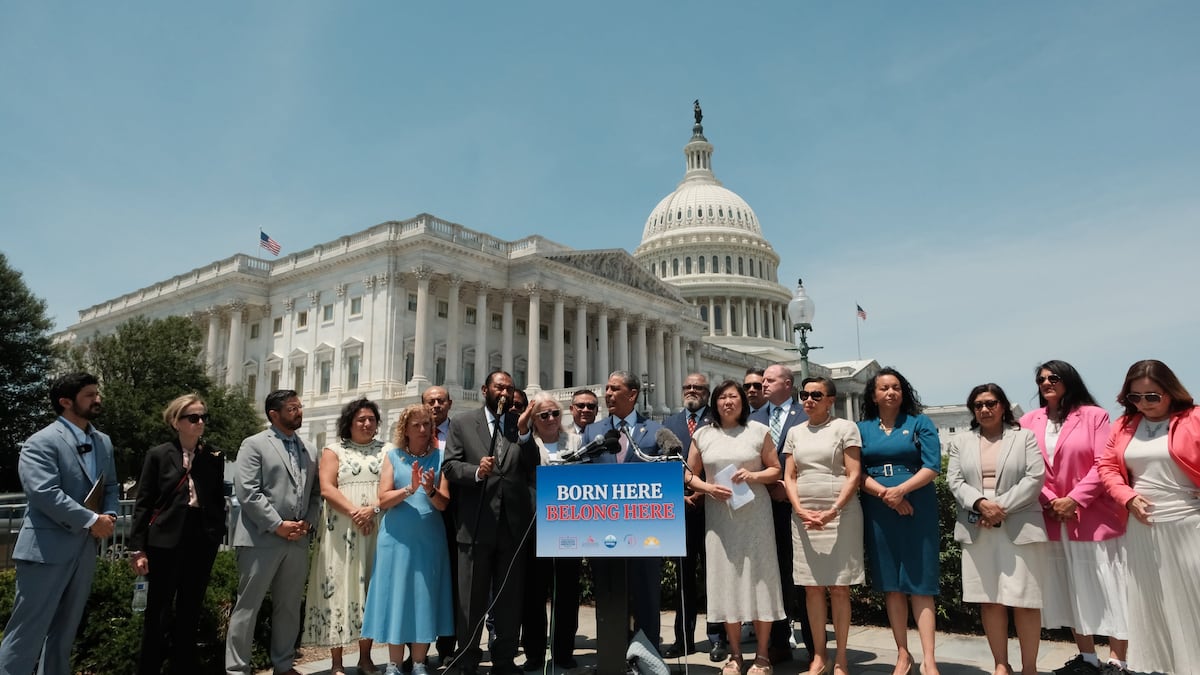
Latinos became central figures inside and outside Congress in last Tuesday’s midterm elections. Beyond Capitol Hill, their leftward shift helped secure Democratic victories; inside, they won a record number of seats. The Congressional Hispanic Caucus (CHC), which brings together Hispanic Democratic lawmakers, will have more members than ever.“In December, the CHC will celebrate its 50th anniversary with more than 50 incoming Members joining our ranks, making this the largest Congressional Hispanic Caucus in history. This milestone is a testament to the communities, generations of leaders, and advocates who fought to ensure that Latinos have a seat at the table and a voice in shaping our nation’s future,” the group said in a statement on November 4.At least 14 Hispanic Democrats were elected last Tuesday; 10 of them won in districts held by Republicans or that had been redrawn to favor the Republican Party.“This victory was decided by Latinos who were fed up, frustrated and under economic attack — especially when it comes to healthcare, not being able to afford groceries, or struggling to put gas in their car, given that we have seen fuel prices skyrocket to exorbitant levels as a result of this reckless war in Iran — particularly here, in my district, in San Antonio,” Johnny García, one of the Latinos who will join the House of Representatives in January, said yesterday in a videoconference.García won in Texas’s 35th district, where 57% of the population is Latino. It is one of the districts that Republicans redrew to gain votes, but the result did not go as conservatives expected. “With the new map, Trump would have won by more than 10 points. But in a district like [García’s], the result depends on who shows up to vote, and it was Latinos who showed up,” said María Teresa Kumar, president of Voto Latino, an organization dedicated to registering Latino voters.Latino voters have long complained that neither party paid them proper attention, and in these midterms, they emerged as the demographic most likely to switch parties. Latinos turned out at the polls in record numbers and helped paint the U.S. political map blue.The cost of living, driven by higher gas and basic goods prices, was the factor that mattered most to their vote. García says he won by understanding voters who identified with him. He grew up in a working-class home raised by a single mother. He worked in construction and plumbing to pay for community college and later served in law enforcement in San Antonio. “When we talked about the impact of affordability — and how the affordability crisis is wreaking havoc in this district — I knew I had to convey the frustration people feel here, on the ground,” García said; he defeated Republican candidate Carlos De La Cruz.De La Cruz’s sister, Mónica de la Cruz, also lost her race to Democrat Bobby Pulido, the Texas singer who took the seat in that state’s 15th district, which became the prime example of Democrats’ overwhelming victories nationwide.Other Latinos who will sit in the House for the first time include Patty García, the first Hispanic to win Illinois’s 4th district; Teresa Benitez-Thompson, who won Nevada’s 2nd district; and Manny Rutinel, who prevailed in Colorado’s competitive 8th district after defeating Republican Representative Gabe Evans, who is also of Hispanic origin.Rutinel, the son of a Dominican immigrant, said Latinos voted for him because he understands their economic concerns after growing up in a family that at times struggled to make ends meet. “I think they elected me because they know this is deeply personal for me,” he said.In House districts where at least one-quarter of the citizen voting-age population is Hispanic, the share of Democratic votes in the midterms exceeded, on average, the performance of the Democratic presidential candidate, Kamala Harris, in 2024 by about 11 percentage points. By contrast, in other House districts the increase was seven percentage points.The Democratic Congressional Campaign Committee (DCCC) celebrated the wins by the Latino candidates it backed. The DCCC invested in the most competitive contests, including races in Texas, North Carolina, Nevada, Nebraska, California, Colorado, and Arizona. “While rejection of two years of Republican governance was evident across the country, make no mistake: we also won district by district thanks to our extraordinary candidates; they were, in fact, the key to our success — what I call our ‘secret ingredient,’” said Representative Suzan DelBene, chair of the DCCC.One of their bets was JoAnna Mendoza, the Hispanic candidate who won Arizona’s 6th district. The daughter of farmworkers and a single mother, Mendoza served 20 years in the Navy and with the Marines. Mendoza defeated Representative Juan Ciscomani, a Republican serving his second term, in a highly competitive district in the state’s southeast.More Garcías than SmithsSenator Ben Ray Luján (Democrat of New Mexico), Representative Teresa Leger Fernández (Democrat of New Mexico), Representative Gabe Vásquez (Democrat of New Mexico) and Representative Adelita Grijalva (Democrat of Arizona) — all CHC members — were reelected on Tuesday night. “There are now more Garcías than Smiths in Congress,” Kumar joked.The CHC dedicated the victory to activist Dolores Huerta, who died last month at 96 and “whose courage and lifelong commitment to justice taught generations that our rights must be fought for, our voices must be heard, and our communities must never be counted out,” the committee wrote.Democratic Latinos also notched wins in gubernatorial races. Xavier Becerra was elected as the first Hispanic governor of California, and Gina Hinojosa will be the first Latina governor of Texas.Sign up for our weekly newsletter to get more English-language news coverage from EL PAÍS USA Edition
Latinos grow stronger in Congress with over 50 representatives
Full Article
Original Source
Read the full article at English →KhanList aggregates and links to publicly available news content. We do not host full articles from third-party sources. Always verify important information with original sources.