
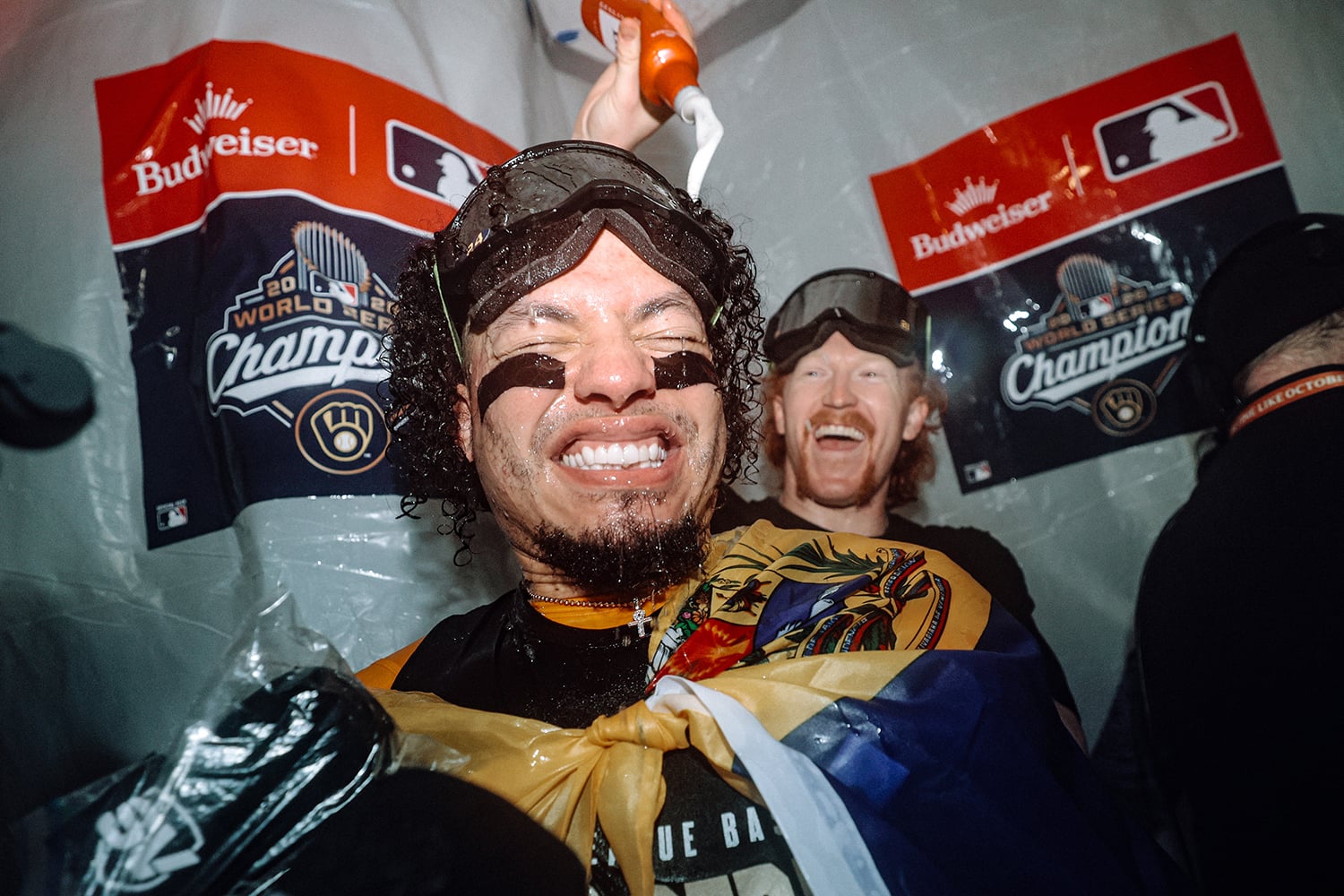
The Milwaukee Brewers won the MLB World Series against the Tampa Bay Rays on Wednesday night after a five-game final matchup that gripped U.S. audiences. But beyond the excitement of the games, another story unfolded on the field. Some of the most compelling figures of the United States’ national pastime began their journeys thousands of miles away, in the neighborhoods and ballparks of Latin America. Consider Milwaukee’s Jackson Chourio and William Contreras, both of whom are from Venezuela. Tampa Bay features Dominican stars Junior Caminero and Freddy Peralta, Cuban players Yandy Díaz and Victor Mesa Jr., and Mexico’s Jonathan Aranda. Their presence reflects how baseball has become one of the most enduring cultural and economic connections between the United States and Latin America, even at a time when those ties are being threatened by an administration that is deeply hostile to immigration. Chourio’s journey began in Maracaibo, Venezuela. He started playing baseball in 2008, at the age of 4. He was encouraged by his father, a former player who shares his name. By age 12, Chourio believed that he could make a career out of baseball, and at 14, he was already attracting the attention of U.S. major-league scouts. His athletic ability impressed Milwaukee’s staff, although he did not always perform well in early evaluations. At one showcase in 2018, he struck out in his first two times at bat before demonstrating the speed and hitting ability that convinced the scouts that they had discovered someone special. The Brewers signed Chourio in January 2021, when he was just 16, paying him a $1.8 million signing bonus. He spent the next three seasons climbing through their minor-league system, beginning in the Dominican Republic and eventually playing for teams in North Carolina, Wisconsin, Mississippi, and Tennessee. He joined the major leagues in 2024, shortly after his 20th birthday. Today, he is one of the most recognizable athletes in Wisconsin. Tampa Bay’s Caminero grew up in the Dominican Republic’s capital of Santo Domingo, less than 10 minutes from Quisqueya Juan Marichal stadium, where two of the country’s most celebrated professional teams play. Caminero was such an enthusiastic New York Yankees fan that, when his parents had another son, he persuaded them to name the boy Girardi, after Yankees manager Joe Girardi. Caminero’s is a wonderfully Dominican baseball story and an equally revealing American one. He grew up following MLB, idolizing players who had already made the journey to the United States. As MLB’s account of his childhood makes clear, the U.S. game was woven into his family life long before he ever signed a professional contract. Yet he also grew up in a country with its own proud baseball traditions, professional teams, and devoted fans. Several young children wearing baseball gloves stand in a grassy field with trees and small buildings in the background. Some of them stand with wide stances and their gloves in the air as they prepare to catch. Dominican children shield their eyes while playing in San Pedro de Macoris, Dominican Republic, on Jan. 17, 1986.Manny Millan /Sports Illustrated via Getty Image Latin America has made considerable contributions to U.S. baseball. According to MLB’s 2026 opening day statistics, 249 of the 948 players on major-league teams’ opening-day rosters were born outside the United States. The Dominican Republic led with 93 players, followed by Venezuela with 60 and Cuba with 20. Together, those three countries supplied nearly 70 percent of foreign-born players. These figures reflect generations of shared history. Baseball spread through the Caribbean and parts of Latin America in the 19th and early 20th centuries, carried by travelers, students, workers, and commercial relationships. Over time, countries developed their own leagues, sporting traditions, and national heroes. What began as an American game became something distinctly Cuban, Dominican, Nicaraguan, Puerto Rican, and Venezuelan. Baseball occupies a place in public life in these countries that outsiders can easily underestimate. In Nicaragua, baseball heroes have become national figures. During the 1990s, when Nicaragua briefly transitioned to democracy, U.S. Ambassador John Maisto would go on live radio in Managua on Fridays at noon to discuss the local baseball teams. I served as a U.S. diplomat in the country and remember how those appearances made Maisto a local celebrity. In 1998, the Nicaraguan government officially named the national stadium in the capital of Managua for Dennis Martínez, the first Nicaraguan to play in the U.S. major leagues. Martínez had pitched a perfect game in 1991, becoming the first pitcher born outside the United States to accomplish the feat. The stadium’s name was a fitting tribute to a national hero—and a reminder of the importance of baseball in the country’s collective imagination. In Cuba, baseball has additional historical and political significance. It has remained a national passion through six decades of difficult relations with the United States. Fidel Castro himself was an avid fan—and he was falsely rumored to have been scouted by MLB prior to his revolutionary days. Yet for years, Cuban players have faced legal and political restrictions from both governments that prevent U.S. teams from recruiting them in the same way that they recruit players elsewhere in Latin America. Many have had to establish themselves outside Cuba before signing professional contracts. A black-and-white action shot of Castro swinging a bat on a dirt field, with a catcher crouching behind home plate and a chain-link fence in the background. Fidel Castro takes a cut at the plate during a sandlot baseball game in Cuba on March 10, 1961.Bettmann Archive/Getty Images Venezuelan players face their own hurdles. U.S. teams once operated baseball academies throughout the country, but violence, economic instability, and political turmoil over the past decade led them to withdraw. But teams continued scouting promising Venezuelan players, often developing them through facilities in the Dominican Republic. Chourio’s career followed that route. A 2018 agreement between MLB and Cuba’s baseball federation intended to provide a safer, legal route for Cuban players to sign with U.S. teams. But the U.S. government blocked it the following year. Still, the game itself remains a connection that political disagreements have not extinguished. Tampa Bay’s Díaz and Mesa are part of that continuing relationship. If there were any doubts that baseball belongs as much to Latin America as it does to the United States, this year’s World Baseball Classic provided a convincing answer. In March, Venezuela defeated the United States for the title with a 3-2 win in Miami—its first championship in the tournament. The game was tied in the eighth inning after a two-run home run by U.S. star Bryce Harper, but Venezuelan hitter Eugenio Suárez delivered the winning run with a double in the ninth. A dense crowd of ecstatic fans cheering and celebrating with raised hands and joyful expressions in an outdoor setting at night. A woman near the front is clapping and shouting, while a young boy standing next to her has his hands pressed to the baseball cap on his head and an expression of surprise. Venezuelan fans celebrate their national baseball team’s victory in the final of the 2026 World Baseball Classic against the United States, seen in Caracas on March 17. Juan Barreto/AFP via Getty Images The celebration reflected something more profound than a sporting victory. For Venezuelans at home and throughout the diaspora, the championship offered an opportunity to unite around a common national identity, regardless of political and class differences. Venezuela was not simply supplying players to MLB teams—it was defeating the United States at its own national pastime, under the Venezuelan flag, and before an international audience. The tournament demonstrated how far baseball has traveled from its U.S. origins, and how thoroughly Latin American countries have made it their own. There is a substantial economic story behind the players on the World Series rosters. MLB’s international scouting and development system has created a remarkable market for athletic talent. U.S. clubs invest in training facilities and recruitment networks in other countries, while talented young players pursue opportunities that can transform their families’ circumstances. But not everyone enjoys the success that the likes of Chourio do. A September ProPublica investigation examined the recruitment of young Dominican players and documented serious problems involving early informal agreements with players, financial intermediaries, and diversion of signing bonuses. ProPublica did not establish that MLB itself diverted the signing bonuses. The investigation concerned a network of private trainers, intermediaries, and lenders surrounding young Dominican players and their families. According to MLB data cited in the investigation, fewer than 10 percent of Dominican prospects who sign professional contracts ever reach the U.S. major leagues. Those intermediary trainers and lenders may claim substantial portions of the money that young players expect to receive, while some children sacrifice years of education pursuing a professional career that might never materialize. Private trainers may have extensive relationships with MLB scouts, but that does not automatically make them employees, agents, or contractors of MLB organizations. A nighttime stadium view from the stands filled with cheering spectators seen from behind as they watch the game, with a large flag raised in the foreground under bright floodlights. A fan waves the Puerto Rican flag before a game against Cuba at the World Baseball Classic in San Juan, Puerto Rico, on March 10, 2006. Al Bello/Getty Images ProPublica’s findings do not diminish the achievements of Latin American baseball stars. They are a reminder that a system capable of producing enormous opportunity can also expose vulnerable young people to risk. The economic relationships between the United States and Latin America are often similarly complicated. Baseball is not a substitute for diplomacy, trade agreements, or immigration policy. Nor should we exaggerate the ability of sports to overcome political disagreements. The economic interests of U.S. baseball franchises do not always coincide with those of the Latin American communities supplying their players. Nevertheless, the game illustrates how deeply connected various cultures in the Western Hemisphere have become—independent of government action. Baseball is not simply entertainment imported from the United States: It belongs to the people who play it, follow it, and pass it from one generation to the next. These connections are particularly visible in the way that U.S. fans embrace players from abroad. Brewers supporters need not know the details of Chourio’s childhood in Maracaibo to appreciate his performance in the outfield. Tampa Bay fans celebrate Caminero because of what he accomplishes at home plate. Yet behind those achievements are families, communities, and countries whose contributions have become indispensable to U.S. professional sport. The World Series offers a particularly vivid reminder that—for all of the tensions between the United States and Latin American countries over issues such as immigration, trade, and security—there is something larger about the hemisphere that we all share.
(Latin) America’s Pastime
Full Article
Original Source
Read the full article at Foreignpolicy →KhanList aggregates and links to publicly available news content. We do not host full articles from third-party sources. Always verify important information with original sources.