
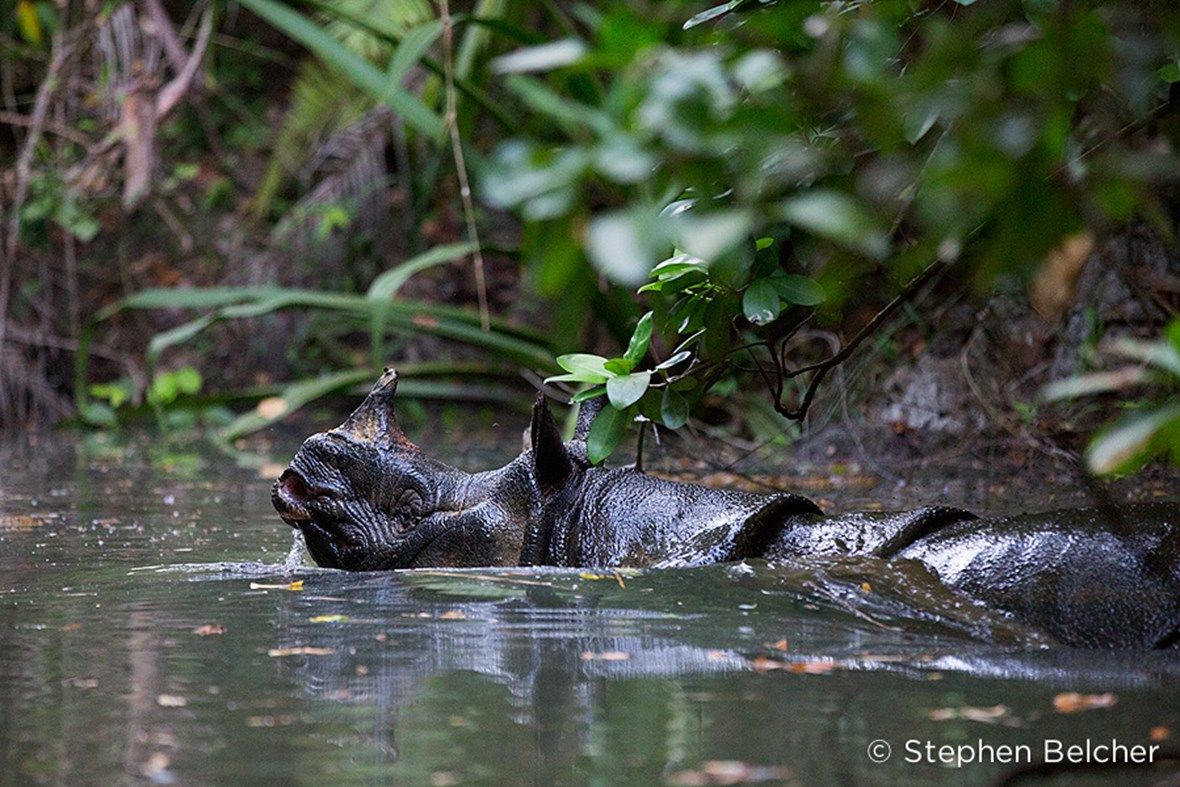
Indonesian lawmakers and environmental groups are urging the government to revoke a mining designation covering part of the waters around Ujung Kulon National Park, the last refuge of the critically endangered Javan rhino.The designation, issued by the energy ministry in February, has drawn renewed scrutiny following a proposal by President Prabowo Subianto’s brother to relocate some of the rhinos to another national park at the other end of Java Island.Conservationists say establishing a second population is important for the species’ long-term survival, but warn that moving animals from an already small and vulnerable population to a site not yet proven suitable for them carries significant risks.Experts are mixed on the urgency and approach to relocation, but emphasize that any move must be guided by rigorous scientific assessments of habitat suitability, genetics, animal health, and transport risks. JAKARTA — Indonesian lawmakers and environmental groups are urging the government to revoke a mining map covering part of the waters around Ujung Kulon National Park, home to the world’s last surviving Javan rhinos. The calls were in response to a proposal by Hashim Djojohadikusumo, a mining and energy tycoon and the brother of President Prabowo Subianto, to move some Javan rhinos (Rhinoceros sondaicus) from Ujung Kulon at the western tip of Java to Alas Purwo National Park at the other end of the island. Hashim made the statement during the COP31 U.N. climate summit in Türkiye on Nov. 12, in his role as the Indonesian government’s special envoy for climate and energy. He cited natural disasters as a major threat to the species, making the need for a translocation necessary. “If there is a tsunami due to an earthquake or a volcanic eruption, our Javan rhinos can go extinct,” he said. The national park is located around 70 kilometers (43 miles) from Anak Krakatau, a highly active volcano in the Sunda Strait that’s the remnant of the famous Krakatau. An eruption in December 2018 sheared off part of the slope of Anak Krakatua, leading to a landslide that triggered a tsunami. The waves radiated to Java and Sumatra, killing more than 420 people on both islands. None of the 68 rhinos at Ujung Kulon were affected, it was reported at the time. President Prabowo Subianto, right, confers a civilian honor on his brother, Hashim Djojohadikusumo, at the State Palace in Jakarta on Aug. 28, 2025. Image courtesy of the Office of the Indonesian Presidency. Hashim’s statement brought public attention to a recent decree from the energy ministry rezoning areas in Banten province, where Ujung Kulon is located, for future mining activity. The decree, issued in February this year, classified part of the sea around the park as a “mining business area,” a step that lets the government later carve out those zones as corporate mining concessions. Greenpeace Indonesia called on the government to revoke the decree, saying it ignores environmental and local conditions and borders the customary territory of the Indigenous Baduy people. Walhi, Indonesia’s biggest environmental advocacy group, said it’s considering filing both a letter of objection to the government and a lawsuit to have the decree revoked. Some lawmakers have also urged the government to cancel the decree, saying economic interests should not come at the expense of nature. “Just revoke that decree first,” Rieke Diah Pitaloka, who sits on the parliamentary committee on human rights and regulatory reform, said at a Nov. 18 hearing. She also urged the energy ministry to publish the digital map of the rezoned areas and the scientific justification for the rezoning decision. The ministry said the designation stems from a 2013 request from the Banten provincial government. It added that no mining permits have been issued for land inside the national park or its waters, and that the park itself is not a mining zone. A Javan rhino in Ujung Kulon National Park. Image courtesy of Indonesian Ministry of Forestry. Banten Governor Andra Soni said the decree doesn’t automatically allow for mineral exploration, but stopped short of saying whether he supported calls to revoke it. According to the forestry ministry, Alas Purwo, at the eastern tip of Java, has long been one of the sites being studied as a second habitat for the rhinos, but no decision has been made on translocating any of the animals. The government has since said it will not move any rhinos without a comprehensive study confirming that a site is suitable. Second population site The Javan rhino once ranged from India through Myanmar, Thailand, and Malaysia. Today, it has disappeared from nearly all of that range, with its last population outside Java, in Vietnam, declared extinct in 2010. In Ujung Kulon, poaching slashed the population by about a third between 2019 and 2023, according to the International Rhino Foundation, and a population viability analysis forecasts the species could go extinct within five decades. With only about 50 Javan rhinos left, all living in Ujung Kulon, establishing a second population site is critical to the species’ long-term survival, experts said. The push for a second population began as far back as the 1980s. In 2015, an assessment organized by the International Rhino Foundation, WWF and the IUCN, the global wildlife conservation authority, set a goal of having at least 80 rhinos in at least two sites by 2025 — a target that’s nowhere near close to being achieved. Indonesian conservation authorities, working with the International Rhino Foundation, WWF, and local NGO Yayasan Badak Indonesia (YABI), established the Javan Rhino Study and Conservation Area (JRSCA), a roughly 5,100-hectare (12,600-acre) site within Ujung Kulon National Park, in 2010 to expand the animals’ habitat and support intensive breeding. In late August 2025, the authorities announced a program with the Indonesian military and YABI to eventually move a male and a female rhino to the area. They said the translocation was intended to establish a second population and improve genetic diversity, setting a target of achieving this by 2029. Establishing a second population site will require careful planning, including on the questions of when and where to move the animals. Timer Manurung of conservation group Auriga Nusantara, whose 2023 investigation helped bring to light a rhino poaching operation in Ujung Kulon that later led to convictions, warned that moving rhinos out of the park in as little as five years would be “clearly very dangerous.” “The current population in Ujung Kulon needs to grow and is not sufficient to take [away] even one rhino, let alone several, for relocation elsewhere,” Timer told Mongabay. He cited the death of Musofa, the first Javan rhino translocated under the conservation program. In November 2025, the rhino was moved to the JRSCA, about 20 km (12 mi) from where he was captured. However, his condition immediately deteriorated, and he died two days after arriving at the new location. A necropsy found he had chronic illnesses and a severe parasitic infection. Wildlife experts later said the stress of capture and relocation could aggravate underlying health problems. Rangers patrol the forest of Ujung Kulon National Park, the sole habitat for the world’s remaining Javan rhinos. Image by Rhett A. Butler/Mongabay. That incident, Timer said, underscored the risks of moving the critically endangered animals, particularly over much greater distances. He also questioned the suitability of Alas Purwo, about 1,400 km (870 mi) away, saying he had seen no study demonstrating that the area could support the species. John Payne, CEO of the Borneo Rhino Alliance, who has worked on Southeast Asia’s rhino species since 1977, said Musofa’s death should not deter Indonesia from pursuing a second Javan rhino population site, arguing that translocation remains a necessary conservation strategy. He attributed the failed operation to poor management, including involving too many people and lacking an experienced veterinarian in charge. Payne noted that the idea of establishing a second rhino site had been discussed for more than four decades, while threats to the Ujung Kulon population, including poaching and a potential eruption of Anak Krakatau, remained unresolved. He said the remaining rhinos are already highly inbred, but argued this should not prevent relocation, saying even one male and two female animals would be acceptable for starting a new population. He also urged stakeholders to consider Hashim’s relocation proposal separately from concerns over mining. “If Indonesia wants more Javan rhinos, that will never happen by leaving them all inside Ujung Kulon,” Payne told Mongabay. Ronny Rachman Noor, an ecological genetics expert at the Bogor Institute of Agriculture, just outside Jakarta, said any plan to establish a second Javan rhino population should be guided by comprehensive scientific assessments. In comments published on the university’s website on Nov. 17, he said a second habitat makes sense in principle, but evaluating one requires more than assessing forest cover and available space. Researchers would also need to examine food availability, carrying capacity, infectious disease risks, and interactions with resident wildlife. Ronny said any decision should also rest on studies of the animals’ genetics, health, and behavior, along with careful planning for capture and transport to minimize risks such as capture myopathy, a potentially fatal condition caused by severe stress. “The move must follow strict risk-mitigation protocols,” Ronny said, adding that translocation shouldn’t end at the point of release, but should be followed by long-term monitoring. Banner image: A Javan rhino takes a dip in the Cigenter River in Ujung Kulon National Park. Image courtesy of Stephen Belcher via Ujung Kulon National Park Agency. Basten Gokkon is a senior staff writer for Indonesia at Mongabay. See related story: Search for a new home for Javan rhinos put on hold FEEDBACK: Use this form to send a message to the author of this post. If you want to post a public comment, you can do that at the bottom of the page. Credits Topics
Last Javan rhino habitat caught between mining plans and relocation debate
Full Article
Original Source
Read the full article at News →KhanList aggregates and links to publicly available news content. We do not host full articles from third-party sources. Always verify important information with original sources.