
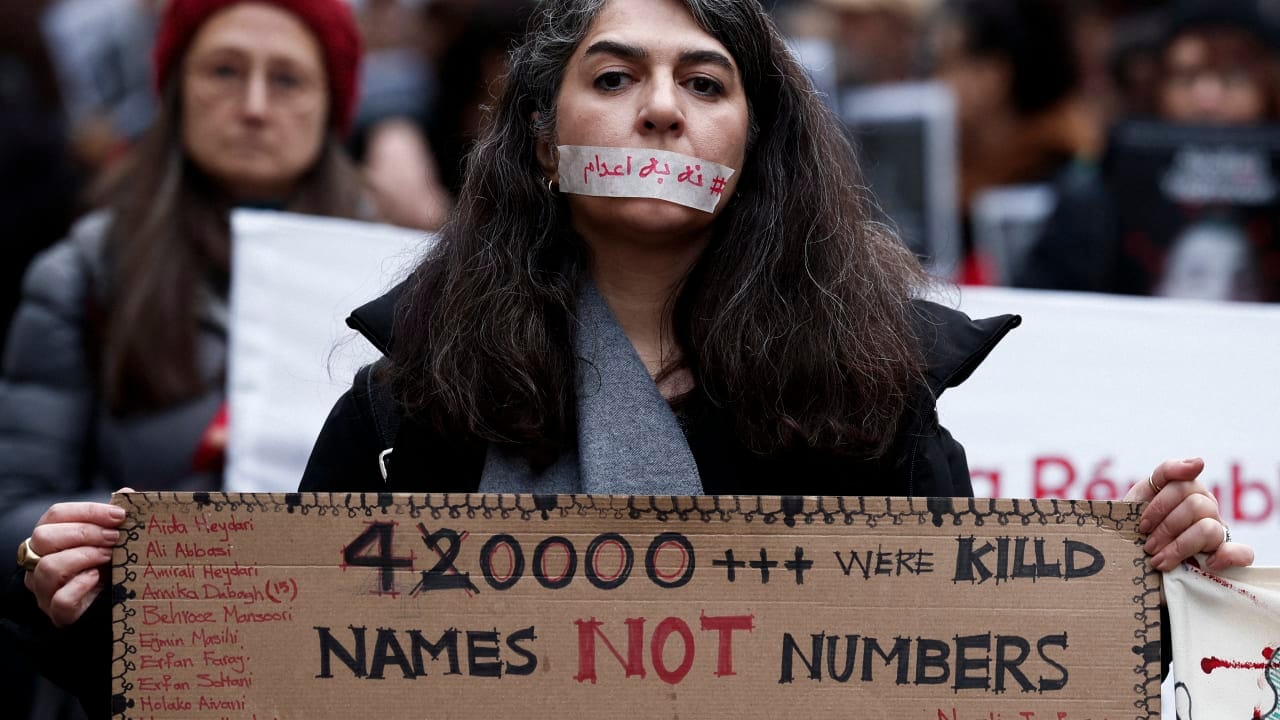
SEPTEMBER 15, 2026 15:46For Iranians, the disappearance of mass demonstrations from the streets does not mean the end of the regime’s crackdown. Far from it.Since the turn of the year, more than 950 people have been executed in Iran, including at least 29 people arrested in connection with January’s protests, which left thousands dead across the country. Months later, scores of those detained remain at risk of execution.Now, a new campaign is spreading among Iranian opposition activists.Known as “Last Breath” (akharin nafas in Persian), the campaign has begun appearing across Iranian social media over the past several days, and its premise is relatively straightforward: take the name and photograph of somebody facing execution, tell their story and push it as widely as possible among politicians, journalists, human rights organizations and the wider public.It puts a face to each name and allows individual stories to be told, rather than allowing those condemned to become merely another statistic.People rally and hold a vigil to honor those killed during the nationwide protests in Iran, outside the White House in Washington, DC, US, January 16, 2026 (credit: Reuters/Kylie Cooper)“They breathe behind prison walls, not knowing which sunrise will be their last,” read one Persian-language appeal circulated under the campaign. It urged supporters to call, send emails, publish prisoners' photographs and names, and demand action from those contacted.Another of the campaign's early posts contained an expanding list of people said to be facing execution, including Ehsan Hosseinipour, Matin Mohammadi, Erfan Amiri, Hamidreza Fathi, Abdolreza Fathi, Saeed Zarei Kordshouli, Peyman Ganji, Erfan Khalili, Ali-Akbar Mahlouji and others.“These are not just names,” the appeal said. “They are lives in imminent danger.”Campaign spreads with posts in English, French, GermanThe campaign has already moved beyond Persian, with posts carrying the Last Breath hashtag appearing in English, French and German, suggesting that participants are trying to take the cases beyond the mobilized Iranian diaspora and into the wider international conversation.One of the central images of the Last Breath campaign is that of sunrise.For most, dawn represents the beginning of another day. In Iran's prisons, however, the early morning has long carried the association with executions, which are frequently carried out in the Islamic Republic at or around dawn. Iranian human rights organizations routinely record executions taking place in the early hours, while two protesters, Abolfazl Sepahi Badjani and Amir Hossein Safari Hosseinabadi, were publicly hanged at dawn in Isfahan's Alikhani Square on July 28.That contrast - between sunrise as a symbol of hope and the executions carried out by the Islamic Republic – lies at the heart of the campaign.“Sunrise should bring a new day, not a final breath,” one campaign appeal said of Alireza Sepahi and Mahdi Zarif, both facing execution.Sepahi was arrested in connection with the January 8 protests at Alikhani Square in Isfahan and sentenced to death alongside a group of other defendants. Five of those co-defendants have already been executed. Sepahi himself came extraordinarily close. According to human rights organizations, he suffered a heart attack shortly before his scheduled public execution and was rushed to hospital. He was later returned to prison.On September 12, Iran Human Rights reported that Sepahi had been moved from the general ward of Isfahan Central Prison to solitary confinement, where prisoners condemned to death are frequently transferred before execution. The organization said he was consequently at imminent risk.Another whose name has become prominent in the campaign is Benyamin Naghdi, a 26-year-old kickboxer and mixed martial arts athlete arrested during the January protests in Shiraz.“Medals belong around Benyamin Naghdi's neck, not a noose,” one Last Breath appeal said.Iran Human Rights reported in June that Naghdi, then 26, had been arrested on January 3 during a protest in Shiraz and sentenced to death by Branch One of the city's Revolutionary Court after being convicted of “corruption on earth.”The organization said Iranian state media broadcast what it described as a forced confession only a day after his arrest.Campaign aims to internationalize individual casesHis story also brings to the fore the campaign's attempt to internationalize individual cases.Iranian-French chess grandmaster Mitra Hejazipour used the Last Breath hashtag in a French-language appeal describing Naghdi as a kickboxing champion who “must live,” tying his case once again to the campaign's recurring image of sunrise and execution.Perhaps the most immediately personal story circulating through Last Breath is that of Taraneh Rahimi, a 20-year-old woman who has been sentenced to death following her arrest after the January protests.Rahimi and her twin sister, Romina, were arrested after participating in demonstrations in Isfahan.According to reporting based on accounts from their family, both women were subjected to severe abuse in detention. Their US-based cousin said their mother barely recognized them when she was eventually allowed to see them in prison. Taraneh has been sentenced to death, while Romina received a 25-year prison sentence.In a French-language post circulated thousands of times, Hejazipour in particular highlighted the person behind the name: Taraneh is 20, she rides horses, and while most people of that age might think about their next competition or future plans, she is waiting under a death sentence.Last Breath’s strength lies in simplicity - one does not need to be an Iran expert, understand the complexities of the revolutionary courts or opposition politics to comprehend that the person you see in front of you is at imminent risk of execution.It makes the victims difficult to ignore, which is the point.That can already be seen in the multilingual posts circulating online. Taraneh Rahimi becomes the 20-year-old who loves horses. Benyamin Naghdi becomes the fighter whose medals, campaigners say, should hang around his neck instead of a noose. Alireza Sepahi becomes the man who has already suffered a heart attack once at the foot of the gallows.In a country where information from prisons can be difficult to verify, the legal details remain important, but the campaign is built on the calculation that statistics eventually lose their power to shock.Hundreds of executions can become a generality, while the life story of a 20-year-old woman waiting to learn whether she will be hanged is harder to ignore. For the prisoners whose names and photographs are now being circulated around the world, every sunrise means another day survived, and, campaigners fear, one of them may be the last.Follow us on Google
‘Last Breath’: The campaign giving Iran’s condemned a face and a name
Full Article
Original Source
Read the full article at Jpost →KhanList aggregates and links to publicly available news content. We do not host full articles from third-party sources. Always verify important information with original sources.