
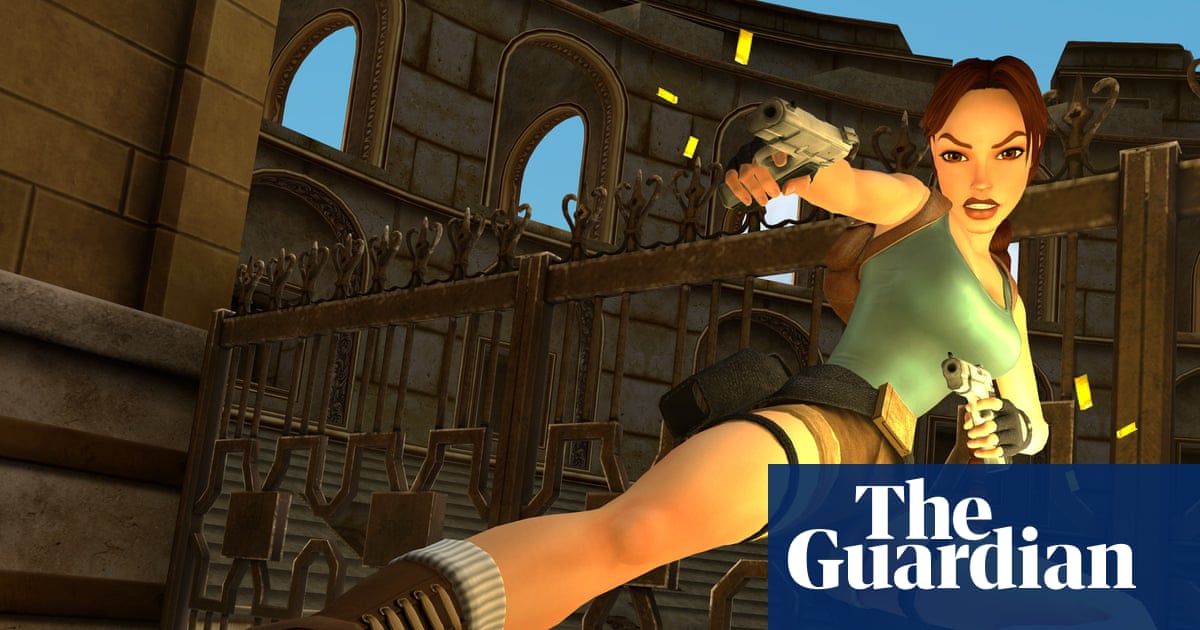
Happy birthday, Lara! This month marks 30 years since Ms Croft first swan-dived into our lives with her unique blend of athletic prowess, archaeological expertise and giant knockers. More than 100 million Tomb Raider games have been sold since. We all remember the good times: the bold design and sheer playability of the original titles; the establishment of Lara as a 90s icon, embodying both lads’ mag culture and girl power; the way she made games cool, even appearing on the cover of the Face. We’ve had blockbuster movies, big budget reboots, and shiny reissues. And who could forget the time we got to powerwash her house?But no one gets to 30 without a few skeletons in the closet – or in Lara’s case, butlers in the freezer. So here’s a look at the darker parts of her past.Lara Croft, corporate shillLara Croft sells Lucozade in 1999. Photograph: Core DesignLara’s image has been used to hawk a multitude of products over the years, from cereal and soft drinks to reasonably priced Spanish hatchbacks. Low points include the 1999 promo for a German women’s magazine in which Lara tells us what she really, really wants isn’t the Dagger of Xian or the MacGuffin of Atlantis, but a big meringuey wedding dress.See also the weird Dreamcast advert where Lara talks about the console as if it’s a jar of anti-ageing moisturiser. This led an entire generation of women to try reducing the appearance of fine lines by rubbing Sega hardware on their faces. Because she’s worth it? Let’s hope the money was.Murdered by her makers One last adventure … Tomb Raider: Chronicles. Photograph: Eidos InteractiveBack in 1996, no one predicted how successful this quiet game about a posh archaeologist made by a small team in Derby would be. But once publisher Eidos realised it was in possession of a goose that laid golden eggs, it launched an intensive battery farming operation. Core Design was forced to churn out a new Tomb Raider title every year.Four games in, the developers had had enough. In 1999 they decided to bury Lara under a collapsing pyramid at the end of The Last Revelation. News of her demise was tucked away towards the end of the design document, the Core team having taken a punt that their publisher overlords wouldn’t bother reading that far.They were correct. The Eidos execs were furious when they learned of Lara’s fate, but it was too late to change the game’s ending. Instead they put pressure on Core to find a narrative workaround so they could squeeze out one last PS1 adventure. The result was Tomb Raider: Chronicles, which begins with a memorial service for Lara and continues in a series of flashbacks. It is rubbish.Lara’s emo periodEmo Lara Croft with the reviled Kurtis Trent... Tomb Raider: Angel of Darkness Photograph: Core DesignLara’s first PS2 outing, The Angel of Darkness, was released in 2003. It was aiming for mature and edgy, but landed slap bang in the middle of dull and depressing.The game missed the point of what players loved about Tomb Raider – the thrill of exploring exotic locations and abandoned temples. No one asked to wander around a gloomy version of Paris that could pass for Croydon, talking to sex workers and pawn shop owners while dressed in double denim.It didn’t help that the game was full of bugs and had awful controls. A terrible new strength mechanic forced the player to build up Lara’s muscle before she could perform previously simple tasks, like moving a crate.To top it all off, a secondary protagonist was introduced: tiresome edgelord Kurtis Trent, whose toxic masculinity ruined the party for everyone. Which brings us to…Terrible sidekicksAbsolute liability … Jonah Maiava and Lara Croft in the TV series Tomb Raider: The Legend of Lara Croft, 2024. Photograph: COURTESY OF NETFLIXAnother key appeal of the original Tomb Raiders was the feeling of being a solo adventurer exploring a strange world, never knowing when the eerie silence would be shattered by the snarl of a hungry wolf. No one ever wished Lara was accompanied by a bloke in a padded gilet saying: “Hey, I wonder if that rusty key we found will fit in this rusty lock?”But when Crystal Dynamics took over from Core in the 00s, they decided Lara needed some annoying sidekicks. The worst offender is Jonah, who makes his debut in the 2013 reboot. Not only is he feckless and mansplainy, he actively creates work for Lara by being an absolute liability. Over the course of their adventures he gets trapped, tortured, stabbed, kidnapped, knocked unconscious, shipwrecked, buried in an avalanche, caught in a tsunami, falsely declared dead, and almost killed in a plane crash. Ironically, the only calamity that doesn’t befall Jonah is being swallowed by a whale. A shame.Big screen blundersNone of the Tomb Raider films are stellar – although many middle-aged women have a soft spot for the first Angelina Jolie outing, in which our hero dispatches an army of goons without having to leave the house, or even get out of her pyjamas.The follow-up, The Cradle of Life, is absolute twaddle. Philip French called it “repetitive and curiously inert”. The BBC’s Nev Pierce went further: “Incoherent, dumb and stupefyingly bland … It’s as though they wanted to make a terrible film.”Pierce went on to describe Lara as a “pumped-up Judith Chalmers”, which points to a missed casting opportunity – who wouldn’t want to watch the affable host of Wish You Were Here…? scale Angkor Wat with a grappling hook?Absolute twaddle … Angelina Jolie in Lara Croft: Tomb Raider – The Cradle of Life, 2003. Photograph: REUTERSPlayboy problemAlthough Chalmers never got the chance, plenty of other women were cast in the role of real-life Lara over the years. They included model Nell McAndrew, who donned the turquoise tank top to promote Tomb Raider III.Things went tits up when she also appeared in Playboy magazine, the game’s logo proudly displayed on the cover alongside the words: “LARA CROFT NUDE.”Core Design sued, unhappy that the video game character they had endowed with comically enormous breasts was being sexualised. They won – a judge ordered stickers be applied to 20,000 copies of the magazine, covering up the offending logo. It is not known how badly this affected sales among the Playboy readers eager to catch an illicit glimpse of unlicensed intellectual property.Reboot controversyLara Croft having a bad time in 2013’s Tomb Raider reboot. Photograph: Crystal Dynamics/Square-EnixThe 2013 Tomb Raider reboot was solid and polished. However, its creators failed to understand Lara’s appeal as a strong, enigmatic main character, particularly for female gamers.Art director Brian Horton talked about wanting to make players “care for” Lara. He said her torturous experiences and ripped clothing would show “beauty and vulnerability”, suggesting this was “sexy in its own way”.The controversy really kicked off after a trailer was released showing a man pinning Lara against a wall and groping her. Executive producer Ron Rosenberg said the sexual assault would make players want to “protect” the game’s protagonist, and “root for her in a way you wouldn’t root for a male character”. This focus on the male gaze and demotion of Lara to damsel in distress represented a staggering failure to read the room, and to notice there were women in it.Thirty years of hurt?There’s no doubt that Lara has endured some dark times over the last three decades. In fact, she’s had it harder than any other veteran video game character. No one ever suggested Solid Snake would have more appeal if he sported a gigantic pair of testicles, or insisted on giving Mario daddy issues. (Although, as annoying sidekicks go, Sonic the Hedgehog’s mate Tails gives Jonah a run for his gold rings.)Yet here she is, still standing, with another adventure arriving next year. Perhaps this one will tell Lara’s true origin story: how she rose to prominence not because of her prominent chest, or past traumas, but because she was the cool, enigmatic star of a bloody great game.Lara Croft remains a leading icon of gaming culture, despite the repeated failure of sexist developers and unimaginative marketing teams to understand her power. As someone born after she was created might say, that’s why Lara Croft is the GOAT – not just the greatest of all tomb raiders, but the greatest of all time.
Lara Croft is 30! We look at the video game icon’s biggest blunders
Full Article
Original Source
Read the full article at Theguardian →KhanList aggregates and links to publicly available news content. We do not host full articles from third-party sources. Always verify important information with original sources.