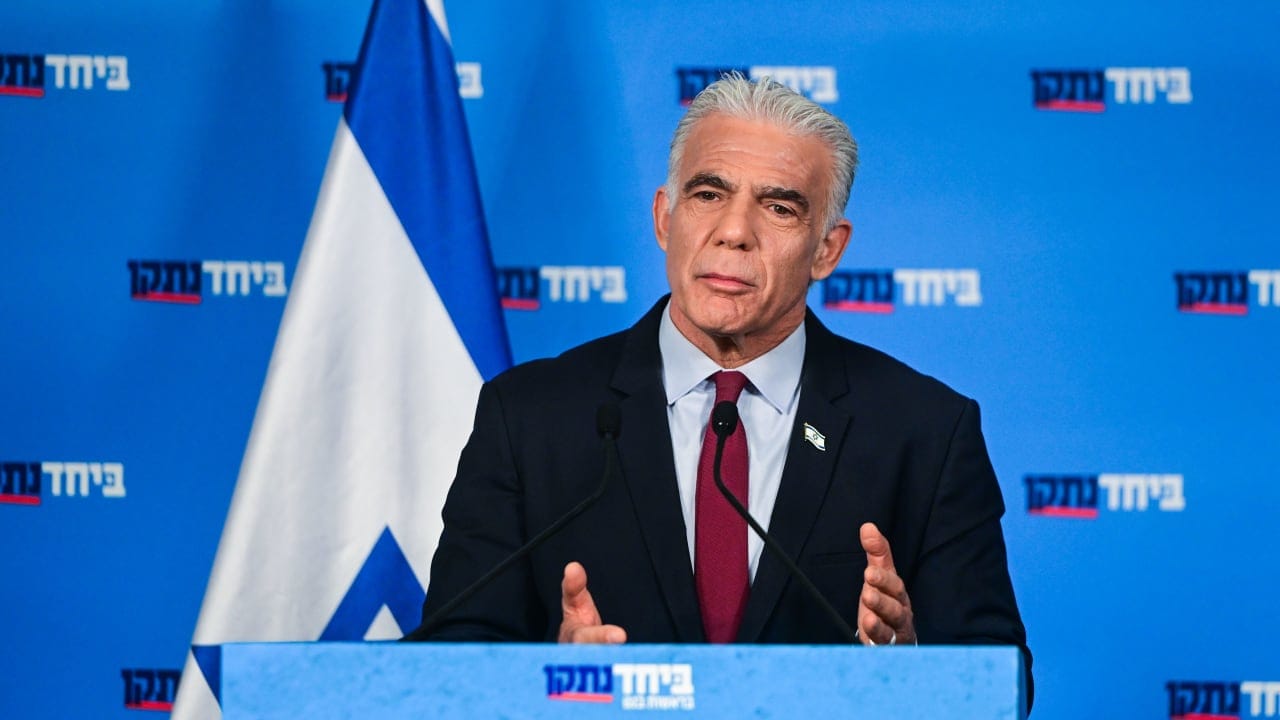
BySHIR PERETSAUGUST 19, 2026 18:01Opposition leader Yair Lapid presented a six-point plan for rebuilding Israel's foreign relations at the B'Yachad National Security Conference in Tel Aviv on Wednesday, warning that the country's international standing had entered a "disaster zone" and that foreign policy must be treated as an integral part of national security.Lapid said Israel's diplomatic relationships could bolster its access to advanced weapons, intelligence cooperation, technology, energy, scientific partnerships and global markets.He rejected the argument that the October 7 massacre alone explained Israel's diplomatic decline, accusing Prime Minister Benjamin Netanyahu's government of worsening the crisis through “negligence, arrogance, and amateurism."Lapid criticized the rotation of three foreign ministers over three years, the absence of a permanent head of Israel's national public diplomacy apparatus, and Netanyahu's handling of relations with US President Donald Trump.Despite this, he argued that the damage could still be reversed, as many foreign governments distinguish between Israel and its current government.Former Prime Minister and Together party leader Naftali Bennett is seen with Opposition Leader Yair Lapid as they arrive for a press conference as part of the B'Yachad party election campaign in Tel Aviv, central Israel, August 19, 2026. (credit: AVSHALOM SASSONI/FLASH90)"The positive part is that this means that things can be fixed," Lapid said. "There is long-term damage, but with the right management, the direction can be reversed in a relatively short time."First policy: Rebuilding relations with WashingtonLapid said Israel's first foreign policy priority must be restoring bipartisan support in the United States.He pointed to the July US House vote on military aid to Israel, in which an amendment sponsored by Rep. Thomas Massie (R- Kentucky) to cut off aid to Israel was defeated 314-104. Of those supporting the measure, 103 were Democrats.Additionally, Lapid cited polling showing weakening support for Israel among younger Republicans, arguing that the country is “in a disaster zone, and this disaster is not just because of antisemitism, it's not just because of the American left, and it's not just because of Qatar's influence."Israel should work not only with Democrats and Republicans in Washington, he said, but also conduct targeted outreach to younger Americans, Hispanics, African-Americans, evangelicals, academics and liberal Jewish communities.He also rejected the suggestion that Israel should allow its current security memorandum of understanding with Washington, which provides $38 billion over 10 years, to expire in 2028 without replacement, calling the abandonment of the agreement "a serious mistake by Netanyahu."Lapid proposed negotiating a new memorandum while also establishing a separate scientific and technological agreement covering small modular nuclear reactors, quantum technology and semiconductors.Second policy: Rebuilding relations with Europe, NATOThe second policy Lapid presented was rebuilding relations with Europe, particularly Germany, while deepening cooperation with NATO and engaging directly with public opinion in countries that have been highly critical of Israel, including Spain, France and Ireland.Lapid criticized Israel's diplomatic withdrawals from hostile capitals, saying Israel should maintain representation even where relations are difficult. Israel closed its embassy in Dublin in December 2024 after accusing the Irish government of pursuing extreme anti-Israel policies."We don't run away from a fight," Lapid said. "We stay on the battlefield even when it's difficult."Third policy: Repairing relations with Diaspora Jewry and regional tiesLapid named repairing relations with Diaspora Jewry as the third policy, describing the Diaspora as “family” and a strategic asset.He called on Israel to show greater respect for Reform and Conservative Judaism, merge the Diaspora Affairs Ministry into the Foreign Ministry, restore the post of special envoy to combat antisemitism, and establish a network of young Jewish "ambassadors" around the world.Fourth policy: Integrating Israel into the Middle EastThe fourth policy, he said, should involve deeper Israeli integration into the Middle East, with Egypt and the UAE serving as central partners.Lapid called for the revival of projects connected to the India-Middle East-Europe Economic Corridor, the Negev Forum and I2U2, as well as efforts to forge a common regional approach toward Iran.He also emphasized the importance of a peace agreement with Saudi Arabia as a major strategic objective, while warning that Israel must oppose uranium enrichment on Saudi soil because of the risk of triggering a regional nuclear arms race.At the same time, Lapid renewed his demand that Qatar be declared an enemy state, accusing Doha of supporting Hamas, funding terrorism and contributing to efforts to delegitimize Israel. Lapid introduced legislation seeking such a designation in February.Lapid also called for a clearer policy toward Turkey, particularly over its activities in Syria. He said Israel must make clear that it will defend its interests while establishing a mechanism to prevent unnecessary direct confrontation between the two regional powers."We do not need to create more and more regional conflicts, but to prevent them," he said.Fifth policy: Economy and public diplomacyLapid's fifth policy included integrating Israel's economic and foreign policy more closely.He proposed establishing an interministerial team bringing together the Foreign, Finance, Economy and Defense ministries with the Israel Innovation Authority to promote Israeli technology and defense industries abroad.Modern diplomacy, he argued, requires Israel to manage complex relationships with states that may cooperate with Jerusalem in some areas while maintaining close ties with its adversaries.India, he said, was a prime example because of its extensive security and economic relations with Israel alongside its ties with Iran.Sixth policy: Complete overhaul of Israel’s public diplomacy operationLapid's sixth policy called for a complete overhaul of Israel's public diplomacy operation, with greater emphasis on younger audiences, social media, and skilled communicators.He accused government ministers of damaging Israel's international standing through inflammatory statements and said Israeli officials failed to mount an adequate public diplomacy campaign alongside military operations."Good public diplomacy cannot rescue bad policy," Lapid said earlier in the speech, arguing that Israel's communications strategy could succeed only as part of a coherent foreign policy.Beyond the six priorities, Lapid called for greater engagement in the Indo-Pacific region, including technological and security dialogues with Singapore, Japan and South Korea, as well as efforts to create a diplomatic opening with Indonesia.Lapid concluded that Israel's domestic political character was inseparable from its ability to build partnerships overseas, saying the country must present itself as democratic, liberal, technologically advanced and governed by the rule of law."We need to give the world the opportunity to love the State of Israel and to want to work with us," he said."We need an advanced, liberal, technologically-driven and smart domestic policy, which can be transformed into a foreign policy that will strengthen the State of Israel against its enemies and strengthen our alliances with our friends."Follow us on Google
Lapid: Israel's foreign relations 'disaster,' must be considered integral part of national security
Full Article
Original Source
Read the full article at Jpost →KhanList aggregates and links to publicly available news content. We do not host full articles from third-party sources. Always verify important information with original sources.