
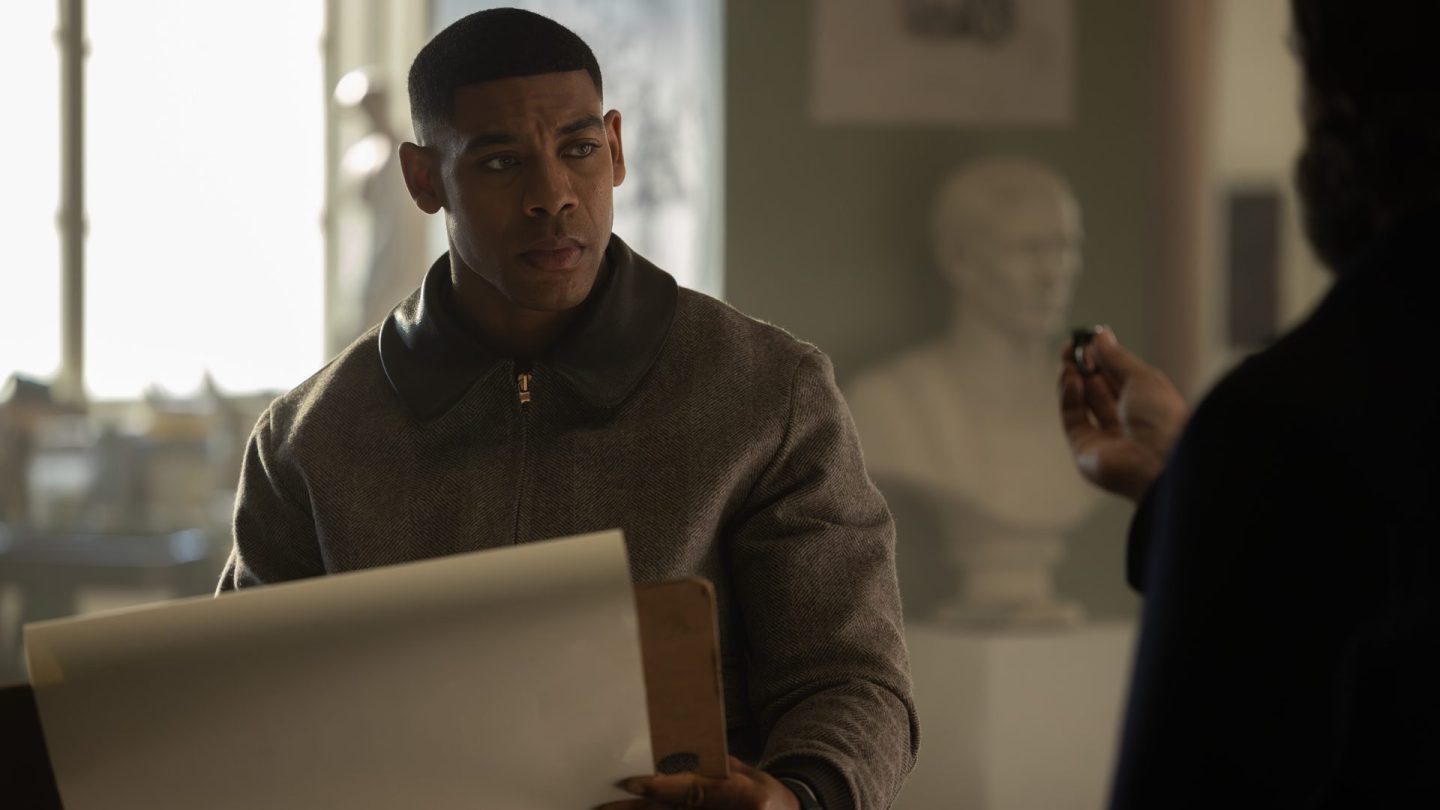
Logo text [This story contains spoilers from Lanterns episode three, “OutKast.”] The third episode of HBO Max’s Lanterns doesn’t just pay homage to OutKast, the legendary hip-hop duo from Atlanta, it also serves as metaphor symbolizing the isolation John Stewart Jr. felt as a child — and still feels as an adult in his pursuit to become the long-fabled Green Lantern superhero in the DC Comics. The episode, titled “OutKast,” shows not just how John Stewart’s parents raised him differently from his two older brothers, but also tries to explain why. Reminiscent of the discussions around Michael Jackson’s upbringing, this Lanterns episode has sparked specific conversations about parenting Black boys and children into greatness, and what actions constitute abusive or unhealthy parenting. (The hour also averaged a new series high, per the streamer: In just three days, more than 10 million viewers, with 7 million from the United States, watched the episode.) Because the Guardians cited fear, not race, as the primary factor for rejecting John Stewart Sr. (an excellent J. Alphonse Nicholson) as the Green Lantern in favor of Hal Jordan (Kyle Chandler), who is white, Bernadette (a powerful Jasmine Cephas Jones), on the Guardians’ guarantee their youngest son would get a fair shot if he’s fearless, becomes determined for John Jr. to succeed where his father failed. Testing John Jr.’s fearlessness throughout his childhood, John Sr. routinely pointed a gun at his son’s head, successfully shooting an apple off it, with the younger John never flinching. The HBO series, from Watchmen creator Damon Lindelof, Tom King, and series showrunner Chris Mundy, picks up on the racial awareness in the comics’ portrayal of John Stewart and takes it further, especially in this episode that digs deeper into the backstory of the John Stewart that Aaron Pierre portrays. Speaking to THR, Pierre shared his approach to portraying John Stewart: “The question I would ask myself is: How do you make an interesting portrayal of somebody who is seemingly as cool as an ocean breeze, but internally, there is a tornado going on? And that’s something that I wrestled with throughout the process.” Lanterns co-executive producer and writer Vanessa Baden Kelly, whom many remember as a child actress from Gullah Gullah Island and as the little sister on Kenan and Kel, admits to having anxiety around the episode she penned. “The week leading up to it, I was having heart palpitations,” she tells The Hollywood Reporter. “I was super nervous, just worried that the things we were hoping were going to land would, and that we would do the character justice. About two days beforehand, I started seeing some of the ‘woke’ commentary, and that started making my stomach turn a little bit. But Damon [Lindelof], who had been through this for The Watchmen, has been such a resource. He was like, ‘Hey, here’s this guy on TikTok that helps me breathe.’ I attempted to do that, and then the night of, I tried my best to stay off socials as much as I could. But, of course, I would keep taking peeks and get like an anxiety attack.” She’s a lot calmer since then. “Now it feels overwhelmingly positive,” she says. “It feels like people took from it the things they were supposed to take from it. It feels like it moves people in all the right ways. It feels like the debates around whether the Stewarts were abusive or not were the exact debates we were hoping to have.” Not everybody is pleased, shares Baden Kelly, who won a Daytime Emmy in 2019 for her role as Journee in the web series Giants, which tackled mental health and where she was also a writer. “There is still a contingent that’s really angry about it,” she says. “They are mad and they’re loud and they’re saying mean things, but that kind of just comes with the territory.” Baden Kelly spoke further with THR below about the pivotal episode, offering insight into the conversations in the writers room, why they leaned into the music of OutKast, what role her background as a child actor and mother played in her choices, and her personal takeaways. *** Your name was trending immediately after the episode aired, which is already impressive, but people also went and found your picture, and we don’t often see the writer get credit like this. That was weird. But in situations like that, you’re just grateful for the little two seconds you got. I haven’t really said anything myself other than just reposting cool things. I’m grateful that Chris [Mundy] and Damon [Lindelof] allowed us the freedom to write an episode like this, and gave me the freedom to make it what felt real to me. Hard stop. We all wrote this season together. I wasn’t solely in there [with] all these ideas myself. There’s a room full of writers and staff who are coming together and thinking about what rings true to us, and there are people asking questions, because there might have been things that ring true to me and Justin [Britt-Gibson] and other people were like, “Yeah, but I don’t get that. So, if a Guardian came down, she wouldn’t get that,” and us having to do that kind of back and forth. So while I might have been the writer on the episode, I certainly was not the only person who crafted everything that was in it. Let’s talk about OutKast. There are a lot of little milestones for OutKast this year. It’s the 30th anniversary of the ATLiens album and the 20th anniversary of their film Idlewild. So when did OutKast come into the process? And why was OutKast perfect for this episode? Well, I’m from Florida and I went to Florida State, so all Southern rap is very specific to me. It brings me back to a particular season in my life. But the thing that was really big for myself and for Justin Britt-Gibson, also another African American writer in the room, was that experience and our childhood kind of coming up and knowing exactly what we were doing when certain albums or songs came out. John Stewart is canonically from Detroit, so us in the South felt like he wasn’t necessarily listening to as much West Coast rap. There was probably some New York influences because that was nationally spinning at the time. But realistically, everybody we knew from that area was also listening to a lot of Southern stuff and stuff coming out of the Midwest, because it felt a little bit more akin to who we were at the time. So we were going through that, and Justin and I were immediately like, “ATLiens.” We played with a couple of other songs, too. Maybe the first song I picked was “SpottieOttieDopaliscious,” and Justin was like ‘No, it’s aliens, “ATLiens.” But we have “SpottieOttieDopaliscious” coming back later in the season. Another big thing was having to figure out what child actor was going to have to say, “Damn, damn, damn.” We let our actors show their chops. But they’re just such iconic songs. They’re ones that also embody who John Stewart is [in that] he is part of this mainstream phenomenon that was hip hop, but is so different and so singular and still so beloved, so it made sense to us that it would be OutKast. You were a child actor, and you are a mother as well. How much of that background played into this exploration of what it takes for a child to succeed in something big? It was the conversation more often than not. For my personal career, I was very lucky to not grow up with stage parents. Sometimes my parents or grandparents were so far the other direction that I probably could have had a bigger childhood career but they were just like, “you are not Webster.” That was their POV. They were like, ‘This is for college money.’ I think I believed in what I was going to be when I grew up more than they did. I think they believed that it was possible for me, but they also had seen the pitfalls and they were not pushing it any harder than I was, and there were times they put the brakes on. But now being a mom, and being a sports mom, my son plays competitive baseball, and I say all the time, baseball and sports parents are worse than stage parents because it feels so tangible and realistic. A scholarship is still a scholarship, and there’s so many to give out. So we talked about a lot of those things. We talked a lot about Tiger Woods’ dad, Serena and Venus Williams’ dad. We’ve more recently been talking about the Brunsons, who I actually think did it in the best way. Then, of course, we talked about the Jacksons, and about those people that have notoriously been known to be on what we consider the more abusive side of it. Aaron Pierre and Kyle Chandler in Lanterns. Courtesy of HBO What else did you talk about? We had real discussions about: Is there a necessity for it when you’re growing up in certain environments? If you’re growing up in Gary, Indiana, if you’re growing up in Compton, is this the smartest way to do it? Because even if they don’t make it all the way, there’s a different discipline. Does it fuck you up so bad that you’re not able to ever come back from it? And could they have done this in something else? Could they have done this in education? We had all those conversations. Because of my background and because I’m a mom, I continue to see such a plethora of this story play out. We talked ad nauseum about it, and I think in certain ways, we still are talking about it, right? The discourse raging online, watching people have the same debates we had in the room about whether this is abuse or whether they did what needed to be done is reminiscent of what we talked about for six months. Here the mother is more hardcore on John than the father, which is not the narrative we’re used to. We had those discussions as well. I was really interested in exploring the idea that, especially with sports moms, because I’m experiencing it a lot now with my son, the moms really are. I thought King Richard did this really lovely. When he was out with Venus because her star was rising faster, mom was out there doing the same shit he was doing with Serena. It wasn’t that they disagreed. They’re just the bigger personality, and maybe [the men] were the ones who had the initial vision. But, many times, the moms buy in. They’re just not the bigger voice. I was recently watching Steph Curry’s documentary [Stephen Curry: Underrated] with my son, and Sonya Curry was talking about how Steph wanted to give up that summer. That he needed to change [his] shot because he was small, and I immediately recognized her voice when she was like, “Look, if you want to quit, quit,” which is where some of this stuff came from for Bernadette. “But if you say you want this the way you want this, what your daddy is doing is what it takes. So you need to stop crying about it and get your ass back [out there].” These are not women who are coddling their children. They’re like, “When you come in, I’ll have protein ready for you.” The fact that those stories are often colored towards what otherwise seems like a father-son dynamic was interesting to extrapolate. The other thing I was really interested in seeing, and I think the room agreed, was when dads do it, it’s tough love. When a mom does it, people are like, “She’s terrible!” I wanted to play with that a little bit because it’s like, “Is she?” Or if he had been doing it, how much or how little of this would we be talking about? Now, granted, in their case, they were shooting apples off their child’s head, so that’s pushing it a little bit in a different direction. How gratifying is it to be able to give a character like John, with an actor like Aaron Pierre portraying him, this kind of backstory? So often with TV shows in the past with Black characters in, we had to imagine their backstory and didn’t get to see it. Honestly, it’s been an honor of a lifetime because Aaron’s John Stewart is going to live on in DC. He’s going to be my kid’s and his friends’ Green Lantern. That’s going to be their Black superhero of the next decade. Aaron obviously is about to leave the stratosphere himself, so to have a little slice of that to have been able to hopefully broaden what we’ve normally seen in the backstory before for Black superheroes. I definitely took a page from [Ryan] Coogler to just go in there and do what feels real and right. I was given the green light to do that by Damon and Chris, so I’m forever grateful. It’s specifically gratifying as a Black person, as a Black woman. But I am really sad that there are comic book fans that feel like we ruined it. I would caution anybody who feels like they know where the John Stewart story ends, based on episode three, to really make it through to the end. Because not only is he a Black man, he also goes through the very human experience of what it feels like to make your own decisions about the life that you’ve been given. As a Black woman, it’s a gift to my son: You might turn 30, and everything that I taught you, you may be like, “I disagree, mom. I think it should be this.” And you should have the freedom to do that. You should still be good afterwards, even if you decide that you want to be a completely different person than who I thought you were. And I think that’s universal. I just hope that people stick it out with John. *** Lanterns is now airing new episodes on HBO/HBO Max every Sunday until Oct 4.
‘Lanterns’ Writer Responds to Buzzy Episode Three Reaction: “I Just Hope People Will Stick It Out With John”
Full Article
Original Source
Read the full article at Hollywoodreporter →KhanList aggregates and links to publicly available news content. We do not host full articles from third-party sources. Always verify important information with original sources.