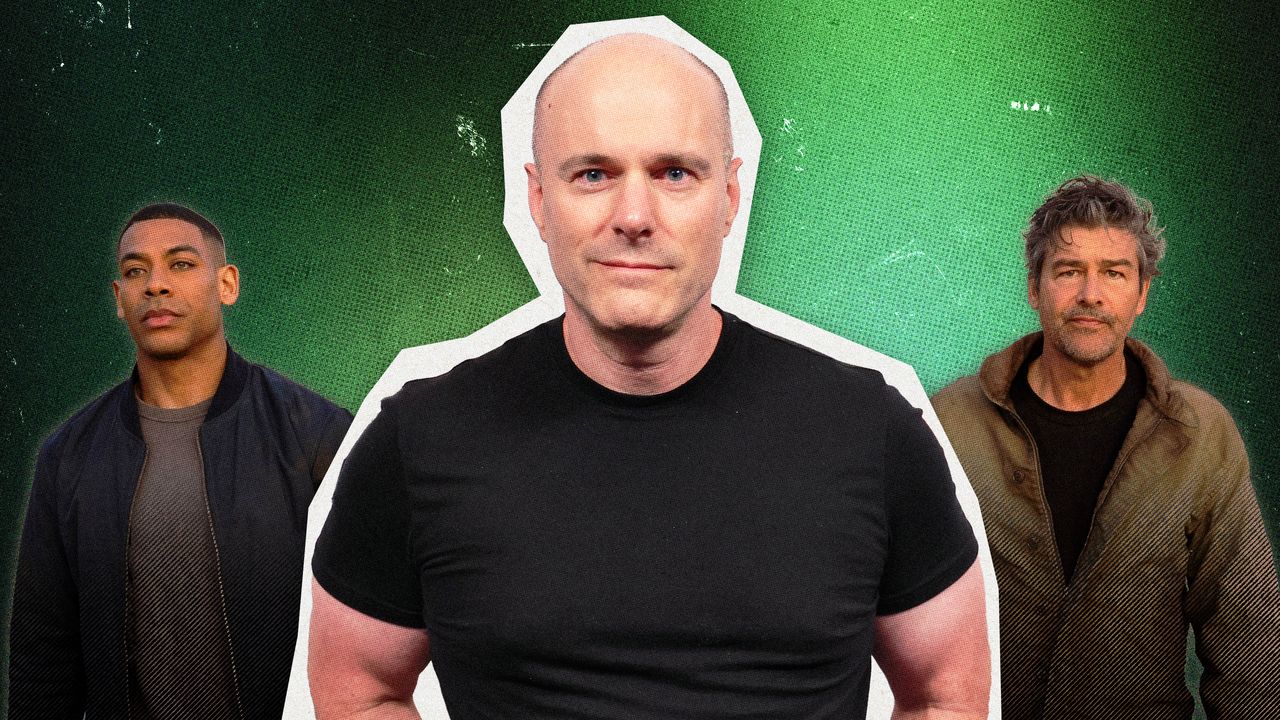
"We wanted this to be a show about high stakes," King says about the HBO superhero-mystery series’ “knock-them-to-the-side” season opener.Getty Images; Collage: Eva BaronMajor, major spoilers for the premiere episode of HBO’s Lanterns. You’ve been warned.Let’s clear the air on this right at the top: Lanterns is unquestionably better than Green Lantern. Even fifteen years later, the 2011 film, with Ryan Reynolds as a wisecracking test pilot drafted into an intergalactic police force, is widely considered a nadir for the big-screen superhero genre, a fact so well-understood that it inspired a post-credits meta-gag in Deadpool 2 (Deadpool travels back in time and shoots Ryan Reynolds to stop it from happening.)Based on the first four episodes shared with critics, Lanterns does more than just clear that admittedly-low bar. Initially announced alongside Superman and Supergirl as part of James Gunn’s initial slate as head honcho of the DCU, the series—which premiered Sunday night—had an immediately eyebrow-raising premise: What if two Green Lanterns, Hal Jordan and John Stewart, were dispatched to investigate a mystery in America’s heartland à la True Detective, and stumbled on a cosmic threat in the process?Since then, the series picked up a staggering roster of talent on both sides of the camera. The creative nexus consists of Ozark’s Chris Mundy, acclaimed comics writer Tom King, and the one and only Damon Lindelof (you probably know him from shows like Watchmen, The Leftovers, and a little show called Lost). Oh, and it stars the one and only Kyle Chandler, who dazzled viewers for years on Friday Night Lights, and the now-surging Aaron Pierre, whose commanding turn in 2024’s Rebel Ridge essentially earned him the role.The Lanterns premiere doesn’t pull any punches. After establishing a contentious relationship between the two men in 2016 as they investigate a bizarre murder in Nebraska, the plot jumps forward a decade to 2026 as John Stewart is summoned back to the town to discover that someone’s killed Hal Jordan and absconded with his Green Lantern power ring in the process. It’s a hell of a way to end a pilot episode, and a decision that King and the rest of his collaborators didn’t take lightly.When GQ spoke with King for an expansive interview about the Lanterns premiere, he’d just returned from showing the show to an excitedly gathered crowd at San Diego Comic-Con’s famed Hall H, where they had no inkling of Hal’s impending fate. But for King, it turns out, that shift to being on the stage at Hall H marks, in some ways, the culmination of a journey that started over a decade ago. King spoke with us about being in Hall H, how he got involved in creating the show, casting Chandler and Pierre, John Mulaney (trust us, it makes sense), killing Hal, and much more.GQ: It’s been 16 years since I went to Comic-Con, but the last time I went, I was there in Hall H when they announced the original Avengers cast—Tom King: Holy shit.I’m not an overly spiritual person anymore, but that was the closest I’ve felt to being back at church. What was it like for you to take that stage with a big announcement?I started out at Comic-Con in Artists’ Alley. Artists’ Alley is the first spot in the rest of the Con. Hall H is a big chunk on the left, and then the rest of the convention center starts on the other side of Hall H, on the right. The worst seat you can have in the entire convention, which I had for my first convention when you pay, whatever, $200, to sit there, was on the other side of the wall, because people don't walk that far. The very last seat on the left is the shittiest seat in the entire con. I would hand-sell my books [there] because that’s all I could forward. I started my con on the other side of Hall H, literally against the wall, yelling at people in the aisle, Hey, over here! I have books to sell. And hearing the roar—it probably was Avengers [being] announced. I was probably doing this the same year you were there, being like, Please buy my book, while the Avengers were on stage. So to go 15 years later and go one foot through that wall and face the other direction is super. My whole career just moved one foot and turned around. It was surreal and crazy. My daughter is a huge Firefly fan; she’s really into it. I was sitting next to Mal for the whole Con. He was joking with me. I was like, This is fricking insane. I was just watching you shoot space pirates and space zombies, and now we’re sitting here talking. And I was two [seats] away from Kyle Chandler and Aaron Pierre, who are these huge movie stars.I got [to answer] one question. Of course it was the Is this show nerdy enough question. Which is a cool question to get, but I took a moment to just say “Thank you.” My books are so weird, and they only get read because people recommend them. To think of all the people who recommended them [for me] to get there—I just felt grateful.How did the pitch for Lanterns come together originally?There was this writers' room, or “architects' room”—it has different names. James and Peter, the heads of DC Studios, had assembled people James likes, or friends of James. [They] created a great creative writers' room very, very early in the process. James had just gotten the gig, and he called me in. I was the one comic book writer. Drew Goddard was in that room. Jeremy Slater was in that room. You can look it up; he's posted photos of it. There were, I think, five or six of us. The idea was: sky's the limit. I brought with me my DK DC handbook, which was slightly outdated—I think it was [published] pre-New 52. I put it on the table, being like, I wonder if we’ll need this, and we literally did. We flipped it open. James is a deep nerd, but not everyone else in that room was. They were like, Oh my god, what’s Brother Power the Geek? At times we’re going through and being like, What has worked, what hasn’t, what could be a TV show, what could be a movie? James is already working on Superman. Supergirl came out of that room.And we're like, What can we do with Green Lanterns? What’s new? What’s interesting? Asking what had worked in the Ryan Reynolds movie and what had maybe not worked. I threw out that we should do True Detective, Training Day, Green Lantern. It was nothing more than that elevator pitch. James just scrawled it up on a board among 20 other ideas. At the very end of the two days—it was me, Drew, and Jeremy at the very end—and James was like, What do you guys want to work on? I was there because my Uber was running a little late. I looked at the entire board of what we discussed over those days. I still couldn't get that idea [out of my head]—I could see John and Hal going to some rural town and encountering a mystery. I had the idea that the Manhunters would be involved because they had such a complicated history with the Green Lanterns. I thought they would be a great bad guy.So it was nothing more than “John and Hal go to a town and encounter Manhunters.” I was like That’s the one I want. James said, Great. And, I don’t know, two weeks later, I called him and was like, Hey, I want to work on this. I developed it, pitched it out. They announced it, in their first slate, which was a little crazy, and announced it was called Lanterns. I’d always pictured it being an HBO 9 o’clock show, which is somewhat unprecedented for superhero shows—although it had been done before once, and the one person who had done it was Damon Lindelof.And I got the call. They said, Damon Lindelof is interested in working on this with you. Damon and I knew each other just vaguely, from a Watchmen overlap. I said yes, they brought Damon on board, Damon and I started talking, and we just threw everything out the window because now Damon's on board and I wanted to build it with him—except for those very few concepts of True Detective, Training Day, Green Lanterns, Manhunters, and Nebraska, because my grandmother’s from Nebraska.Neither Damon nor I wanted to run the show, for personal reasons. I'm Washington D.C.-based, and it was Damon’s kid’s last year at home. We needed a showrunner, so they brought in Chris Mundy from Ozark, which was kind of the perfect thing because he was from Nebraska. Then the three of us, again, scrapped everything Damon and I had done and started over, and the three of us built it from scratch. That's a long answer. Sorry. It's a complicated story.Damon is literally on the pantheon of TV writers, one of the greatest of all time. It was very annoying being in a room with him, watching the best of the best, and wanting to be as good as he was at it and never quite achieving it. But it was wonderful.What do you remember from reading your first Green Lantern comic, and what did you want to bring from that experience into the show?It's a great question. Green Lantern is one of those series, like Batman, Superman, or Wonder Woman, that just always lives in your subconscious.Let me rephrase it slightly: What is your earliest Green Lantern memory?I start a little bit before Hal goes crazy, probably when he had the gray hair. He was always a little older, a little wizened. But also, there's this comic back in the day, which was Emerald Dawn. Christopher Priest wrote the first issue, and it was about Hal as a very flawed character whose fearlessness is tied to his recklessness. I think that aspect that Christopher Priest brought to that character is definitely in the show.This is such nerdy stuff, but when I came to comics in 1990, Hal was just on the precipice of blowing his entire life up and being replaced by a person named Kyle. Hal was always kind of a lost ideal. I read comics backward, right? I went back into the bins like, Oh, here's this hero who had once been this super cool guy. But when I was in comics, he had fallen. He'd committed a sin. He had gone insane, destroyed his entire city, and he'd driven him to the dark side, to the fear side. So to me, Hal was someone who had some deep flaws in him, and that made him a much more interesting character to me. It wasn't until I wrote him that I completely started understanding him.Lanterns is interesting in that it's a combination of two genres that have gotten a lot of play over the last few years: it’s a superhero show and a crime show. How did you and the team want to go about either playing into or subverting those genre expectations?Damon and I are both the same way: we like to play with clichés. We love to set up clichés and then undermine them, and we're both utterly allergic to them. We’re doing a TV show that’s about cops set in a rural town. By this point, that’s a genre now. We have Mare of Easttown, True Detective. There’s a thousand of these. There’s always like the sheriff of the town. You’re going to have a lot of two guys driving. These are the cliches that make up this thing.We were like, how can we undermine each of these and use our genre and our special Green Lanterns to make it completely different? So the pilot starts off with two people driving, but it ends up one of them jumps out and crashes the car. And the idea that we have this seemingly rich rancher person, who you could immediately associate with [characters from] a thousand shows you've seen. Oh, he's the super conservative ranch guy. But it turns out he's very accommodating, very kind, and he's actually really an anti-colonialist. We took all of the genre and turned it on its face to be like, How can we surprise? How can we make everything different but still be in that genre so that people feel familiar? Then we knock them to the side. That’s the motto of the show.What's wonderful about this show is that a lot of people, when they bring superheroes into the television space, they're like, Okay, that's easy. That's just a movie cut up into eight pieces, and they bring the movie team in. James and Peter are very smart. They're like, No, we want to build television. We want to build television people in it. Chris and Damon are television born and raised. That's their genre. They've been in there for 30 years. They know what works. They've been on the procedural shows in their youth. They've been on the prestige shows in their adulthood, and now you combine the two things. They know the aspects and know how to do it. It was always leading into, What makes an incredible TV show? Not, What makes an incredible superhero movie cut up?Watching Aaron and Kyle, it’s very apparent that they have an instantaneous level of chemistry. The mystery is engaging, but I found myself invested in their dynamic, and it really drives the premiere for me. Can you speak about casting them and how important it was to get that right and get it right with these guys?It was thrilling and frightening at the same time. You’re exactly right in your assessment of the show. If the show succeeds or fails, it's all about Aaron and Kyle, their relationship, and their chemistry as actors.To me, this show was like going to the best TV college of all time. I'm coming from comics, sitting in a writer's room with two of the best to ever do it. I'm watching Damon pitch ideas. I'm watching Chris lead the show to where he wants it to be. I do remember them saying, This show's going to depend on this casting. And I’d be like, No, no, no, it's the writing, it's the writing. But no, at the end of the day, it was really the casting of these two incredible people.We’re fortunate in that James Gunn is the best caster of his generation. If you look at Guardians—what a miracle that movie is, because of that cast and how each of them was not who you'd expect in any of those roles. That just continues today. [He’s] the guy who found John Cena and said that guy could be an Emmy-winning actor. James has a nose for people like no one else. But it was a big effort. We had huge lists. Chris had a brilliant casting director who cast The Wire. For Hal, we had almost every actor between the ages of 45 and 65 on the list, and absolutely brilliant possibilities. Chris, Damon and I would be like, Okay, here's our top three. We’d throw a three at each other and see what the Venn diagram is of them. Then we'd nail it down to another three and be like, Okay, who's our vote now? Ultimately, this goes all the way up to Casey [Bloys], who's the head of HBO, and then James is the head of DC Studios. Both of them are very creative-focused.Chris is the leader of the show, as he should be, so ultimately it's Chris's decision. We were kind of the nominating committee. He was the one who was awarding the thing. We kind of convinced him this way and that way. Eventually, we land on Kyle. Kyle is amazing in this show. I was the one who was probably the most reluctant; to my shame, I was a little reluctant on Kyle because Hal’s a very West Coast kind of guy. I'm a West Coast kind of guy. Through Friday Night Lights—if you meet Kyle, there’s a kind of Texas, Georgia twang to him. I was like, Is that the right vibe? Not that he couldn't act, but was that the right vibe for Kyle? He came in, and as soon as he read, I was like, Oh, that’s Hal Jordan. We’re done. All my hesitation was gone. I was like, He has that kind of cowboy [nature]. He has that kind of glint in his eye. Just absolutely wonderful.I know it’s more nuanced than this, but his performance reminds me of him doing his best Maverick impression, that brash confidence.100%. I was the nerd in the room. Go talk to Tom to find out who these characters are. I could tell him about the creators of Hal Jordan, their original intent, his history. The idea that he was that Top Gun, devil-may-care figure—but also that I’ve seen a little too much thing. Kyle’s age is no secret. He’s the youngest-looking 60-year-old man in the world, but he’s been around. He's done all the things, he's seen all the angles. God, that guy just has a chill to him that I wish I had. He has perspective on his entire career in a way that Hal does as well. Absolutely brilliant from day one. For [John Stewart], there were more candidates. We knew with Hal, the idea was like, Let's get a movie star. One of the best things about True Detective was seeing Matthew McConaughey come to the small screen. That was always the plan. With John, it was like, Let’s break a movie star. Let’s find one. Which is ironic now, because Aaron Pierre has become a movie star in the two years since we cast him [laughs]. We had an incredible casting director who was bringing us the best. We were getting phone calls from everyon— just brilliant, brilliant actors. Agents were calling all of our personal phones. It was a little unfair because Rebel Ridge came out while we were doing the casting, which is probably the best thing, the biggest mic drop any actor could do: Here's me playing a badass Marine who's very John Stewart-y.That's a hell of a demo reel.Yes. I was like, Do you need an audition tape? Here's a two-hour hit movie on Netflix that you could watch at home today. The thing about Aaron is you meet him, and you're like, Oh, this is a movie star. I get it. It’s weird to meet a movie star, as an outsider who doesn’t do that too often, and be like, Oh, I understand now. This is what it must’ve been like to see Robert Redford. Of course you hold the screen. The camera loves you. You look like a superhero. It felt like meeting Chris Hemsworth, pre-Avengers. We were just like, You’re going to be the guy.One of the throughlines of the premiere is the notion of John being tested in these various ways. How did you feel like you were tested as a writer throughout this process?I always felt like I was the oldest 22-year-old in the room, and I was 46. Every day I was tested because I was learning a new skill. I was being thrown into the deep end of a pool. There's no one way into comics. There's lots of ways people come in. Some people are screenwriters, and some people have never written a word before. We get a lot of people who are artists. In television, there's a ladder you climb, and 90% of television writers climb the same ladder, where you go from being a PA to a writer's assistant to writing on a show to making your own. That’s the way both Damon and Chris had done it. I'm coming in completely sideways, becoming an executive producer and one of the head writers, but in service of Chris being the head writer, on a show where we had a brilliant writer's room of a bunch of people who were very professional. These are people who had all done their reps, and I had not. Every day I had to learn how the writer's room works. I write on my computer by myself. Here I am writing in a room with five other brilliant people. I had to learn how to make a pitch in a room, how to let go of a pitch in the room, when to raise your voice, when not to raise your voice. I had to learn all the skills that come with being an executive producer—things like casting, managing up, how to turn an outline into a thing, and knowing how to respond to notes. It wasn't a difficult thing when you have great teachers. Damon and Chris were incredibly patient, especially Damon, in showing me, This is how you do it; this is how you respond. This is how you say “Yes,” and this is when you shut your mouth, this is when you speak up. But every day was a challenge. It was very much like being at the first day of college or the first day of a job. It was wonderful. It's good to be challenged. I've written so many comics now, I do it as secondhand language. It was nice to learn a new skill and to be like, Okay, I could do this now. This is a different kind of thing.I have to ask, given what I imagine the sense of humor was in that writers’ room, if John Mulaney’s “What’s New Pussycat?” bit came up during the breaking of the “Brand New Key” gag at the bar.I think the pitch was Damon's. The pilot was written by the three of us before the writer’s room, so just the three of us. The general tenor of how those things went is: Damon and I are these alpha dog idea guys. You get us in a room, we're very mirrors of each other, which I'd say, knowing I have a much smaller mirror than him. But we're guys who are just like, I have an idea. No, I have an idea. No, I have an idea. No, I have an idea. Chris, he's more of the referee who sits back and watches these two dogs argue over each other and be like, That's working, that's working, that's working. Eventually he'll throw out something absolutely brilliant.Damon is the best idea man in the history of television. I'll stand by that. There's no one who could be like, Here's a problem. How do we solve it? Damon will come up with it faster than you think. It's fucking annoying how good he is. I spend my life around the most creative people in the entire world. I'm a comic book writer. We have to come up with 50 stories a year, twists every single day. To be in a room and be like, Damon is maybe the most creative person I've ever met is saying something. Damon threw out that idea. I immediately responded, That's just a John Mulaney bit. [laughs]. He was like, What? I was like, You never heard that!? I YouTubed and sent it to him. We were both laughing, and I'm like, Okay, we're putting it in. It came from an honest place, but I immediately recognized it as the John Mulaney bit. It's one of my favorite comedy bits of all time. My son and I quote that to each other constantly. In the final moments of the premiere, you reveal that Hal is dead. How did you all land on that?I very much remember this, too. I think Damon has a slightly different memory of it, so you should ask him. But my memory is, again, Damon and I were throwing ideas back and forth of where Hal is. The central thing we were solving was the mystery of the Superman movie. The Superman movie takes place today, contemporary to us, and Guy Gardner is the Green Lantern. Where are Hal and John? Why does Guy have the ring? We were figuring out other sorts of mysteries: Okay, where do we end? Why did this happen? I remember I had the thought in my head: Hal is dead. I could see Damon have the same thought at the same time. I reached for a pen. I was sitting in this very chair I'm sitting in now, because we're doing a Zoom. I wrote Hal is dead on a card because I knew he was about to fucking say it. He goes, Wait, Hal is dead. I held up my card. So, it was Damon's idea. But of course, this is superheroes. If anyone's read my first book, my first thing I ever did in superheroes, it was a book that was about a superhero that thinks everyone can come back. So you absolutely never know.There’s a metatextual reading here that when you’re playing with Green Lanterns that you have to be unafraid to make big choices, but I’m wondering if making that decision in the room scared you all?Oh no, we very much talked it through. All the aspects of what it would mean, how big it would be, and what the big mystery would be. I've been saying this for 10 years: my favorite character to write in comics, and I only got to write him once time, is Hal Jordan. To take him off the board was not a small thing, but it suddenly made the stakes of the show high. It can't be a cheap death. Death exists in comics as it does in life. If it doesn't, then why read? The whole point of this show was to be like, Can we make a show that feels as realistic as life, that feels like it has the same stakes as any show you watch on HBO where you're like, “Holy shit, that could happen to me?” One of the things that can always happen to you is death. We wanted this to be a show about high stakes. We wanted the people who watched this to think they were watching—because they were—huge moments. There have been so many superheroes in TV shows where you're like, Why did I watch that? That just felt like a small chapter and a small thing. Why did I waste my life on that? We wanted to be like, No, this is a moment. This is a big thing. And as an audience, you're involved; you're on the ground floor of something huge. That aspect of the show said that to the audience and said it to us.Sign up for Manual to receive useful advice on style, health, and more, five days a week.
‘Lanterns’ Premiere: Writer Tom King on Being “The Nerd in the Room” (and That Ending)
Full Article
Original Source
Read the full article at Gq →KhanList aggregates and links to publicly available news content. We do not host full articles from third-party sources. Always verify important information with original sources.