
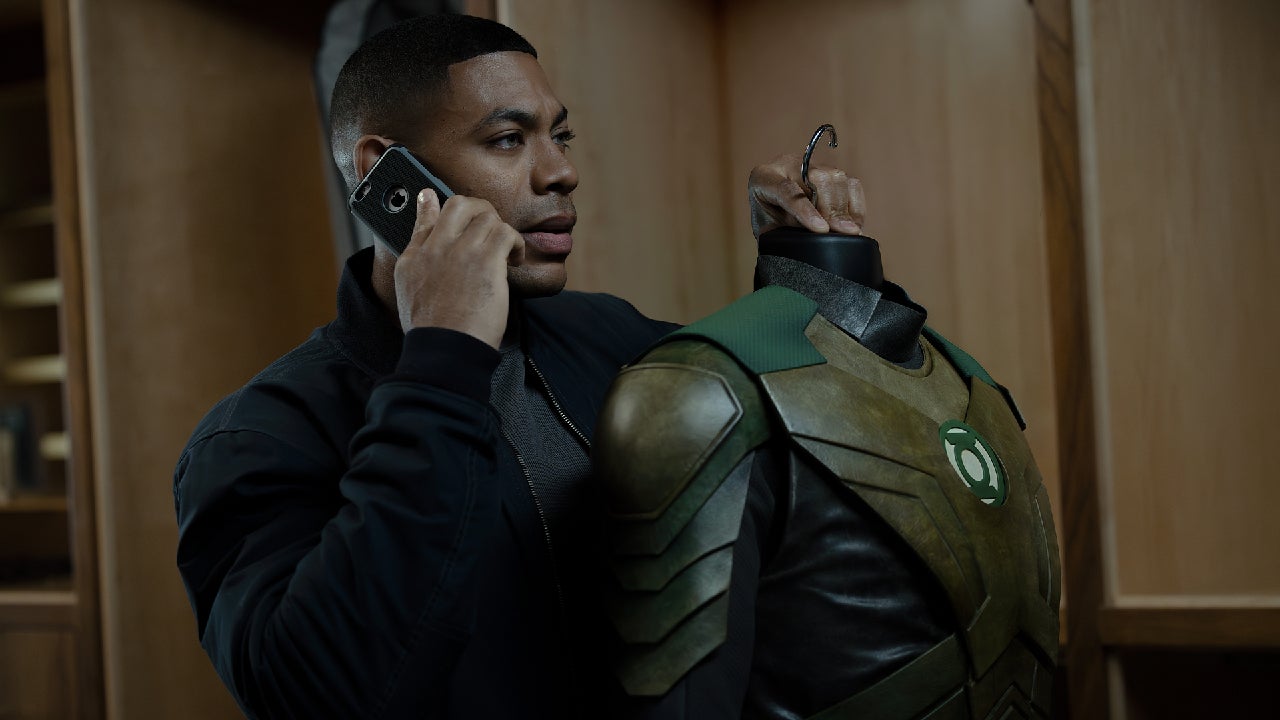
Note: This story contains spoilers from “Lanterns” Episode 3. How do you make a Green Lantern? This question, asked by John Stewart Sr., becomes the guiding force for the third episode of HBO Max’s “Lanterns.” Here, director Stephen Williams and writer Vanessa Baden Kelly take viewers into the origin of John Stewart (Aaron Pierre), showing how he was raised from infancy to become Earth’s second Green Lantern. “I think when we were discussing John and Hal as characters from the very, very beginning of the room, we were really trying to go an extra layer deep,” Baden Kelly told TheWrap. “One of the things that kept coming up for us was that there was so much lore surrounding Hal’s backstory, but John’s was a little thin. Obviously, there were versions where his dad was a Marine. There were ones where his parents were civil rights activists. But we were really trying to get under the character and figure out who was the character that becomes the John Stewart that we’re trying to tell in the show.” The John Stewart they’re trying to tell, it turns out, has some pretty notable differences from the John Stewart of DC Comics. The episode, titled “OutKast” (referencing both John and the episode’s soundtrack), delves into an origin that is entirely unique to the world of “Lanterns,” tying his story into more modern conversations around race. “What (does it mean) to be a Black man and get that ring when other characters canonically had it? We really started discussing how much more a Black superhero has to do to be accepted in that world,” Baden Kelly said. Baden Kelly, who came up as showrunner Chris Mundy’s assistant on “Ozark,” recalled years of conversations the two of them have had, examining the differences in how they’d have to raise their respective children (“No matter what, my son was going to be judged more harshly,” Baden Kelly said). To mold these conversations onto John, she was able to draw from the expertise of co-creators Damon Lindelof and Tom King, both of whom (particularly the latter) have experience writing comics. “When you’re playing around with the canon, you have to treat it like you’re handling plutonium. But at the same time, there’s kind of no fun and creativity and originality in that,” Lindelof told TheWrap. “So you simultaneously have to start to iterate. How do I expand upon the existing canon without completely and totally violating it? Are there different contextual frameworks for fearlessness that are more relatable to the time that we live in now?” “Green Lantern #87” cover by Neal Adams, Jack Adler (DC Comics) “Now let ‘em try me” “Sure, I’ll try your gig! Might be laughs, being a superhero. My mama named me John Stewart, ‘Square’ John to my friends! Only from now on, maybe you better call me … Black Lantern.” These words are featured on one of the first pages of 1971’s “Green Lantern #87,” the Dennis O’Neil/Neal Adams comic that introduced one of the first Black superheroes to the DC Comics universe. Of course, John Stewart didn’t actually go by Black Lantern, but this declaration exemplifies the characterization given to him in that very first issue: He was a confident, proud hero (visually modeled after Sidney Poitier), one unafraid to engage in the Black power political movement of the time. “I just think it was super brave. In the 1970s, at the time of that original John Stewart was written, you choose to put a dark-skinned Black man, in Detroit, who is in some ways using some language that is akin to Black Panthers, that is f–king great,” Baden Kelly said. “I think if we’re going to honor anything with our John Stewart, we have to honor that bravery.” Like “Lanterns” Episode 3, that issue (available to read for free on DC’s online platform) makes no attempt to stay out of the politics of the day. In John Stewart’s first adventure, he becomes a new backup Lantern after Guy Gardner is injured in an earthquake. Hal (typically portrayed as more conservative) clashes with the new recruit, questioning the Guardians’ decision after seeing him argue with an aggressive police officer (“We are not interested in your petty bigotries,” a Guardian tells Hal). John eventually proves Hal wrong when he exposes a plot from a racist presidential hopeful to blame a cop killing on Black activists. “I stumbled across some people calling the show ‘woke,’ and there were people putting panels in the reactions and the comments, and they were panels from the 1970s John Stewart,” Baden Kelly said. “Him calling people ‘Whitey’ or him opposing wars, and I’m like, ‘Oh my God.’ I read a bunch, but I couldn’t read all of it, and you’re just like, that’s right, just keep it in the front of your mind — that this is who John Stewart’s always been.” J. Alphonse Nicholson and Jasmine Cephas Jones in “Lanterns” (HBO Max) “You have your target” In “Lanterns,” John Stewart wasn’t born to wield the ring. He was conditioned. “OutKast” reveals that Hal Jordan wasn’t the first person Abin Sur’s Green Lantern ring sought out to watch over Sector 2814. Before the ring made its way to Hal, it found John Stewart Sr. (J. Alphonse Nicholson), encasing him in a green bubble and echoing one question: “Are you afraid?” “Yes!” John Sr. shouted, and the ring went on its way. “I’m just grateful that the writing room put this into the script. How can you expect this African American man in this world … to be fearless? It really raises a lot of questions on who has the privilege to move through life without thinking about those things, even in the fictional world,” Nicholson told TheWrap. “It allows us to kind of look at John through a totally different perspective and understand why the writers are coming at it this way.” As John’s mother, Bernadette (Jasmine Cephas Jones), asks, “Do you understand how unfair it is to ask a Black man in America if he’s afraid?” Baden detailed how the qualities that made John Sr. a good candidate for the ring are the same ones that caused him fear — he’s a good, noble father who worked hard to get where he is and is terrified to leave the people he loves behind. “That to us was where black exceptionalism backfires,” Baden Kelly said. “You’re doing everything right in all those spaces, and that’s exactly what they use against you.” When Bernadette presents this contradiction to a Guardian of the Universe (Laura Linney), she is given an opportunity: Train the then-infant John Stewart Jr. to be fearless so he can secure his spot as Earth’s next Lantern. John’s parents begin conditioning him, training to remove any doubt that the ring should be his. Baden Kelly compared John’s upbringing to that of famous Black athletes, invoking the names of Tiger Woods, the Williams sisters and Jalen Brunson, all of whom were trained from young ages to be the best. “They’re having to make the really hard decision that I think a lot of Black people have to make, a lot of Black athletes have to make, a lot of Black creatives have to make, which is, if I keep trying to play the game the way that they want me to play it, they will always have an opportunity to pull the rug out from under me, so I’m just going to have to sacrifice what others may think, what we may think, if we’re really trying to hit exceptionalism,” she said. “It’s a hard thing for Black creators. It’s definitely been a hard thing for me.” For everything John’s parents did, he immediately demonstrated proficiency with the ring when asked to assemble a watch piece by piece. It’s a much more precise construct than the others seen in the DCU, evoking a famous page from “Green Lantern: Rebirth” where Geoff Johns describes John’s projections as being “built from the inside out. You look close, you can see every nut and bolt that makes it work.” “(Guy Gardner) and Hal are allowed to be imaginative. They are allowed to think of these like incredibly silly things if they want to. They’re allowed to think of incredibly fun, big, large things, like how he’ll come in with a giant fist,” Baden Kelly said. “John has to be precise. He can’t miss.” Aaron Pierre in “Lanterns” (HBO Max) The day of our interview, just five days before “OutKast” released, Baden Kelly found an odd way of spending her morning: Scrolling through old Reddit threads leaving 2019’s “Watchmen” negative reviews. “I have to read through all of this, because not only did I love it, and not only was it super decorated, but it’s considered one of the best DC shows, and one of the best comic book TV shows in the past 20 years,” she explained. “So I have to see that even if a million people hate (‘Lanterns’), that’s OK, because people didn’t like ‘Watchmen’ either, and it still was what it was.” “I had to kind of sit with it today in that way. But I’m more concerned for the character John Stewart, which in some ways feels like my tiny baby,” Baden Kelly continued. “Him and Earl.” These concerns have been brought up a lot on the press tour of “Lanterns,” a show that takes characters with decades of history and adapts them in a way both faithful and radical. The showrunners are in a particularly difficult position with John, a character only now making it to live action for the first time in his more than 50 years. “One of the things that Tom would keep bringing up, as did Damon, is that every new volume of any comic that comes out changes lore a bit. Completely different universe, but we’re dealing with that even right now in the MCU where we’re seeing all the different versions of what Peter Parker can do, whether his web is organic or not, folding that in and changing that over,” Baden Kelly said. “For us, that gave us a little breath of relief, because we are working so hard to make sure that we’re making a Green Lantern that has the lore of the comics, but also making it fresh.” Baden Kelly said she hasn’t felt this way about a comic book character since Black Panther, knowing the importance of putting Green Lantern on the screen as a Black superhero with a rich history. Aaron Pierre has already been tapped to reprise the role on the big screen in “Man of Tomorrow,” spinning out of the all-new origin he’s received in “Lanterns.” “It just feels like we have to protect him,” Baden Kelly said. “We almost low key have to bubble wrap him like in Episode One to let him get through this and be a fully formed character so that there’s a fully formed Black superhero that can exist in the DCU and inspire.” “Lanterns” airs Sundays on HBO and HBO Max.
‘Lanterns’ Episode 3 Writer Breaks Down John Stewart’s Radical New Origin
Full Article
Original Source
Read the full article at Thewrap →KhanList aggregates and links to publicly available news content. We do not host full articles from third-party sources. Always verify important information with original sources.