
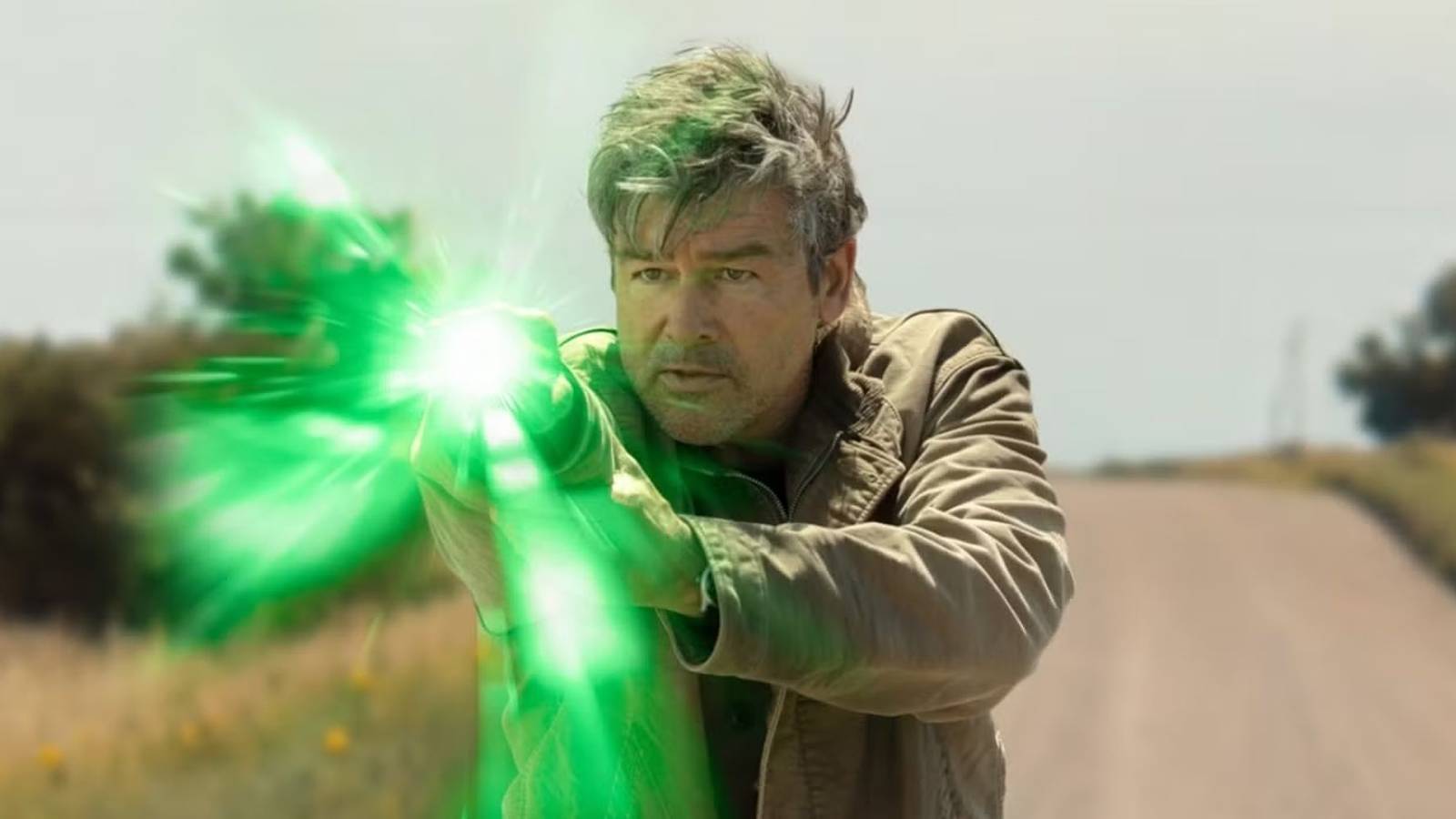
Image via HBO Published Oct 4, 2026, 10:00 PM EDT Sign in to your Collider account Editor's Note: The following contains spoilers for the Season 1 finale of Lanterns.In just a few short months, DC and HBO Max's Lanterns has taken the world by storm, with both critics and fans praising the show's True Detective-style approach to two of DC's greatest sci-fi heroes: John Stewart (Aaron Pierre) and Hal Jordan (Kyle Chandler). Both known as the hero Green Lantern in the comics, Lanterns has flipped the sci-fi genre on its head to craft a gritty, mature, terrestrial story that differs greatly from other tales in this universe like Superman and Supergirl. Now, Season 1 of the series has finally drawn to a close, with the mystery behind Hal's murder finally solved. While Lanterns closes the book on John's story before his confirmed return in James Gunn's Superman follow-up, Man of Tomorrow, some questions do remain about his future as Earth's definitive Lantern. To answer those questions and more, Collider's Steve Weintraub had the extraordinary opportunity to speak with Lanterns co-creator Damon Lindelof to discuss the Season 1 finale and its many behind-the-scenes secrets, such as Sinestro's (Ulrich Thomsen) surprising role in the series, whether we could see the Hal hologram again, and John's role in the DCU's future. Check out Weintraub's full interview with Lindelof below: The 'Lanterns' Team Had to Ask "To Sinestro or Not To Sinestro" "He's very resourceful." Image via HBO COLLIDER: The title card and imagery throughout the season play heavily with green and yellow. How much were you telegraphing through color rather than dialogue? DAMON LINDELOF: A fair amount, I think. I do feel that when this all began, just between Chris, Tom and myself, Tom was obviously, I would say, the graduate that had a postdoctoral in Lanterns lore. I had an undergraduate bachelor's in Lanterns, and Chris probably a high school education. And so inside of that process, Tom educated us on what were the essential critical parts of the storytelling, sort of under the very specific question that I think Chris Mundy asked, which is, "If you're doing a Lanterns show, a great Green Lantern show, what are the things that have to be in it?" And so yellow came up very early, particularly because yellow is a Lantern's weakness. And then kind of got into the Sinestro Corps and some of the deeper cuts, etc., etc. But I think that the idea of: how are we going to use yellow in the show, both as motif, as signal of fear, of vulnerability for Hal and John, just kind of was in the groundwater, as it were. And so I do think that it permeated the visuals, but also the storytelling, especially once we brought in the rest of the writers and the "To Sinestro or not to Sinestro" question was posed and answered in short order. It was, "Well, you can't do Sinestro and not start working out of the green and into the yellow, as it were." Very nerdy. But how is Sinestro surviving without food and water on that little island? LINDELOF: Oh, he's very resourceful. Well, A. Sinestro is very resourceful, but I'll say, "How long was he alone without Hal? What supplies and/or sundries did Noah leave him with? So some combination of species and how long they can go without food and traditional water, and also what did Hal and/or Noah bring that is now run out?" is the short answer to your excellent query and something I'm sure that the fans will be nitpicking about, as I would expect them to. Damon Lindelof Knew How 'Lanterns' Season 1 Was Going To End From the Start "You're going to kill him off in the pilot? What are you, insane?" How early on did you guys figure out the season would end with John putting on the ring, becoming a lantern, and finally flying? LINDELOF: Early. I think that idea came from the very early days of the larger writers' room. And I think that part and parcel of making the hardest decision, which was, we're going to get a lot of mileage out of a story that its central conflict basically revolves around one ring, two people vying for the ring. And, in order to play fair, it felt like one of them definitively had to end up with it, and I don't think that there was any question amongst Tom, Chris, and I, and certainly once we brought in the larger room, that Hal's death had to stick in order for it to be felt. And even though, as an audience, as a DC fan, as a writer, the ridiculousness of, "Okay, now you can play with Hal Jordan, you're going to kill him off in the pilot? What are you, insane?" But also sort of understanding that it didn't feel like John could take the ring until Hal was gone, and that there was some degree of stewardship under Hal, but also a lot of things that Hal would get wrong. We had the ingredients, but in terms of how to prepare the casserole, the last instruction was Hal has gone for good and sends John on his way. That enables John to accept the ring on his own terms vs. Hal's terms or the Guardians' terms, and that ring had to be forged with a little special something in and of itself that could potentially set up future storylines. But most importantly, John was shaped by his own parents, by the will of the Guardians, by the culture, and he needed to go through a period of rejecting everybody else's premises and expectations and come to a place where he wanted the ring on his own terms. That was in the first three weeks of the writers' room. What was the most nerdy thing that you, Chris, and Tom argued about when you were putting the show together? LINDELOF: Oh, God. I, ironically or not — or maybe I'm definitely misusing irony, but I wouldn't use serendipitously — but I think one of the things that the audience has keyed in on as a primary bug as opposed to a feature or something that is kind of annoying to them, is the idea of ring charge. And so I do think that the rules of how the ring worked, how quickly it had to be recharged, what amount of energy it took to create a construct, what amount of energy it would take to fly, what amount of energy would exist in the ring to construct the hologram? Those conversations were maddening for all of us, and the hubris that we felt like we had actually solved those problems vs. it was going to be something that the audience would struggle with once the show was on. And I think it's a Kryptonite problem too, and by that I mean that the challenge of these characters, whether they're in the DCU but very specific to the DCU, vs. the Marvel Universe, the audience is always asking the question, "If they have all of these powers, why aren't they using them more?" And "Why wouldn't they just use their powers in this instance of conflict?" And you have to come up with emotional, psychological reasons which are more interesting, which is: how do you create a character who wants to implement some level of restraint in the use of their powers and make it make sense from an emotional level, and then there's the artifice of the lantern — that is to say, the charger, or Kryptonite, or a red sun. The external factors that take a superpowered being and make them "more mortal," so that it makes them more relatable to the audience. And you keep the pendulum swinging over the porridge so that you're never settling on just right. It's always too hot or too cold, but if you can keep the pendulum moving, at least it passes through just right. But I think the nerdy, obsessive conversations, and I'd say the biggest "fights and conflicts" that we had were over the issue of ring charge. You're going to hear a lot about it in the finale, in terms of how long Hal was able to stay around when the ring was on such a low charge. LINDELOF: Sure. Yeah. To your point, though, there's also almost a supernatural component of John's willpower in that he can use the ring without wearing it. That, again, potentially crosses and/or at least puts a toe across the line of what we understand from the established canon. Damon Lindelof Weighs in on 'Lanterns' Season 2 "Where there's a will, there's a way." Image via HBO I know you're not involved in Season 2, assuming it were to get a Season 2, but do you think after John charges the ring, he can still bring back Hal? Or once he charged the ring, that was it? LINDELOF: I definitely don't want to speculate about the answer to that question. I can only tell you that everybody in the Season 1 room, inclusive of the writers who are working on ideating on Season 2, felt like, even though we knew that it was going to be emotionally devastating and/or disappointing and maybe even frustrating, that the worst possible schmuck-baity thing that we could do is show you a pilot where Hal Jordan was definitively dead, and then try to walk it back and say, "Oh, he was a clone" or "He's only mostly dead" in the Princess Bride vernacular. In terms of moving forward into subsequent seasons of the show, I swear to you, as I look at you in the eye on Wednesday this 30th of September, I do not know anything about the creative, and I wouldn't want to hamstring those writers in any way for what future storytelling mechanisms they could indulge in. Knowing what the comics have done with Parallax and Hal, I think, has died at least 3 or 4 times over the course of the canon, and celebrating everything that Kyle did in his performance to get the audience to fall in love with Hal. So I think that honoring the emotional impact and making Season 1 feel felt. The question that you're asking would be the equivalent of, "Would I want to see a movie called Ghost 2 where Patrick Swayze was alive again?" And the answer is, I would not, because it would degrade the emotional impact of Ghost. But where there's a will, there's a way. Where there's will, there's a way. John's New Lantern is a "Wild Card" in the DCU "It might be dangerous." Image via HBO How much did you guys discuss what could happen to John by using this ring that's been charged with yellow with fear? LINDELOF: Going back to your first question about yellow, we wanted to make sure that the ring that was on John's finger represented a wildcard energy, if not a monkey's paw or a One-Wish Willow. The idea that, in order to wield this ring on his own terms, it might be dangerous, as all weapons are, right? I think even Hal's ring as a weapon is quite dangerous. And I think John fundamentally being aware of its danger and, especially thematically, the choices that he makes about what to do about Noah, who is kind of a yellow ring incarnate, are potentially quite dangerous. What are we supposed to do about weapons and/or people and/or beings that could bring about great harm? We talked about that a lot. But more importantly, yeah, I don't think that you can introduce Sinestro into a story, even though Sinestro is not the big bad. He's every bit as significant as the Joker in the Batman-verse. He's the Alpha and the Omega of villains in the Green Lantern-verse. So, all this is a very long-winded way of saying we talked about it. What's Next for John Stewart? "There's a lot of planets out there where a lot of bad things are happening." Image via HBO One of the things I was always wondering about when they announced a Lanterns TV show is how are you going to make a Lanterns TV show that can be made on a budget, because Lanterns can do anything, and the show ends with John saying, "I want to be Earth's protector," which makes sense for who he is, but it also makes sense when making a TV show involving the Green Lanterns. Can you talk about coming up with the decision to have John be Earth's protector and the fact that it does manage to keep the costs at a reasonable level? LINDELOF: Yeah, I think nobody wants to hear and writers certainly don't want to feel like the creative decisions that we're making are budgetary, or even pragmatic. I mean, we have imaginations, and our job is to dream. That said, for reasons that I think you guys have reported on, and many others have reported on, the appetite for a Lanterns show, both that preceded James and Peter taking over the DCU, and then ultimately, once they did take over and they and they convened their brain trust, of which Tom King was, an inaugural member and basically said, True Detective/Lanterns and inadvertently was unaware that some version of that idea had been bandied about all the way back to when Greg Berlanti, who I think is incredible and has done more for the DCU than any living human being. I admire greatly and love his stuff, but going back to what he and Marc Guggenheim were working on was a more space-bound Green Lantern Corps, I think. Yeah, of course there's a budgetary consideration, but the other consideration is when audiences see materials, whether they're fans, lifelong fans, or they're looking to flirt, their brains basically tell them, "I can relate to this" or "I can't relate to this," and you don't design the story to pander to the audience. But when you see a Superman trailer vs. a Supergirl trailer, your brain basically tells you, even though it's set in Metropolis, this story is taking place on the planet Earth, and when you see a Supergirl trailer, your brain tells you this story is not taking place on the planet Earth. And so we wanted to create the biggest tent that welcomed the greatest number of people without alienating or pissing off the fans, because the Green Lanterns are a universal intergalactic space force, but we get to decide what beat we're focused on, and at least for Season 1, which is the only decision-making that I was involved in, it felt across the board that we should stick to Earth with some limited dalliances to show the audience that the Lanterns were intergalactic. Where they go in Season 2 and beyond, or where they even go in [Man of Tomorrow], which I have not read and know nothing about because I don't want to be spoiled, is anyone's guess. But obviously James' vision for the DCU is intergalactic, because we've already seen Supergirl, and there are references to alien beings. And I think that it's been reported that an alien being is the big bad of the Man of Tomorrow movie. So yeah, there's a lot of planets out there where a lot of bad things are happening that would benefit from the intervention of Green Lanterns. But I think that John, for all the emotional reasons, wants to keep his focus on Earth for now. [That] felt important to us — not just for budget. Lanterns Season 1 is now streaming on HBO Max. Release Date August 16, 2026 Network HBO Showrunner Chris Mundy Directors Alik Sakharov, James Hawes, Stephen Williams, Geeta Patel Writers Damon Lindelof, Chris Mundy, Tom King, Vanessa Baden Kelly, Justin Britt-Gibson, Breannah Gibson Cast Kyle Chandler, Aaron Pierre, Kelly Macdonald, Garret Dillahunt, Poorna Jagannathan, Nicole Ari Parker, Jason Ritter, Chris Coy, J. Alphonse Nicholson, Cary Christopher, Cairo Cash Lee, Noah Gibson Slates, Jaylen Lyndon Hunter, Michael Ocampo, Cristina Frias, Bella Shaw, Shirl Boe, Doug Long, Tony Taboada, Juliette Hourani, Zosia Rinderle, Jaime Alvarez, Nick Epper, Ben Strickler, Laura Linney Franchise(s) DC Universe Creator(s) Tom King, Chris Mundy, Damon Lindelof
‘Lanterns’ Co-Creator Officially Answers the Biggest Questions From the Season 1 Finale
Full Article
Original Source
Read the full article at Collider →KhanList aggregates and links to publicly available news content. We do not host full articles from third-party sources. Always verify important information with original sources.