
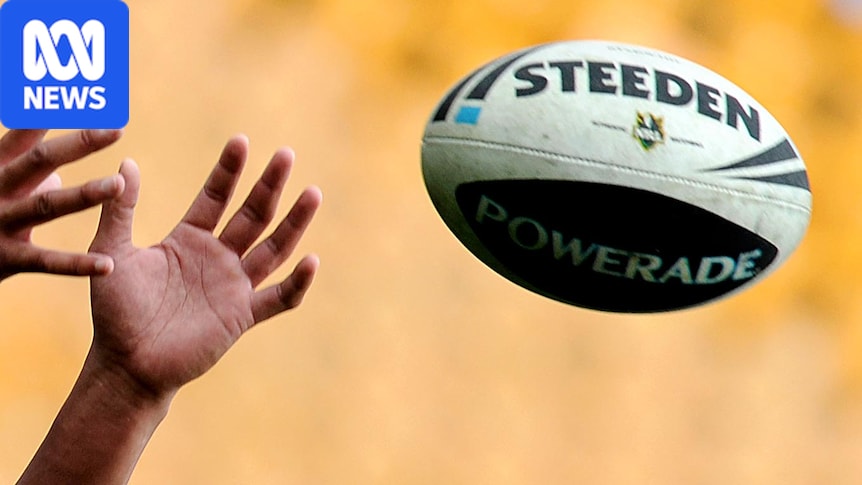
A landmark study has found 31 rugby league players have been diagnosed with the degenerative brain disease chronic traumatic encephalopathy (CTE).Rugby league players in their 20s, 30s and 40s have been found to have had the degenerative brain disease, which can only be diagnosed after death.Among them were decorated league footballer and NRL coach Paul Green, 49, as well as Manly Sea Eagles player Keith Titmuss, who was just 20 when he died.The ABC has obtained the latest statistics, which are based on the first 150 brain examinations of people who played contact sports completed at the Australian Sports Brain Bank.Of the 51 rugby league players' brains donated to the brain bank, 31 were found to have CTE. They played at various levels of the game from amateur to professional.The paper was presented by molecular biologist and data scientist Jennifer Cropley at the International Sports Concussion Conference in Melbourne on Tuesday.CTE's sole cause is repetitive hits to the head and body. Symptoms can include memory loss, impulsivity, anxiety and anger.The disease has been found in several athletes who have died by suicide, but experts say more research needs to be done to establish a "causal" link.'I feel a massive responsibility'Former league star Paul Green's widow Amanda Green is calling on all collision sports to do more for the next generation of players.Amanda Green says she had "no idea" about CTE until her husband Paul died in 2022. (ABC News: Michael Lloyd)Experts have repeatedly called for football codes to ban contact until the age of 14.Ms Green has appealed for more people to donate their brains to understand the disease and wants more awareness around the issue."Now that we know what we do about this disease I feel a massive responsibility, as we all should, to protect the brain health of the next generation of young athletes," Ms Green said."I owe it to my kids and their sports-loving mates. We need to ensure they don't make the same mistakes as our generation did. The key here is to pledge our brains and support the incredible and potentially lifesaving work of the Australian Sports Brain Bank."Ms Green said she had "no idea" about what CTE was until after her husband died."I had been involved in the highest level of professional sport in this country and did not understand this disease we now know as CTE," she said. "That was not OK I didn't know what CTE was, and since Paul's diagnosis, I have constantly called for more education on the issue. People needed to understand this disease so no-one else suffered in silence."Amanda Green wants to see more action to protect the brain health of future generations of players. (ABC News: Michael Lloyd)Green died by suicide in 2022.Ms Green said that since learning about the disease, she could see her husband was showing CTE signs prior to his death."On receiving Paul's diagnosis from [sports brain bank director] Professor Michael Buckland, he had mentioned that Paul had one of the most severe cases of CTE that he had seen, but due to Paul's intelligence, there was a possibility that he has masked a number of his symptoms, but the symptoms I had seen were symptoms such as anxiety, impatience, he was impulsive in his decision making, he definitely had lower levels of tolerance and quite elevated emotions," she said."These were changes that I had seen over time that I put down to the stress of his job."Swinburne University professor Alan Pearce, who is an author on the paper which reveals the latest rugby league statistics, said more needed to be done to protect players."Given rugby league is a collision-based sport, it is not surprising that we found over 60 per cent of rugby league donors had CTE, but this tells us we need to start implementing modifications," he said."Introducing contact limits in rugby league is a good start but rugby league and all contact and collision-based sports must also start modifying to non-contact versions for children to the age of 14 years of age.Alan Pearce says all contact sports should be protecting children by banning contact until players are 14. (ABC News: Simon Tucci)"Keith Titmuss's result, having stage two CTE at 20, tells us that this is not an old person's disease."Keith passed in 2020, and his brain results typify that exposure risk for CTE starts at junior sport level."Keith played junior rugby league from the age of five years old, then schoolboy rugby union, and his brain results show the effect of that."Titmuss played as a schoolboy at Newington College in Sydney and had had a substantial exposure to repeated head impacts throughout his 15 years playing junior contact sport.Titmuss died of exertional heat stroke after a 2020 Manly Sea Eagles training session.Keith Titmuss was only 20 when he died after a Manly Sea Eagles training session. (Twitter: Manly Warringah Sea Eagles)His CTE diagnosis was revealed in 2024 and sparked warnings the major football codes were not doing enough to protect young athletes. His parents Lafo and Paul donated his brain for research.The latest rugby league statistics follow a Four Corners report in June which revealed 33 Australian Rules footballers have been diagnosed with CTE and exposed the scale of the AFL's brain trauma crisis.The Four Corners report triggered enquiries by WorkSafe Victoria and WorkSafe WA into incidents related to footballer safety.Last month a Boston University study revealed at least one in four former NFL players who died between 2016 and 2021 was found to have CTE.The NRL has been contacted for comment.Watch Four Corners' full investigation into the AFL's brain trauma crisis on ABC iview.
Landmark study exposes scale of brain injury crisis in rugby league
Full Article
Original Source
Read the full article at Abc →KhanList aggregates and links to publicly available news content. We do not host full articles from third-party sources. Always verify important information with original sources.