
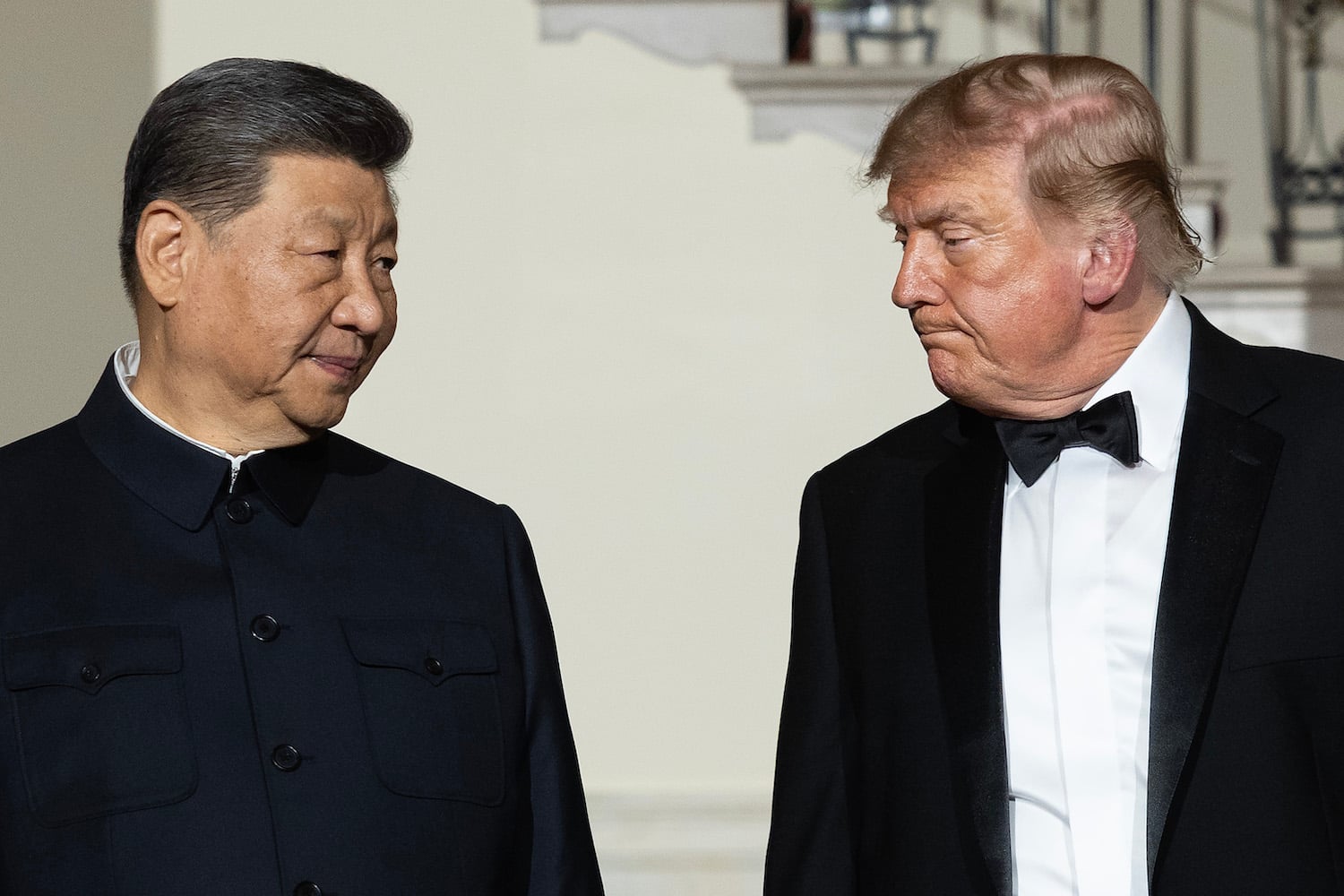
Like many U.S. presidents before him, Donald Trump is responding to a final midterm election drubbing by heading for foreign shores—to a region that has been far from top of mind over the past two years. Trump is scheduled to travel to the Philippines and China next week to attend the Association of Southeast Asian Nations (ASEAN) summit in Manila and the Asia-Pacific Economic Cooperation (APEC) summit in Shenzhen. At the latter, he will meet Chinese President Xi Jinping for the third time this year. In Manila, Trump is expected to meet with the other leaders in the Quadrilateral Security Dialogue—between the United States, Australia, Japan, and India—for the first time in his second term. Trump will make those trips under the shadow of his political diminishment at home, with last week’s elections leading to the Democratic Party’s control of Congress starting in January and giving them the ability to block Trump’s legislative agenda. “It is often the case when a president ventures to a major trip in Asia, a long domestic shadow casts its darkness over the trip,” said Kurt Campbell, chairman and co-founder of The Asia Group, a geopolitical advisory firm in Washington, D.C. “This is another case of just massive overhang from domestic politics that are going to shape everything that he does,” added Campbell, who previously served as deputy secretary of state and Indo-Pacific coordinator on the National Security Council under former U.S. President Joe Biden. But Trump is equally likely to try and push past that dynamic, said Mike Kuiken, vice chair of the U.S.-China Economic and Security Review Commission, a bipartisan panel that advises U.S. lawmakers on China. “The reality is that Trump is weaker at home politically, so I think he’s going to feel very motivated to project power and confidence,” said Kuiken, who is also a distinguished visiting fellow at Stanford University’s Hoover Institution. Trump “loves pomp and circumstance, and these kinds of events present an incredible opportunity there,” Kuiken said. “There’s going to be red carpets, and flowers, and parades, and military equipment all over the place, so this is the kind of thing that plays to his insecurities in a way that he’ll very much enjoy.” Substance, there may be less of. Experts predict that in his meeting with Xi, Trump will seek to maintain the status quo between the world’s two largest economies—whether with their trade truce (which the two countries just extended until mid-January), their nascent dialogue on artificial intelligence, or their tit-for-tat export controls on U.S. semiconductor chips and China’s critical minerals. “I think at least the Chinese expect that he will be more desirous of preserving calm on the diplomatic front now that he is politically weakened and presumably will not want to see the stock market dips or other things that would erode his position even further,” said Hal Brands, a professor at the Johns Hopkins School of Advanced International Studies who also serves on the U.S.-China Economic and Security Review Commission. The commission, incidentally, is set to publish its annual report to Congress on Wednesday—the same day that Trump is scheduled to touch down in Shenzhen. The midterm result “probably makes Trump more interested in getting big, good international headlines to help him restore a sense of momentum around his presidency,” said Brands, who is also a frequent Foreign Policy contributor. Trump’s semiconductor position may also be muddied by the turmoil around Nvidia, the chipmaking giant at the center of the U.S. export control debate. The company’s CEO, Jensen Huang, resigned on Thursday after news emerged of his extramarital affairs with an alleged Chinese spy as well as with one of his subordinates at the company. Huang cultivated close personal ties with Trump and attended both of his previous meetings with Xi in Beijing and Washington along with other tech CEOs. Last December, Huang successfully petitioned the Trump administration to relax some restrictions on sales of the company’s second-tier chips to China—giving the U.S. government a 25 percent cut of some sales in the process. The Nvidia drama is already causing tension in the U.S.-China relationship. “The U.S. should stop fabricating the ‘Chinese spy’ narratives as a pretext for imposing technology restrictions,” Chinese Foreign Ministry spokesperson Mao Ning told reporters in Beijing on Thursday. But the Nvidia elephant in the room is likely to be mutually ignored—or quickly swept under the rug—when Trump and Xi meet. “There’s no gain for Trump in making an issue of this and even less gain for Xi in making an issue of it, and so I would be kind of surprised if it came up in their bilateral meeting,” Kuiken said. However, Xi is likely to stress that any further tightening of chip export controls through proposed legislation would invite retaliation from Beijing. “I wouldn’t be shocked if Xi were to try to find ways of reminding President Trump: ‘Oh, it’s wonderful what we’ve achieved together over the last year, would be such a shame if anything were to happen to disrupt this productive relationship,’” Kuiken added. There’s also the prospect of a trilateral meeting of Trump, Xi, and Russian President Vladimir Putin. Trump said that he thinks he will meet the two leaders in Shenzhen to discuss “a lot of things, including denuclearization,” he said on Sunday. But Beijing appears to be wary of the implications of such a meeting, given its long-standing reluctance to commit to arms control. “If the Xi-Putin-Trump meeting happens, it will only happen because the Chinese have received sufficient guarantees that it’ll be utterly devoid of substance,” Brands said. “The things that Trump wants to discuss are a settlement in Ukraine and nuclear arms control. The Chinese have no intention of being put on the hook as a responsible party in bringing the war in Ukraine to an end, and they have no interest in a trilateral nuclear arms control negotiation,” he added. “They would want to make this as scripted and formulaic as possible.” For Beijing, simply having and hosting the meeting holds a degree of appeal. “When we were in China, we heard over and over again about how the Chinese really liked President Trump’s ‘G-2’ framework,” Kuiken said. “What happens when it becomes sort of a G-3 framework where China effectively has two seats at the table? Because you know Putin’s seat is essentially China’s seat.” Putin, as the leader who first floated the meeting, appears more amenable to discussing both nuclear weapons and Ukraine but will likely look to focus more on the latter, said Edgard Kagan, a senior advisor and chair of China studies at the Center for Strategic and International Studies in Washington, D.C. “This was originally a Putin idea,” Kagan told reporters in a briefing earlier this week. “I think the key for Putin was that this was very much about signaling a desire to talk to the president and talk to Chairman Xi in a way that suggests that they’re making decisions on Ukraine, which obviously the Ukrainians and the Europeans don’t like.” Then there’s the Quad, which will be convening a leaders’ meeting on the sidelines of ASEAN before Trump heads to Shenzhen. It will mark the first and likely final time that Trump meets the other leaders of the security grouping—Australian Prime Minister Anthony Albanese, Indian Prime Minister Narendra Modi, and Japanese Prime Minister Sanae Takaichi—together in his current term. U.S. Secretary of State Marco Rubio has been the flag-bearer for the Quad thus far, having attended and convened multiple meetings with his counterparts over the past two years. Trump’s participation is unlikely to amount to more than a box-checking exercise, experts said. “I don’t think the president can hide the fact that he’s not terribly enthusiastic about the gathering,” Campbell said, adding that the Trump administration’s notable lack of preparation for meetings with traditional U.S. allies and partners will not be lost on their leaders. “If you compare how he prepares and thinks about a meeting with Putin or Xi, or even potentially with [North Korean dictator] Kim Jong Un, there just is a noticeable difference, and that’s not lost on Asian interlocutors,” Campbell added. There are limits to what the other countries that form ASEAN will seek to extract from Trump—to the extent that they get to engage with him at all. “They have probably learned by now that the most effective place to engage this administration is never in a multilateral format but is actually a bilateral format, so I think that the more interesting meetings are the sidebars,” said Kuiken. “These meetings are probably more likely to be the places where these countries choose to engage, as opposed to trying to box in the U.S in some sort of larger regional discussion or engagement.” The White House has not yet released a full schedule for Trump’s visit, though a bilateral meeting in Manila with Philippine President Ferdinand Marcos Jr. appears to be in the cards and others could materialize closer to the date. Trade is likely to be high on Asian leaders’ lists of priorities. “Some of the tariffs that he has imposed on these countries are pretty staggering, and so I think those countries now may feel emboldened to compel or urge Trump to revisit these things,” Kuiken said. “It’ll be interesting to see if they decide to play that card in this first meeting, or if they decide to hold back for a later engagement that’s sort of quieter and a little more underneath the radar.” According to Campbell, the big question on every leader’s mind will be the resolution of a conflict that none of them are directly involved in. “We all know that the Iran war had an impact on this [U.S. midterm] election, but it is starting to have very substantial impacts across Asia,” he said, mentioning supplies of key industrial inputs such as helium, sulfur, and diesel that have been disrupted by the war. “When the war started eight months ago, it was at a moment in which most countries had maximum reserves in many of these areas. Those reserves are now gone,” he added. “So [Trump] is going to be in countries and meeting with leaders—the Philippines, Indonesia, other Southeast Asian countries that are being battered by higher costs associated with energy and the like.” Ultimately, however, Campbell said those leaders will already be starting to look past Trump. “I think what they see [from the midterms] is a pretty clear rejection of a style of politics in the United States and a rejection of the United States as an authoritarian leader-led country,” he said. “And so, the biggest manifestation is going to be Asian interlocutors seeking out other power sources in Washington.”
Lame-Duck Trump Heads to Asia
Full Article
Original Source
Read the full article at Foreignpolicy →KhanList aggregates and links to publicly available news content. We do not host full articles from third-party sources. Always verify important information with original sources.