
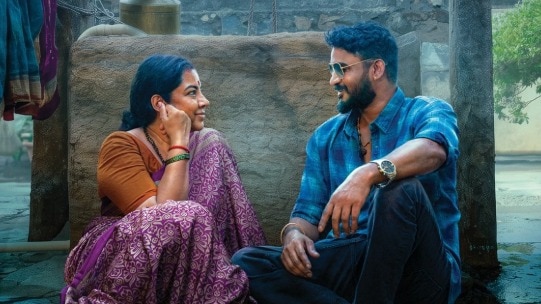
There are films that leave you speechless because of how magnificent they are. And then there are films like Lakshmi Puthra that leave you speechless because you cannot believe someone actually wrote, shot and released something like this in 2026. This is not just a painfully dated film. It is an exercise in normalising regressive ideas, dressing up harassment as romance and expecting audiences to applaud a man simply because he loves his mother. Veteran actor Thara Anuradha is perhaps the only redeeming factor in this otherwise exhausting experience.Directed by Vijay S Swamy, Lakshmi Puthra is Chikkanna's second outing as a lead actor after the success of Upadhyaksha. One would expect a film that builds on the goodwill he earned with his debut. Instead, this feels like an unfortunate career detour. Set in the Mandya region, the film revolves around Krishna (Chikkanna), a man whose primary ambition is to find a woman to marry and fulfil his mother Lakshmi's (Thara Anuradha) wish of seeing him settled. What follows is a screenplay that appears to have been dug out of a dusty cupboard of Kannada commercial cinema from the 2000s.The film's biggest problem is its understanding of romance, or the complete lack of it. Krishna is a serial eve-teaser, constantly pestering women and going after young girls with an enthusiasm that borders on desperation. At one point, a 30-year-old man attempting to woo 18-year-old girls outside their colleges is presented as harmless romantic pursuit. Apparently, he is only doing this because he is looking for a suitable bride for his mother. If that sounds absurd on paper, wait until you see the film attempt to sell it as comedy.The screenplay operates on the assumption that a man can do practically anything as long as his heart is in the right place. Krishna is a devoted son, refuses to have sex before marriage and protects the village's cattle from thieves. These are apparently sufficient qualifications to establish him as a good man. His behaviour towards women, meanwhile, is treated as an amusing character quirk rather than the glaring problem it is. When the woman he relentlessly pursues finally loses her patience and slaps him, the narrative turns it into an emotional turning point. His harassment is eventually rewarded with her acceptance, accompanied by an admission that she actually liked all the eve-teasing. Yes, you read that right. The film manages to turn a woman's anger into an expression of affection and her discomfort into a confession of love. Are we still living in the 2000s? It is one thing to create a film rooted in a rural setting and acknowledge that certain conservative attitudes continue to exist within sections of society. It is quite another to present their regressive aspects as aspirational, harmless or romantic. Lakshmi Puthra does the latter without an ounce of self-awareness. From below-the-belt jokes and regressive commentary about young women to the complete absence of accountability for male misbehaviour and the use of sexual orientation as a source of comedy, the writing repeatedly finds ways to excuse the protagonist. The mother-son sentiment becomes a moral insurance policy: no matter what Krishna does, the audience is expected to forgive him because he loves his mother.The irony is that the film positions this mother-son relationship as its emotional centre. AP Arjun, infamous for directing Martin, has written the story, screenplay and lyrics. He spoke about drawing from his own mother's mannerisms while creating the character. There is nothing wrong with building a film around familial affection. In fact, Krishna's relationship with his mother could have been the foundation for a genuinely endearing entertainer. But what is the point of celebrating a mother's love while using it to excuse a grown man's inability to respect women?Vijay S Swamy, who makes his directorial debut after working alongside AP Arjun for several years, struggles to bring coherence to the material. The film feels as though the makers lost interest somewhere along the way. Its technical quality fluctuates between something contemporary and something that belongs to an entirely different decade. The cinematography, production values and overall visual treatment lack consistency, while the editing does little to improve the experience. Arjun Janya's music is, at best, passable.Chikkanna attempts to carry the film with his familiar comic timing and witty dialogue delivery. His natural screen presence works in a few moments, but he falls short when the screenplay demands emotional depth. His comic instincts are evident, but he struggles to make the heavier scenes convincing. Vandita Gowda, as the female lead, looks pretty on screen, and that is about it. Her poorly written character offers little room to make an impression. The supporting cast, including Kuri Prathap, Dharmanna and Manu, also struggle to leave a mark. There is a conspicuous lack of direction in the performances. Some actors look lost, others seem unsure of how to react, while a few appear to be desperately improvising their way through scenes. Shockingly, all of it makes it to the screen.Veteran actor Thara Anuradha, however, is a different story. She is easily the best thing about Lakshmi Puthra. As Lakshmi, she brings a warmth and emotional sincerity that the film desperately needs. There are moments when she channels the affection and playful energy of her character in Yash's Kirataka, while her emotionally charged portions occasionally remind us of her performance in Rakshit Shetty's Ulidavaru Kandanthe. She adds an emotional layer to a character that could otherwise have been another stereotypical mother in a commercial entertainer. Even her performance has moments where the lack of direction shows, but that is a criticism better directed at the filmmaker than the actor.Mithra, despite his limited screen time, also makes an impression. He particularly shines in an emotionally charged confrontation scene, bringing a sincerity that is otherwise missing from much of the film.There is often considerable criticism directed at filmmakers such as Sandeep Reddy Vanga for their portrayal of relationships, masculinity and problematic male behaviour. But films like Lakshmi Puthra deserve to be called out just as loudly. The problem is not that a fictional character behaves badly. Cinema can portray flawed, even deeply unlikeable characters. The problem arises when the writing refuses to recognise those flaws, romanticises them and rewards them with the affection and validation the protagonist has done little to deserve.Lakshmi Puthra is neither an entertaining comedy nor a convincing emotional drama. It is a regressive, technically underwhelming and thoroughly exhausting experience. A screenplay that treats eve-teasing as courtship and a mother's approval as proof of a man's goodness has very little to offer audiences in 2026. Thara Anuradha walks away with the film's only genuinely memorable performance. Everyone else, including the audience, deserves better.- EndsMUST WATCH:
Lakshmi Puthra review: Only Thara shines in this painfully regressive 'entertainer'
Full Article
Original Source
Read the full article at Indiatoday →KhanList aggregates and links to publicly available news content. We do not host full articles from third-party sources. Always verify important information with original sources.