
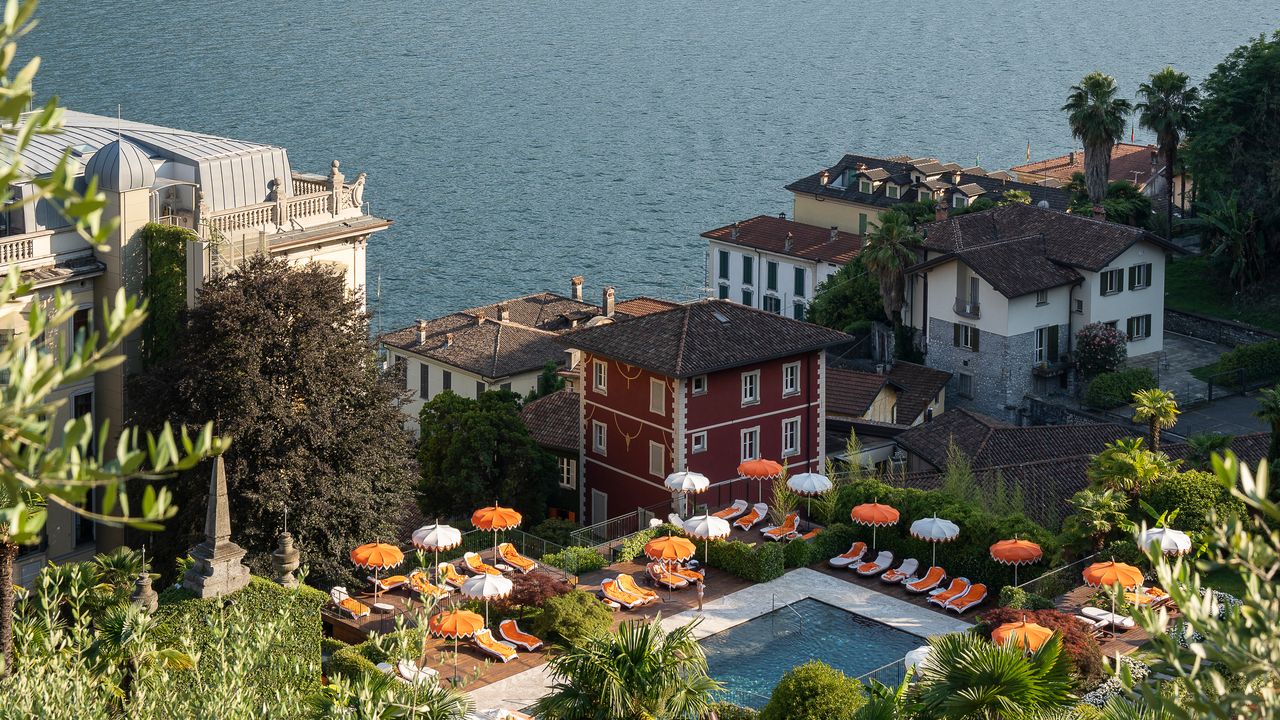
Late-spring afternoon sun streams along Lake Como through a silk curtain, illuminating the sturdy wooden room of the Rubelli mill, where Lorita Bellocco works an 18th-century loom. She pulls at the 800 spools of thread with the care of a doctor in surgery and pushes down on the hulking pedal. The bulking machine grunts like a workhorse. “It isn't just physical,” explains Bellocco. “Few people have the mental endurance needed for this work.” It will take her a year to finish weaving this six meters of material for the famous textile house, whose prized fabrics are found everywhere from Tiffany & Co. in New York to La Scala in Milan, and which has partnered with Gio Ponti, Paola Navone, and Ai Weiwei, among others. Rubelli's archive consists of thousands of textiles, and the most valued of all begin here, just off the shores of the famous lake, in this room.The dock with umbrellas at Grand Hotel Tremezzo Marco ValmaranaA view of the lake over Grand Hotel Tremezzo's pool Marco ValmaranaCraft and artisanship isn't often top of mind when travelers consider Como, known for its Riva boats, chic lakeside hotels, and celebrity-owned villas. But the luxury destination's proximity to Milan, where desire for silks, upholstery, woods, and ceramics ran high for centuries, made it a strategic center of production (its silk industry allegedly began when a 15th-century Milanese duke had the good sense to plant mulberry bushes along the lake's fertile shores). Though regarded for its woodworking centered in towns like Bellagio, the area is especially celebrated for its silk production from maisons like Mantero, which is thought of as producing some of the best in Europe, and has dedicated textile training institutes and the perfect microclimate for mulberry bushes. As wealthy merchants built holiday homes along Lake Como, and hoteliers followed, these local makers and more helped turn them into exquisite places to stay.Lorita Bellocco (right) with Leonardo Favaretto Rubelli of the namesake family Marco ValmaranaRubelli-upholstered pillows at Tremezzo Marco ValmaranaAs such, travel and craft intersect in Como. At the palatial Grand Hotel Tremezzo, the lake's true grande dame, owner Valentina De Santis ensures her couches, pillows, and more are upholstered by Rubelli. Her family, Comaschi for three generations, are committed to using their properties as show ponies for the local artisans and crafts. “Partnering with Como artisans is fundamental for us,” says De Santis. “Heritage, authenticity, and local identity is how we define true luxury.” Her family's second property, the regal Passalacqua, which opened in 2022 inside an 18th-century villa, is a fever dream of frescoes, marble, and Murano glass. Grand Hotel Tremezzo can also arrange for guests to visit the Rubelli factory and see the artisans working the looms. De Santis reveals that even her crib was upholstered in local Como silk. “[These craftspeople] are custodians of Italian traditions, and they bring their centuries of craftsmanship into the hotels spaces,” she says. “It's also about regional pride.”The partnerships don't end there. One of the most storied ateliers in Como is silk company Mantero, famed for its delicate printed scarves for clients like Chanel. More than 500 workers oversee current projects and an archive, a meditative space for its tomes of silk samples that houses a collection of 75,000 fabric prints, 80,000 silk scarves, and more. Though the studios are rarely open to visitors, travelers to Como can experience Mantero through Passalacqua; De Santis has worked closely with the maison on signature scarves available for purchase, which feature custom prints of the property and vignettes from its history, including the local roosters that were often used as entertainment for the nobility who lived in the villa before it became a hotel.At work in Castiglioni Marco ValmaranaTremezzo's delicate flooring Marco ValmaranaBeyond collaborations, the art and craft scene has been brought to life this year in Como town. At the newly opened Casabianca, modern art is displayed in a space alongside a sharp all-day restaurant—an outpost of Cova in Milan—where well-dressed Comaschi sip Negronis and dine on petite plates of pasta and gorgeous confections right on the lake. The art is from the private collection of Paolo and Antonella De Santis, Valentina's parents, and is mostly from the 1960s, '70s, and '80s, with pieces by heavyweights like Anselm Kiefer. The building itself is an homage to Como; noted local woodworkers Castiglioni restored all the floorboards. “We wanted to create the feeling of entering our home,” says patriarch Paolo, next to a work by Marina Abramović near Casabianca's entrance. Part of the motivation is to up the arts scene in the lake's largest town. Recently three suites opened above the gallery, complete with Gio Ponti taps, Rubelli wallpaper, and Milan-designed Azucena chairs, with spectacular views across the water. Even with its siblings, Casabianca may just be the most creative place to sleep on the lake.This article appeared in the September/October 2026 issue of Condé Nast Traveler. Subscribe to the magazine here.
Lake Como’s Other Luxury: Its Enduring Craft Traditions
Full Article
Original Source
Read the full article at Cntraveler →KhanList aggregates and links to publicly available news content. We do not host full articles from third-party sources. Always verify important information with original sources.