
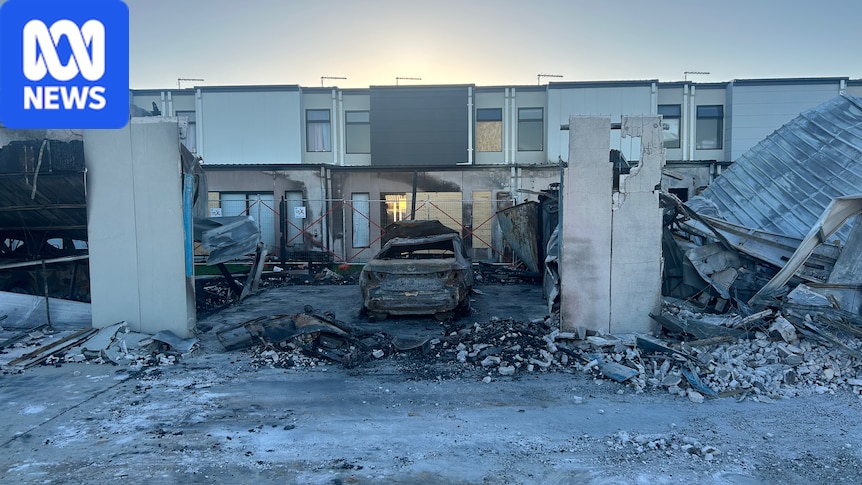
Freda Kililit's thoughts are ravaged by "what if" moments two years after her home burnt down.The mother and nurse started her day hours later than usual due to a shift change, when she noticed an ominous glow from the neighbour's backyard.Her husband and baby were upstairs at home in Clyde North, in Melbourne's outer south-east, unaware of the impending disaster.She was also aware a baby lived in the neighbouring property where the fire was quickly spreading."I immediately worried and panicked," she recalled.Ms Kililit told husband to go downstairs, called Triple Zero (000), and ran next door to alert the family.The Clyde North backyard fire spread to multiple properties in 2024. (Supplied)"You're just imagining the worst possible scenario," she said."You're just thinking: 'The baby, the baby'."While the neighbours were away, she managed to wake up an occupant inside who was visiting.As the minutes past and the fire spread onto her property, Ms Kililit listened for the reassuring sound of sirens approaching.There was nothing. She called Triple Zero again to make sure they had the right address.But that wasn't the problem.Clyde North was due to have a new Fire Rescue Victoria station built in 2023. Yet even today, construction hasn't begun.The nearest professional firefighters had to come from Cranbourne, more than five kilometres away.When professional firefighters eventually arrived, later than target response times, Ms Kililit's home was ablaze."I usually work on Sunday mornings," she said."If I worked that day, and didn't see that fire, it would have had a terrible outcome for my family."Response rates falling shortFor firefighters, every minute is crucial. The difference between five, seven, or nine minutes can be a matter of life and death.To reduce the "what ifs", Fire Rescue Victoria has targets that stations should hit 90 per cent of the time.These targets state firefighters should get to a blaze within 7.7 minutes.For other emergencies, like car crashes, the target is 9.2 minutes.Firefighters have for years raised concerns about the lack of resources to get to jobs on time.New trucks, stations, and crews simply aren't being added to the mix to keep up with Melbourne's sprawling population growth, firefighters have argued.The ABC analysed publicly available data for ten fire stations in outer suburban regions identified by Fire Rescue Victoria (FRV) as growth areas.The data showed not only were response times worse than FRV's targets, but that there was a clear trend of response times becoming slower over the years.The data also showed these regions performed significantly worse than the state average, which was also below FRV targets.Senior station officer Geoff Barker has been a firefighter in Melbourne's south-east for 26 years.He spoke to the ABC as a member of the United Firefighters Union.Mr Barker said slowing response times were "embarrassing" for firefighters."Fire has more time to develop and expand and spread. It's increased property loss."And more seriously, the likelihood of survivability of someone trapped by fire is significantly reduced."Geoff Barker is a firefighter in Melbourne's south-east and member of the United Firefighters Union. (ABC News: James Oaten)In 2020, all career firefighters were amalgamated into one organisation: Fire Rescue Victoria.Volunteers who support professional crews or service less populated regional areas remain with the Country Fire Authority.As well as slowing response times, FRV data also showed the areas of concern were experiencing a consistent increase in the number of emergency incidents firefighters were responding to. The trend lines in some areas are more profound, particularly in western regions like Tarneit, Lara, Point Cook, Melton; in the north like Tullamarine and Sunbury; and in the south-east like Cranbourne and Hallam.The latest Fire Service Outcomes Framework Progress Report provided a scathing assessment of the issue, after it pointed out FRV has not met response times since 2020."This issue has persisted for too long, and as a risk to community safety, necessitates action by FRV," the report said.In the report, FRV blamed population growth for fuelling traffic congestion and expanding areas firefighters need to drive to, adding "significant capital investment" was needed to address the problem.Emergency Services Minister Paul Edbrook said Victoria had "the best response times in the country" but accepted there was "always room for improvement".Paul Edbrook says the state has allocated $40 million for new FRV appliances. (ABC News: James Oaten)"I've met with the chief officer of FRV [and] the chief officer of CFA quite regularly," he said."Any time they have a request, [I am] more than happy to entertain that and twist the treasurer's arm behind his back to make sure they get what they need."Back in 2021, FRV mapped areas firefighters could not reach within benchmark response times. The intention is to show gaps in the system, which could be addressed with more fire stations.Before: Fire trucks can't get to the highlighted suburbs within the required time because of their distance from fire stations. . . After: Areas in the south east of Melbourne where a fire truck can't get to within designated time. . .Instructions: Use left and right arrow keys to control image transition Before and after imagesSLIDE Fire trucks can't get to the highlighted suburbs within the required time because of their distance from fire stations. / Areas in the south east of Melbourne where a fire truck can't get to within designated time. Station officer Geoff Barker said the failure to address the problem was destroying morale."We go to a fire and we witness increased property loss and damage and that could have been prevented," he said."It impacts us. We should have and must do better."Appliance availability concernsCentral to the concerns from firefighters is the number of appliances, or trucks, and crews have not increased to match population growth.The Victorian government has argued it is providing Fire Rescue Victoria with record budgets to add new fire trucks, or appliances, to the network."We are renewing, replacing and upgrading our vehicles and equipment to improve reliability and ensure our firefighters have the resources they need to respond when called upon," FRV told the ABC in a statement."We continue to advocate to government for further investment to support our operational needs."FRV vehicles include pumper trucks and aerial appliances to fight fires in taller buildings. (ABC News: James Oaten)Mr Edbrook, the minister, said a formal request for extra funding to buy new appliances had been made."There's $40 million ready in the pipe for new FRV appliances, $100 million for CFA," he said."That's record funding for the rolling replacement fleet that is being constructed right now."But the total number of appliances in the system has remained steady since FRV took over in 2020.That, according to firefighters, is because the rate of new trucks is not outpacing old trucks taken offline due to wear and tear.The availability of appliances, ready to respond to emergency jobs across the network, has also fallen below targets, according to the latest Fire Service Outcomes Framework Progress Report.The issue came to a head earlier this year, after the death of toddler Jordan Dashwood after his Werribee home caught on fire.Firefighters from the nearby station of Tarneit had long argued for a second truck and crew to cope with increasing demand.Tarneit's population ballooned from around 53,000 people in 2020 to more than 76,000 by 2025, an increase of more than 23,000 people, according to Australian Bureau of Statistics estimates. On the night of Jordan's death, the single Tarneit crew were on another job, so the closest professional fire crews drove from Point Cook, missing the response targets yet again."It's hard to talk about," leading firefighter Josh Mitchell said at the time."We've all got kids. We have the burden of asking ourselves whether we could have done more."Mechanical failures and fire truck repairsAnother key concern from frontline firefighters is the rate of trucks failing.In 2024, a crew from Tarneit was responding to a house fire in Truganina when the water pump failed to turn on.Leading firefighter Dane Heaysman and his crew from Point Cook arrived four minutes later.Dane Heaysman says equipment failure is a regular occurrence for firefighters in Victoria. (ABC News: Nathan O'Brien)"The crews were rattled," said Mr Heaysman, speaking as a member of the UFU."If we can't put water on the fire, that really limits what we can do as firefighters."Firefighters were forced to do a search and rescue without water, something that goes against fundamental training, he added."At the start of my career, [equipment failure] was almost unheard of," Mr Heaysman said."Fifteen years later, it's a regular occurrence. It just puts a lot of doubt in your mind when you're turning up to jobs."Each week, FRV publishes internal documents highlighting the number of trucks that are out of action due to mechanical failure and undergoing repair.The data for the much of Melbourne, known as Division A, goes back years, while the data for outer suburbs and regional cities, known a Division B, was only added in May.The documents show the number of trucks offline in Division A spiked to critical levels late last year. When Division B was added, it was already at critical levels.By the end of August, a record number of 62 trucks were offline for both divisions.But recently, FRV removed the scale that identified what was deemed a "critical" or "significant" shortage of appliances.FRV did not provide specific answers to a series of detailed questions from the ABC, including why it had removed the scale that determines if the system is facing a "critical" shortage.For some firefighters, it represents an attempt to hide the problem."The only thing worse than a stuff up is a cover up," Mr Barker said."What we feel is they're trying to hide and minimise the liability."CFA and FRV borders In regional and outer suburban areas, volunteer firefighters with the Country Fire Authority (CFA) form a vital and highly praised part of Victoria's firefighting capability.In some areas, professional and volunteer brigades can and do overlap.Last week, CFA volunteers also raised concerns about the age of their fleet. "FRV and CFA regularly provide services outside of their district boundaries, supporting one another," FRV said in a statement.Werribee, an outer suburban growth area, still falls within CFA territory.That's despite growing by some 20,000 people over the past five years, while the broader area known as Wyndham — which is Victoria's fastest growing region — has added over 60,000 residents.This year, a four-year review concluded Werribee had experienced a "unprecedented high number" of incidents.Unlike some other CFA regions, there was no suggestion the local brigade was responding "adequately".But despite the issue, the Fire Review did not recommend FRV expand into the area because of "insufficient appliances suitable to the environment" and the "location of current FRV stations".For professional firefighters, that is a chicken and egg problem that can be resolved by building an additional station in Werribee and adding new appliances."The recommendation identifies the lack of suitable appliances ... so let's get them," said Mr Barker, the Cranbourne firefighter.Mr Edbrook, however, said Werribee CFA was meeting response times "by more than 90 per cent"."They're a very experienced brigade," he said."They do a great job keeping their community safe."Faster response time could have saved home, union saysIn Clyde North, the first crew to arrive at Freda Kililit's house fire was the local CFA station.Official call sheet data shows the brigade responded outside targets, at 8:48am, and radio transmission logs suggest just over eight minutes.The then-minister for emergency services, Jaclyn Symes, told Victorian parliament the time of arrival was actually 7:27am and blamed "radio traffic" for the delay in reporting their arrival.A fire gutted Freda Kililit's Clyde North house in 2024. (Supplied)Mr Barker said he was "very confident" a local FRV station would have responded much faster and likely saved Freda's home."Honestly, I could have walked over there," he said.In its response to the ABC's questions, FRV did not explain why Clyde North station had not yet been built.Mr Edbrook said planning for the station was underway.Freda Kililit remains plagued by "what if" moments. (ABC News: James Oaten)Ms Kililit said her community should have a full-time fire station, as was promised."You just want your family, your community, everyone to be safe and secure," she said."I'm just scared to think what can happen if a fire like this happens again."
Lagging fire response in outer Melbourne poses 'risk to community safety'
Full Article
Original Source
Read the full article at Abc →KhanList aggregates and links to publicly available news content. We do not host full articles from third-party sources. Always verify important information with original sources.