
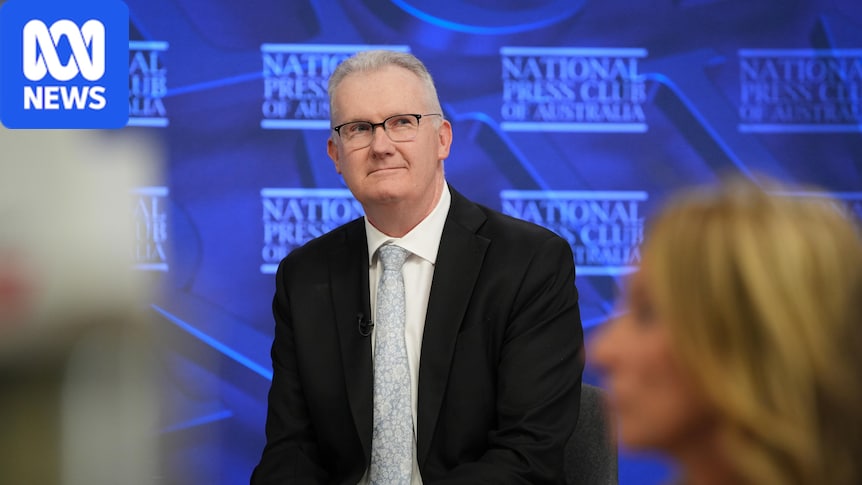
Labor has made a lasting concession to a migration debate that shows little sign of rewarding them for joining it.A Treasury forecast for net overseas migration (NOM) to fall to 225,000 had already become a political benchmark to judge the federal government against.Home Affairs Minister Tony Burke has now gone further by formally accepting the figure as a target and effectively turning it into a guarantee.Most Labor MPs will be glad to see the end of constant speculation about Labor's temporary migration policy, sparked by the six-week delay in unveiling the plan.Burke certainly delighted in dispelling some of the inaccurate reporting when he finally announced the tighter visa rules aimed at bringing down arrivals and increasing departures.He has ended the uncertainty of what the government intends to do, but Labor is now in a fight where the terms have been set by its political opponents.Failure is not an optionFronting the National Press Club on Thursday, Burke declared the NOM forecast "must be met" and was unequivocal when pressed on the possibility of failure.He said that "won't happen".The distinction was essentially academic, but future governments may wish Labor had never formally accepted NOM as a "target".It was not quite a year ago that Burke was at the press club describing the figure as a "guide" and declining to nominate an optimal number."I won't give you a magic number," he said. "I don't think there is a magic number."Burke argued NOM's predictability would "always be uncertain" partly because of Australian citizens' behaviour.But under pressure from political opponents, who argue they have the public on their side, Labor gave up what wriggle room remained.Migration votes are hard to findThere is no doubt Australians are concerned about migration.Ask voters if levels are too high and many will say yes, just as they would complain about congestion, housing or pressure on services.But pollster Kos Samaras argues there is a difference between disliking something and voting on it.Research conducted by his firm Redbridge over the past year has found migration is a salient issue for only about 10 per cent of voters, with most already supporting One Nation."I do not know why the political class keeps talking about migration," Samaras told this column. "There are no votes in it for anyone except One Nation."Pauline Hanson's One Nation is the only party winning votes from migration. (ABC News: Matt Roberts )Even on housing, only about 30 per cent of Australians believe migration has contributed in some way.Samaras said the main vote drivers remain the economy and health.Reducing migration might be popular in isolation, but the voters most likely to reward a government for doing it are already parked with the one party promising to go much further.Pinning down the numbersThe other difficulty for Labor with fixing on 225,000 is how the number was arrived at in the first place.Treasury does not start with a desired number deemed optimal for the economy and work backwards. It forecasts movements into and out of Australia based on observed behaviour, visa data and government policy.Lately the predictions haven't been great, largely because it has proved difficult to pin down when temporary migrants already here will leave.Still, Labor has adopted the destination already sitting in the budget and promised to make policy conform to it.But that doesn't settle whether a number calculated as the likely outcome of existing settings should become the basis for future policy.Anthony Albanese and the government have to decide if 225,000 is indeed the right NOM. (ABC News: Adam Kennedy)How low is low enough?In embracing NOM as a target, Burke argued the post-COVID migration peak had been too high and housing supply needed time to catch up. But there is no guarantee Labor will get any political dividend from hitting 225,000, particularly when its opponents are promising to go much lower.That would be why Burke has been trying to make the case against deeper cuts, warning they would "trash" the economy and services.Burke rejected the idea of Australia as a nation of "mass migration" — a term used by One Nation and many in the Coalition — as "absurd". And yet Labor has accepted the premise of that debate, that there should be a publicly nominated migration number for which government is accountable.Once everyone is bidding on NOM, the argument naturally becomes who will go lower.One Nation want to plunge into the negative before settling at 130,000 in three years' time, while the Coalition will tie its target to housing completion rates and likely settle on a NOM of between 150,000 and 170,000.Political control over migrationLabor may want the argument to be about how migration is managed, but in fixing on a target it has given greater legitimacy to the numbers contest.Every time housing gets tighter, unemployment rises, infrastructure strains or the NOM overshoots, there would be political pressure to revise the number down.There would be much less political reward for arguing it should go back up.It's hard to imagine anyone outbidding One Nation leader Pauline Hanson in this auction.And Labor spends its time explaining why its own reduction is sufficient, then the argument has already moved away from whether cuts are the right response to the underlying problems.Burke's policy package is largely about gaining control over parts of the migration system that are demand driven like backpacker extensions, student dependants, visa-hopping and overstayers.But as no one knows better than him, greater control over the system is not the same thing as precise control over NOM.
Labor's migration target comes with a political catch
Full Article
Original Source
Read the full article at Abc →KhanList aggregates and links to publicly available news content. We do not host full articles from third-party sources. Always verify important information with original sources.