
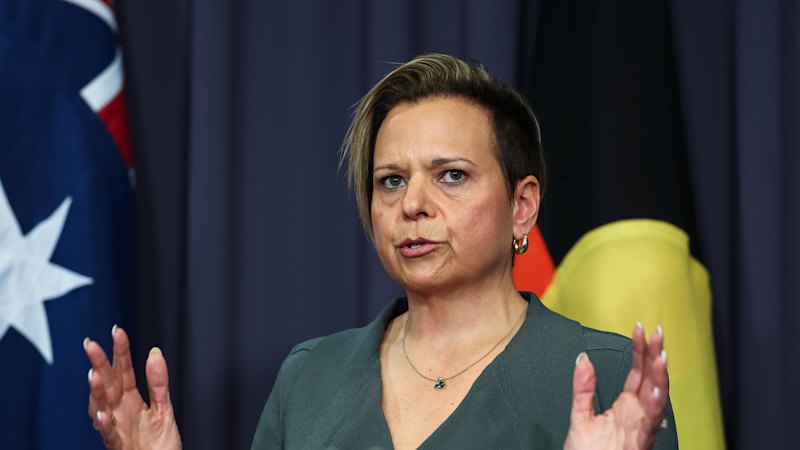
AI glasses will continue to flood into Australia despite the federal government acknowledging serious concerns that nefarious actors are using the wearable technology to covertly film unsuspecting victims.Attorney-General Michelle Rowland said at a press conference on Monday it would be up to public swimming pools, childcare centres and small businesses to consider whether they wanted to restrict the use of smart glasses on their premises, saying a federal import ban was not imminent.Attorney-General Michelle Rowland in Canberra.Alex EllinghausenRowland was announcing consultation on the government’s latest attempt to update protections for Australians’ privacy as technology rapidly evolves, including restricting how tech giants use people’s data.But the Coalition and Greens said the reforms, which Rowland billed as “the toughest and most digital-compliant privacy reforms in this generation”, failed to tackle the issue of AI glasses as cheap versions fly off the shelves at Kmart. Advocates have sounded the alarm about how much easier the devices – dubbed “pervert glasses” by American talkshow host Jimmy Kimmel – make it to covertly record others. Earlier this month, Rowland demanded the privacy commissioner urgently intervene to protect women and children from potential privacy risks.Rowland said on Monday the government’s focus was on strengthening existing laws under the Privacy Act, rather than playing “whack-a-mole” with an import ban as demanded by the Greens.Labor’s proposed changes include a new “fair and reasonable test” to stop tech giants from harvesting more data than they need, and a “right to erasure” that would allow consumers to demand platforms destroy their personal data.The proposed laws also include stronger standards for consent by cracking down on hidden terms and “take-it-or-leave-it conditions” that allow platforms to exploit user data, and requiring explicit permission for businesses to buy and trade Australians’ personal information, including shopping habits or location data.“I acknowledge that there are deep concerns about [AI glasses]. But the notion that this is somehow a quick and uncomplex mechanism to impose an import ban is not correct,” Rowland told reporters in Canberra.“An import ban is a matter that would have consequences across government, including across trade, foreign affairs, and other potential legal obligations that can apply internationally.”She said the government would continue to work on striking the right balance between embracing new technology that had legitimate uses – smart glasses can be used by visually impaired people to read labels and describe objects– and protecting Australians from harm.“This is an opportune way of dealing with some of those matters with privacy reforms to make them fit for the digital age right now,” she said.Rowland commended Brisbane City Council for banning AI glasses at its public pools, and urged other local governments to consider doing the same at council-run locations such as childcare centres.She said businesses, such as department stores with change rooms, might also decide it is in their interest to prevent the use of the technology.“Businesses know that good privacy is good business,” Rowland said. “If they consider that this is an area where their ... patrons would be best served by having these kinds of devices banned, then that would be a matter for them to implement.”Rowland challenged the parliament to back the reforms.“We do expect this will be considered by an appropriate parliamentary committee, but I see no reason why we couldn’t have these laws in place within a year,” she said.Greens digital rights spokesman David Shoebridge said the measures announced on Monday went some way to dragging Australia’s privacy laws into the 21st century, but that there were gaping holes in the regulation of AI glasses.“There is still no requirement for a prominent light, a recognisable sound, or any outward sign that a pair of glasses is recording or searching online about people the wearer is seeing,” the senator said.He also noted the Privacy Act only applied to businesses and agencies, not individuals.“Smart glasses that whisper a stranger’s name, their job, and social media history into someone’s ear, will still sit entirely outside privacy laws with this bill unless it is being done during work.”Shadow attorney-general Michaelia Cash said the Coalition was “particularly concerned that this legislation does nothing to address the use of smart glasses”.Independent MP Kate Chaney, who has been calling for a fair and reasonable test, said Labor’s move on strengthening the Privacy Act was long overdue, while warning the Privacy Commissioner would need to be properly resourced to have any hope of enforcing the changes.“A legislative framework is only as strong as the body enforcing it,” Chaney said.Cut through the noise of federal politics with news, views and expert analysis. Subscribers can sign up to our weekly Inside Politics newsletter.From our partners
Labor backs away from outlawing ‘pervert glasses’
Full Article
Original Source
Read the full article at Smh →KhanList aggregates and links to publicly available news content. We do not host full articles from third-party sources. Always verify important information with original sources.