
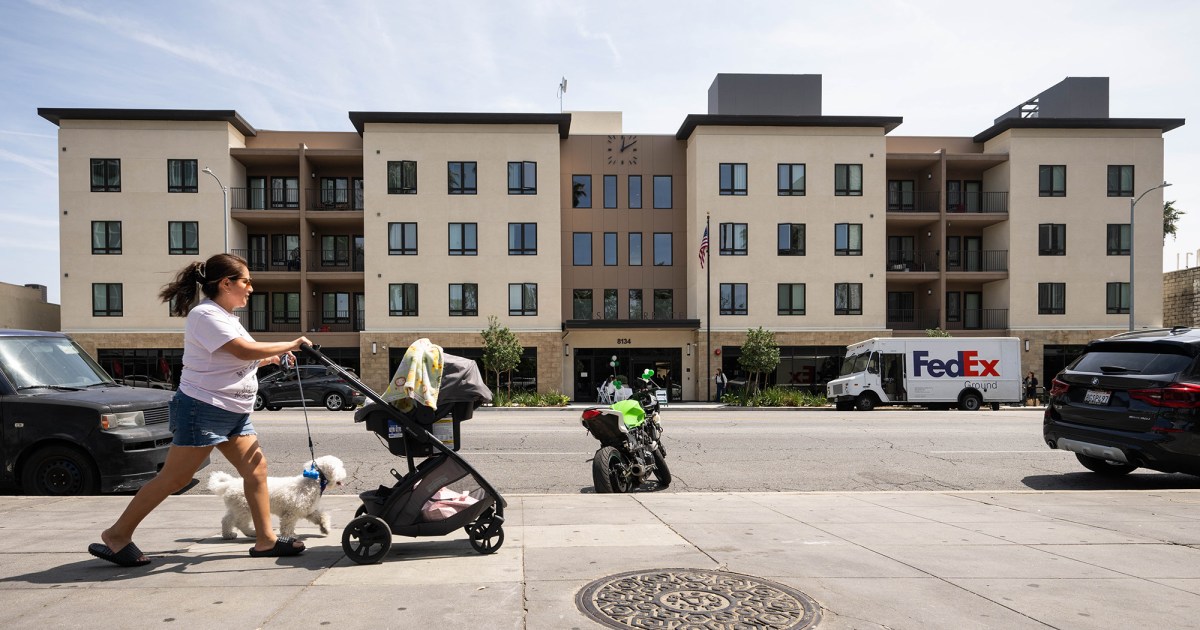
The Vista Terrace, a 102-unit, affordable and supportive housing apartment complex on Van Nuys Boulevard in Panorama City, Los Angeles.Sarah Reingewirtz/MediaNews Group/Los Angeles Daily News/Getty Get your news from a source that’s not owned and controlled by oligarchs. Sign up for the free Mother Jones Daily. For more than thirty years, Maria José has lived in public housing in Los Angeles with her family. Most of that time, the 66-year-old Mexican woman, who asked to go by a pseudonym due to her immigration status, has been a caretaker. First for her five children, who have since moved out and become independent. Now, she takes care of her husband, a permanent resident who was partially paralyzed after a stroke around five years ago. But an imminent change in federal housing policy means the couple could soon lose their home. They are among thousands of households who might have to decide between housing assistance or living without their immigrant family members this winter, because of an incoming change in federal housing policy. This week, Union de Vecinos, a local tenants and community organizing group that Maria José is part of, joined a federal lawsuit contesting a new Department of Housing and Urban Development rule that will push family members without sufficient immigration status from Section 8 and public housing. Undocumented immigrants and those with temporary legal status are not eligible for federal housing support. Still, for decades, many have been able to live alongside their documented family members who do qualify for help. Generally, mixed-status families pay more for housing than other beneficiaries—when providing subsidies, HUD only counts the family members who agree to verify their legal status. Maria José, for instance, says she pays a flat, monthly rent with help from her son, while her husband, who is the beneficiary, is only required to pay 30 percent of his monthly income. The new rule, set to come into effect December 12, would get rid of this prorated option and require that all public housing assistance applicants and recipients verify their immigration status or lose support. The policy change, the Center on Budget and Policy Priorities estimates, could push out nearly 80,000 people across the country out of their homes, including 36,900 children. Most are part of Latino households. In the Federal Register, HUD said these amendments would help the federal agency “align with the current Administration’s priorities and regulatory reform efforts”—that is, with Trump’s immigration crackdown. And the agency’s secretary, Scott Turner, has reiterated that the rule “guarantees only American citizens and certain eligible noncitizens will reside in HUD-funded housing,” and is “closing this decades-old loophole.” Housing and civil rights advocates counter that the rule would add further hardship to the lives of household members who do qualify. “Those are citizen children that now get evicted from their homes,” said Elizabeth Blaney, co-director of Union de Vecinos. “Already, parents are struggling with trying to carry multiple jobs, and now you’ve just taken away another level of support for the family.” In April, two months after the rule was first proposed, a coalition of local governments urged HUD to withdraw it, worried about its impact on their vulnerable communities and how it would destabilize their broader affordable housing networks. They also contended that the rule overrides a framework created by Congress to keep mixed-status families together. “It’s unconstitutional,” Blaney said. “They don’t have the right to discriminate in such a way and target residents, especially residents who are already paying higher rents.” In cities with affordable housing shortages and large immigrant populations, housing advocacy groups say the impact of the new rule would be especially stark. In Los Angeles, where the plaintiffs are based, approximately 1,700 mixed-status families would be affected, according to city estimates. They would enter a market, some for the first time in years, that has an affordable housing shortage of more than 400,000 units, according to California Housing Partnership estimates. “We already have a huge unhoused population here in LA, and we’re really concerned about the support that all of our community members will be able to receive if it is finalized,” said Cassidy Bennett, a staff attorney at Public Counsel, the nonprofit law firm leading the suit. More broadly, California’s Civil Rights Department has reminded HUD that, according to the federal agency’s own analysis, the new policy would require additional spending to implement, meaning the number of public housing units and services available would decline as a result. The rule would also, said the department’s director Kevin Kish, make it more difficult for the state to fight housing discrimination. As news of the policy spreads, tenants rights advocates like Blaney are working to remind families that the rule hasn’t been implemented and they don’t have to move out of their homes yet. “Nobody should be self-evicting,” she emphasized. Even after the rule comes into effect, cities will need time to determine how to implement it while groups like Union de Vecinos ensure they respect tenants’ other legal rights. And it’s possible the rule might be repealed during that time. “We hope that the new Congress will rescind it,” Blaney said. “People voted them in to support immigrant rights, and this is one thing that they can do to show that.” But as the rule stands, Bennett said she’s especially worried about the long-term impacts that losing housing stability could have on tenants, and how it would destabilize their communities. Two of the individual plaintiffs in the complaint, she noted, are US citizens with undocumented parents that have lived in public housing most of their lives. One is a young woman who has lived with her two brothers, her mom, and her stepdad for fifteen years. Her younger brothers both want to finish school—and she is hoping to get her master’s degree too. If the rule passes, Bennett said all three would likely have to work full-time to help their family pay market-rate rent somewhere else, abandoning their studies. The other is a 26-year-old man with cerebral palsy whose parents and sister have taken care of him in the same home since he was one year old. He’s the only citizen in his family, and can’t live by himself, Bennett noted. If the rule passes, the whole family would have to leave.
LA Tenants Sue to Stop HUD Rule Targeting Immigrant Households
Full Article
Original Source
Read the full article at Motherjones →KhanList aggregates and links to publicly available news content. We do not host full articles from third-party sources. Always verify important information with original sources.