
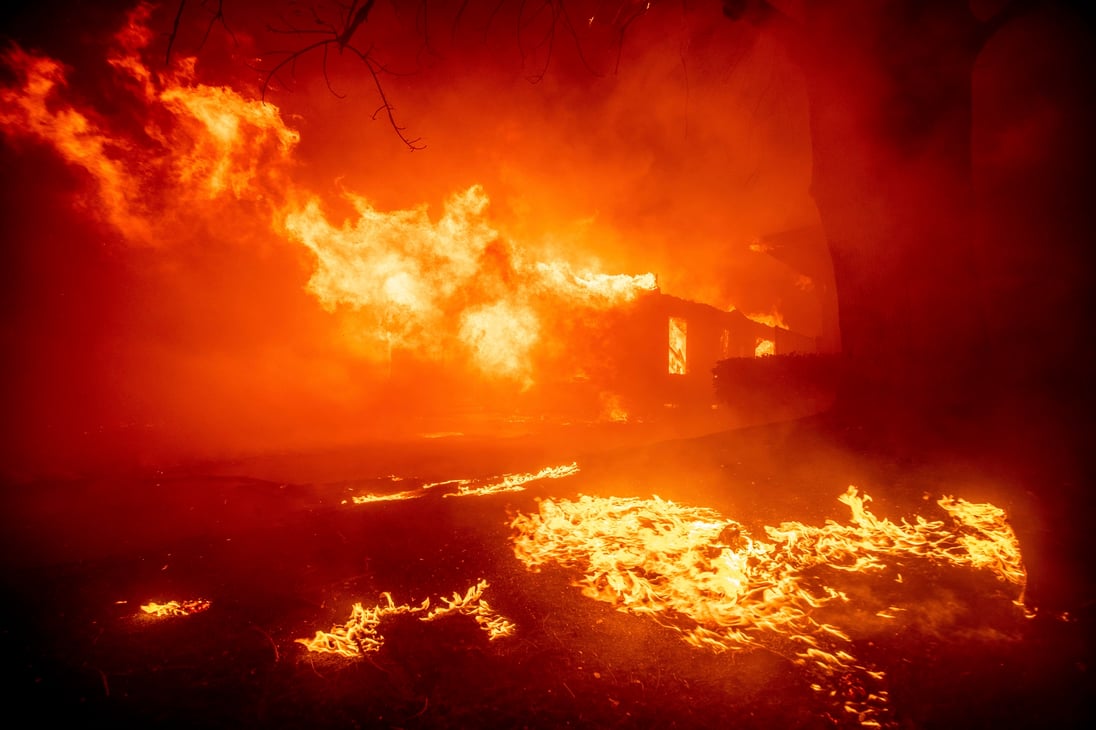
A new scientific paper argues that little is known about the effects of short-term exposure to such harmful pollution.LOS ANGELES (CN) — The 2025 Eaton fire killed 19 people and destroyed more than 9,000 structures, including nearly all of the neighborhood of Altadena, California. It also, according to a new study, unleashed an “urban smoke plume,” exposing nearby residents to potentially harmfully high levels of airborne lead, arsenic and halogens.“Millions of residents faced an acute toxic metal burden with unknown health consequences,” writes Caltech PhD student Haroula Baliaka and her colleagues. “Understanding and ultimately mitigating these health risks must become a priority as such [urban] events grow more frequent and severe.”According to the paper, published Wednesday in the peer-reviewed journal Science Advances, the Eaton fire contained a “cocktail of chemicals,” far more dangerous than recent wildfires in less urban areas.“Compared to wildfire smoke, the urban plume was enriched more than 50-fold in lead, 7-fold in halogens, and 3-foldin arsenic, a toxic mixture linked to burning vehicles, electronics and building materials, a fundamentally different fuel from conventional wildland vegetation,” Baliaka and her colleagues write. “During peak structural burning, we estimate that approximately 7 million residents experienced 24-hour lead concentrations exceeding 50 nanograms per cubic meter, over 80 times background levels.”The paper is an offshoot of Atmospheric Science and Chemistry mEasurement NeTwork, or ASCENT, a network of 12 monitoring stations funded by the National Science Foundation. One of those monitoring stations is in Pico Rivera, an LA neighborhood about 18 miles south of the Eaton fire.When Baliaka looked at the data from the monitoring station following the deadly blaze, what she saw surprised her. The chemicals from the smoke were completely different from a typical wildfire. There wasn’t nearly as much potassium; and there was far more lead.“I was surprised by the magnitude and complexity, as far as chemicals were concerned,” Baliaka said in a recent phone interview. “In retrospect, it absolutely makes sense. When you think of everything you ave in your home — multiply that by thousands.”Baliaka and her colleagues argue the Eaton fire represents a new kind of natural disaster that will only become more common, as urban sprawl and climate change cause more conflagrations with man-made sources of fuel. These fires will create a “chemically distinct class of air pollution” that our current air monitoring infrastructure is not set up to measure. Nor do researchers understand the impacts of short-term exposure to this kind of air pollution.“While the toxicity of chronic exposure to individual elements is well established, far less is known about the consequences of these short-duration but high-intensity exposures, as well as the cumulative effects of simultaneous exposure to complex mixtures,” the authors of the paper write. “There is an urgent call for epidemiological studies to explore the health outcomes associated with these exposures, particularly in children and other vulnerable populations.”“Our emergency responses should potentially change,” Baliaka said in the interview. “We don’t evacuate for smoke exposure, for example. We should just be having these conversations.”The Eaton fire was caused by a decades-old idle power line, owned by Southern California Edison, that had been disconnected from the electrical grid for more than half a century. On Jan. 7, 2025, abnormally high gusts of winds pushed nearby live transmission lines to momentarily reactivate the so-called “zombie line,” temporarily electrifying it. Because the zombie line was surrounded by overgrown, dry vegetation, a fire erupted, with disastrous consequences.More than 10,000 plaintiffs have sued Edison in an action that has been consolidated into one mass tort proceeding in downtown LA. The first bellwether trial is currently scheduled to begin in January 2027. The U.S. Justice Department has also sued Edison in federal court, while hundreds of plaintiffs have also sued State Farm, accusing it of underpaying claims.Categories / Health, ScienceSubscribe to our free newslettersOur weekly newsletter Closing Arguments offers the latest about ongoing trials, major litigation and rulings in courthouses around the U.S. and the world, while the monthly Under the Lights dishes the legal dirt from Hollywood, sports, Big Tech and the arts.Additional Reads
LA fire that devastated Altadena unleashed surge of toxic airborne metals
Full Article
Original Source
Read the full article at Courthousenews →KhanList aggregates and links to publicly available news content. We do not host full articles from third-party sources. Always verify important information with original sources.