
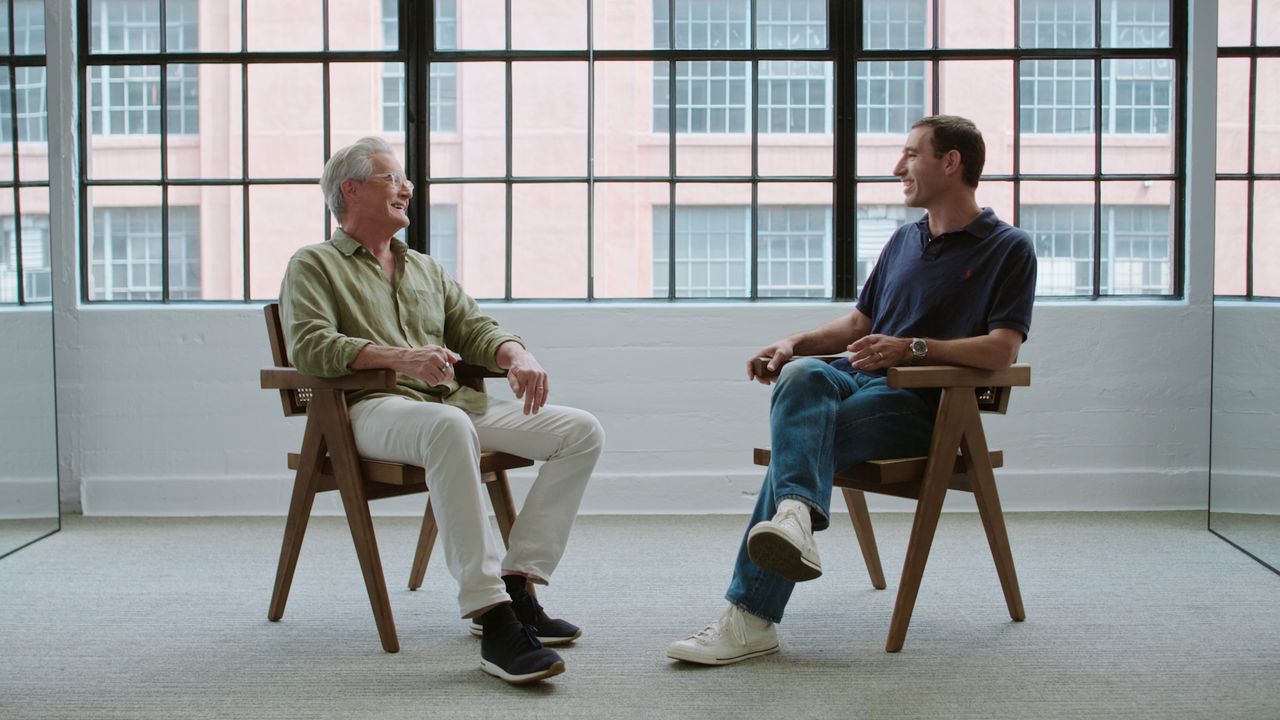
Kyle MacLachlan, Star of the Original Dune, on Watching the New Dune: ‘Everything Kind of Came Flooding Back’In the latest episode of GQ’s weekly interview series One More Question, the Twin Peaks and Fallout star talks to Zach Baron about typecasting, ambition, the ups and downs of his long friendship with David Lynch, and new Dune versus old Dune.Kyle MacLachlan has played many roles in his 40 years as an actor in Hollywood, but he will forever be most closely associated with David Lynch, for whom he starred in Dune, Blue Velvet, and Twin Peaks. MacLachlan — a cheerful, self-effacing guy from Yakima, Washington — had a quality then, and still has it now, off being just a little off. A heartthrob, but also something else. (See: Showgirls. Even if MacLachlan would prefer that you didn’t.) He is a leading man turned, in the back half of his life, into a beloved character actor, a mainstay of Sex and the City, Desperate Housewives, and more recently, The Lowdown and Fallout.MacLachlan’s new memoir, Fictional Selves, is a fascinating look at the life of an actor and the weird highs and lows of a memorable Hollywood career. The book is like MacLachlan himself: earnest, full of unexpected depth and self-doubt, and often quite funny.In this conversation, we talked about his relationship to fame, about David Lynch, about the old Dune and the new Dune, and much more.The following is edited and condensed from the latest episode of One More Question with Zach Baron. Watch below or on YouTube. Listen on Spotify or Apple Podcasts.GQ: I want to start with a line in your book. You write, “It’s not even like I break into movies. It’s as though the movies break through my quiet world and land directly on top of me.”Kyle MacLachlan: I mean, that’s in reference to Dune, really, which was such a fluke. Unless you believe in some kind of weird faith, which I do and don’t. But I was in Seattle, had finished my training as an actor, was going to be a repertory theater actor. That was my thing. And I was about to go to New York to seek my fortune. And I got a call about a movie called Dune. They were auditioning young actors in Seattle for the role of Paul. And it was so specific that I said, “Someone’s pranking me,” because I just happened to be a huge, huge Dune fan. And I went on that audition, and then that carried me down to Los Angeles, where I met David Lynch and Raffaella De Laurentiis on the back lot at Universal Studios. And then conversation ensued with David and he gave me the script at the end of the conversation and said, “Learn these scenes and come back and screen test.” And I was like, “Sure. I don’t even know what I’m doing.”Do you feel like you’re here by accident still, in some way?Every day. I mean, without that intervention or whatever it was, I would’ve gone to New York and I would’ve been hopefully involved in musical theater there. That was my thing. Or I’d be working at the Alley Theater in Houston or somewhere in Milwaukee or who knows where I would be. Completely different career, I’m sure. Completely different life.In the book you relay your first Hollywood experience, which is on the set of Dune, in Mexico. And for instance, they are burning giant piles of rubber tires to get the type of black smoke that David Lynch is seeking. At the time, I assume you’re like, “I guess this is just what movies are.” Now that you’ve been on many other sets, I wonder how you look back on it.It never would’ve happened. It was completely poison that was in those clouds of black smoke, burning tires. And it would occasionally waft right through the scene. And there were times when we were actually speaking and the winds would shift and the smoke would come through and you’d go to take a breath in and you couldn’t take a breath in. And then you couldn’t speak because your vocal chords were frozen. You just put your hand up and said, “Need some water, please. Thank you very much.” And then the wind would shift and you’d go on with it. I just said, “Oh, I guess this is movies.”Sting is on that set. You’re playing guitar with Sting.It was completely surreal. Sting was just about to embark on the Synchronicity tour. “Every Breath You Take” had come out. He was the talk of the town, really nice guy. And I played a little guitar and I brought my guitar with me from when I came down to Mexico City and I would bring it to a set and bring it to my little room in there. And so he said, “Hey, do you want to learn a couple songs?” I was like, “Okay, sure.” And I said, “I like ‘Roxanne.’ And maybe ‘Message in a Bottle.’” And he’s like, “All right, right.” So we sat in his room. His engineer was programming. I’m not sure what he was doing actually, but he appeared to be programming. It was a keyboard, but I think it was more than that. And so all the loops and everything, they were putting those in. So I was just sitting there absolutely fanboying out and trying to learn the songs, which I can still kind of remember.I think there are people who love this version of Dune. There are people who don’t. Did you understand the movie that David Lynch was making at the time?No. And I knew the books really, really well. So I knew the scenes. But the difficulty for me was the fact that all I could focus on was the stuff that was not getting in the movie. And I didn’t know what to say or do. I mean, I would sort of say, “Hey, when they wear the stillsuits, because they’re going in the desert, it’s really hot. What about the mouth covering, the hood thing? And they have these capes that are really cool.” Didn’t care. Not important. So I was like, “Okay. They know what they’re doing because they’re making the movie.” But it felt kind of odd to me.The other actors up for this role in Dune included Tom Cruise and Val Kilmer, both of whom later become your peers and almost, like, alternate selves. Paths not taken.Well, I don’t think there were paths I could have taken, because I tried. But those types of performances, those types of characters, those leading-men kind of performances—Tom, he went a certain direction and he was all in. I think he found what he does well and he’s really good at it. And I think what happens is once he sort of developed that and he found his path through, there were a couple of sidesteps as any career has sidesteps, but he’s found his direction. Val just continued to evolve.You talk about this in the book. After Dune, you get offered Platoon and turn it down. You got close to being cast inTop Gun and Some Kind of Wonderful. These near misses seem to haunt you a bit.At the time, they were really impactful, surprisingly. Because I always, in the beginning of my career, I sort of approached things trying not to care too much, because it hurt too much if I didn’t get it. But along with that went sort of: I didn’t really prepare. I kind of came in a little cavalier and winged it a little bit and that never works. I mean, once in a while you can hit on some inspiration. But if they ask you to do it a second time, it’s very hard to recreate that. So it wasn’t the best choice. A River Runs Through It was one and Dracula was one. I really wanted to do those. And those really hurt. And it’s not so much, “Oh, I want to play that.” I wanted to work with Coppola. I wanted to work with Robert Redford.You say, about those near-misses, that something was not clicking. What do you think that thing was that wasn’t clicking?Part of it is just simply you’re not the guy. And you’re close to the guy, but you’re not the guy. And having been on the other side of things as a producer, you’re kind of sifting through actors, and there are certain qualities and it comes down to a look or a feeling or a personality. It’s not even what they can or cannot do. They say: “This person feels right.” Or: “This person is really good, but I don’t think they’re quite right for this.” Unless you’re a superstar. And then of course they want you to do everything. And so I think it had something to do with that. I also think that just in terms of chops, skill level as an actor, I wasn’t there yet.You have this great line about these parts that you didn’t end up getting, in Top Gun and Miller’s Crossing and The Doors. You write: “Tony Scott knew I was no fighter pilot. The Coen brothers knew I was no gangster. And Oliver Stone knows I’m no rock god.” What do you think you were, in retrospect?I think I always was sort of that slightly enigmatic, more cerebral guy, maybe. Some secrets, some hidden stuff in the guise of this somewhat callow young man. I think in Blue Velvet, David Lynch, that was sort of, “Yeah, you’re perfect for that.” Which I was so happy for. But at the same time I was like, “Okay, I did that. I’ve done that and I want to try something different.” But there were other opportunities. Sex, Lies, and Videotape was one that was there. And I deliberately sidestepped that just because I thought: Now we’re in the same fabric here. And I’m like, “I don’t want to do that again, necessarily,” which turned out to be not the best decision. But it was made because of a certain rationale. I wanted to lean into that romantic hero type guy. I wanted to be that. But I didn’t really know quite how to get there.Do you feel like you ever figured it out?A version of him. Yeah, I think so. But there’s always problems. Either he’s a murderer or impotent. There’s always things. It’s like, “Oh, he has another problem besides that.” The romantic hero, he’s perfect, but maybe he’s got some other sort of major issue he’s kind of getting through.When you watch Timothée Chalamet now in Dune, do you see yourself?I don’t, really, but when I watched the movies, I was very nostalgic. I felt like I was revisiting something. The scene where he puts his hand in the pain box, it was almost word for word, because it’s from the book. I’m like, “Oh God, I remember that day and I remember working with Siân Phillips and I remember the costume and then how the camera moved and the choices I made walking in.” I mean, everything came kind of flooding back in a very unexpected way. And then I was like, “Oh, that would have been a great scene. I wish we’d done that scene in the tent. That would have been really good.” You know what I mean? Or you see something and you’re like, “Oh, I love that scene. That would have been fun to shoot.” But I didn’t really feel like I was watching the movie. I was always kind of in the movie too, a little bit. It was a weird sensation.And it was really fun to see some of the scale of things. When you see the worms in a desert, and I know it’s a lot of CGI and stuff, but I was like, “Wow.” And like, “God, they really move fast, don’t they?” We had a slice of a worm on the side of a boxcar on a railroad kind of chugging along that I was running after like this with the hook. It was very lo-fi in some odd way. But it was my Dune, and it was full of those wonderful memories.Did you ever have a conversation with David Lynch about these new Dune movies?No. No, he didn’t want to see them. He was not interested. I don’t know if he ever saw any of the other things that I did. And part of that I think is, and particularly with Twin Peaks, the character of Cooper, I was Cooper for David. I mean, I was “Kale,” which he used to call me, but I was Cooper. So whenever he’d see me, I’d be Kale sometimes, but sometimes he would see me when I’d go visit and say, “Coop, how you doing?”It’s very… Lynchian.I go to visit him and you’re in that environment. And it was a wonderful environment because he talked about the artist’s life. David was someone who created something every day. So he got up and he made something, or music, or he wrote, or he painted, or he was always creating. I didn’t really know the extent of that until after he was gone and I went to visit to check in on the house and everyone. And they were cataloging his archive. And there was a massive, massive amount of stuff—drawings and paintings and little things on matchbook covers that he had done. There was no material or medium that he wouldn’t create with or use somehow.And do you know what he saw in you?I never really asked him. We had a friendship. He casts based on meetings and conversations and something about me, my personality, maybe because we shared the same look. We grew up kind of in the Northwest. We have similarity in that way. He understood that I could take the audience into this world that he had created, which he recognized as being something challenging. And they would go with me because I come across, I’m a regular guy from Yakima, which is a good part of who I am. But I also had this other side, which was sort of drawn to this darkness. He’s pretty smart and he sensed it. And I think that combination is why he cast me, I think.Blue Velvet is critically pretty well received, but it’s not a huge hit or anything. But then in 1990 you do the Twin Peaks TV show, the pilot of which was watched by, I believe, 35 million people.It’s happening over there. It’s weird. It’s like you’re working on stage, you have an audience, bam, you’re getting an immediate reaction. You do film and television, you do it and you’ve done it. Then it comes out and you’re like, “Oh, great. Great. Okay, what does that mean?” It’s like, “I don’t feel any different. I’m going to work tomorrow, driving to the set.” There was more attention. There were indicators, let’s say. You shoot for a magazine or do SNL.Later, you lament not doing more with the opportunity, right?It was weird because I kind of, for some reason—maybe I was uncomfortable, maybe I didn’t trust it. Maybe I didn’t feel I deserved it. I don’t know what it was, but I didn’t dig in and take advantage of that moment in a way.We were talking earlier about you chasing different versions of a leading man and not finding the thing that clicks. And then later—and you talk about this in the book—you find success on these sort of ensemble shows where you’re in Sex in the City, Desperate Housewives, and now Fallout. One conclusion would be: There’s something about you that wasn’t working as a leading man. But I don’t know if that’s the conclusion that you draw.I think it’s part of it. Or that I don’t really deserve that. I mean, we can get deep with that, maybe. Or that I’m better in an ensemble as a collaborator. I don’t want to be the person out front. Even Twin Peaks, even though Cooper was out front. I mean, it’s an ensemble show, as are all the other ones that you mentioned. I think there’s a part of me that feels like it’s not really me to be out front and take the lead like that.Reading your book, I couldn’t make up my mind. There’s times where I thought that, and there were times where I simply thought: This is a guy who can act, but who for whatever reason can’t quite play the Hollywood game.Well, I don’t know if I’m that aware, to play or not to play the Hollywood game. I think I chose to not engage because—something about just not being comfortable in that world, not wanting to sort of dance in that world somehow. I kind of wanted to be outside of it a little bit.And it seems like at some point you fully realize that, but there’s this period of your career around the Twin Peaks movie and those years afterwards where it seems like you’re chasing this thing that maybe actually in your heart you don’t really want.But maybe deep down I do. But I’m just not willing to step up. So that could be part of it too. Because I love what I do. I mean, the process of creating a character, of going in there and all the layers and the nuance and all that stuff is really fun for me to do. And that’s kind of what I’ve been doing these past decade, I guess, and having a great time with it. But at the same time, I think in some ways I’m kind of like, “Am I ready?” Maybe I’m getting closer to the idea of like, “Yeah, I could carry a show now, I think.” I’m a very late bloomer.You’re gentle about it in the book, but after the Twin Peaks movie, you and David Lynch seem to fall out a bit.One of the great things about doing this is I can put situations in my life in context. You have to understand what was happening prior to those moments when we were a little estranged from each other. And then kind of the aftermath and kind of how it all fell back together again, thank God. And a lot of it was around Twin Peaks and what happened there and the potential that was there and the potential that we kind of saw happening, but no one really knew how to channel it further and take it further. And I felt a little stranded, honestly, out there kind of waving in the breeze. That kind of resentment came up. At the same time, I take David’s side and say these are the things that were going on in his life, and babysitting a show was not something he was actually interested in doing. And then ABC made it incredibly difficult for him to do that his way, which is the beauty of being able to return so many years later with Showtime and be able to like, “Oh, now he can make it the way he wants to make it.”You tell a story about presenting an honorary Oscar to David Lynch at the 2019 Governor’s Awards with Laura Dern and then afterwards, in the parking lot outside, you apologize to both of them. Was it that bad?Not really. It was just something that I had been carrying for a while. We’d healed and everything was fine with Laura and with David. But I had a glass of wine, so you’re feeling a little more loose, right? And I just said, “This happened,” and spoke the truth for me. And it wasn’t a big deal. But it was emotional. And I wanted them to hear that I understood what had happened and that my behavior was not great. I was sort of saying, “We’ve all gone past it, forgive us, but I recognize this.” I’m just sort of saying, “I recognize this.”David Lynch passed at the beginning of last year. How did you find out?I was working out in the gym, my little home gym. And my wife came in and she said, “I’ve got terrible news.” She said, “David Lynch just passed.” And I was stunned. Like: “It’s not possible.” And it takes a minute to sort of get your head around that. Not that you ever really do. He was not well. He had emphysema. But whenever I saw him, he was always—he was a pretty positive guy. He was never moping around and saying, “Oh, I don’t know how much longer I have.” It was always like, “Yeah, we’ve got this project. I’m trying to figure out a way that we can do this.” He had this forward movement, forward thinking, positive attitude. So I think we were all like, “All right, he’s slowed down a little bit, but we’re still going to make stuff.” So when it abruptly stopped, it was a shock.But his compound, where he had three houses together, was such a thing and so powerful. And it was just: That was where David was. And for the longest time, that’s where David was in my mind. We would go for periods of time where we wouldn’t see each other. But in my head, he was always there. And then I finally saw on whatever website they were trying to sell the house and they had interior photos and I’m like, “He’s not there. He’s not there.” And I was just like, “Oh boy.” And that was really tough. It kind of hit you. It’s that delayed reaction for me, is what it was.One of the things I really like about the book is that it’s about fame, in a way. You talk about how people will come up to you and say, “Where did you go?” I think you say in the book, “I’m right here.” How do you feel in those moments?Just in talking with you now, I think I have an issue with fame. You know what I mean? It’s like: That is not something that I want to get close to. It’s too scary. Is it A Bug’s Life when the moth is flying towards the flame and saying, “It’s so beautiful”? Fame is that light. I mean: Don’t go there. I think just the process, just having kind of weathered a lot of time now, 40 years, over 40 years, there’s been the ups and downs. You’re just like, “Yeah, okay. We’re going to be okay. We’re going to be okay.” In the beginning, it’s very hard because you don’t have anything to measure it against. But after you’ve been down the road for a while, you’re like: “Okay, this was a high. And then you had this kind of low, but then you came into here.” Just keep balance. Balance is really important for me.Sign up for Manual to receive useful advice on style, health, and more, six days a week.Zach Baron is GQ’s Senior Special Projects Editor. Since joining the magazine in 2013, he has written dozens of cover stories about people from all over culture — actors (Brad Pitt, George Clooney, Robert Pattinson), musicians (Pharrell, Kanye West, Justin Bieber), athletes (Kevin Durant, Giannis Antetokounmpo, Conor McGregor), and other ... Read More
Kyle MacLachlan on Being ‘A Regular Guy from Yakima’ Who’s ‘Drawn to Darkness’
Full Article
Original Source
Read the full article at Gq →KhanList aggregates and links to publicly available news content. We do not host full articles from third-party sources. Always verify important information with original sources.