
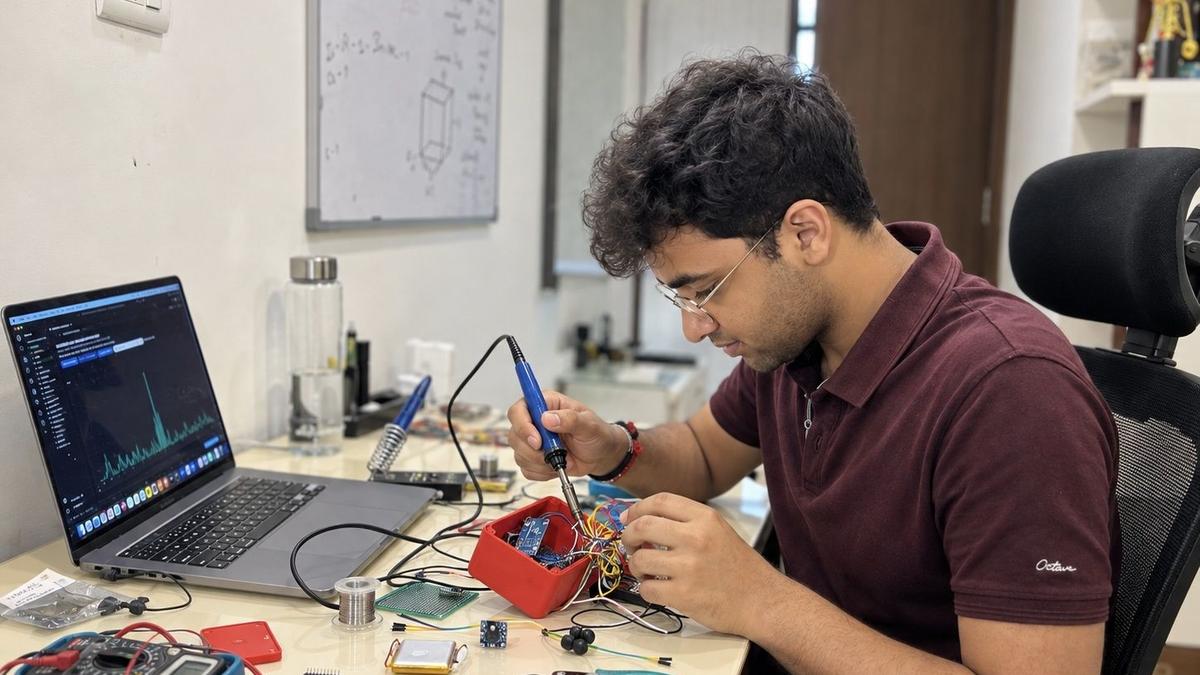
Kush Garg working on his device | Photo Credit: Special arrangement For several weeks, I spoke to therapists, families, and teachers without finding a clear answer to the question that had brought me to them: what should I build? I had applied for the IET India Scholarship Award to develop something that would support neurodivergent children, but their needs were far more varied than I had understood. During a visit to a development centre in Gurugram, I met children of different ages. Some struggled to express their needs; others found everyday sounds painful. Parents and teachers often had to interpret their responses. I realised how much depended on having someone who knew the child well.Learning the needsWhat stayed with me was that the difficulty often began before a child could ask for help. Some children needed support in recognising whether they were hungry, uncomfortable, or distressed. A device that simply offered words would leave that earlier difficulty unresolved. It had to learn about the children, understand their routines, and help them identify what they might need.This also made me think about their opportunities for friendship. If everyday interactions depended on a familiar adult interpreting one’s needs, how would they get to know someone new? A parent was the main source of both support and companionship. I wanted to help children build relationships beyond that circle, where they could share affection and be understood.The approaches I explored often expected the child to adapt or others to behave differently around them. I aimed to build something that could help both interact without putting pressure on either to change. Once I understood what the device needed to do, I could draw on my experience in robotics. I ordered components and spent nights in my room soldering, writing code, and testing the prototype.Eventually, I had a working device to present at the IET finals; one that fits in a pocket. It had one button, an e-paper screen, and a battery expected to last all day. It transcribes surrounding conversations, storing text rather than audio on the device. Its AI software builds a contextual memory of the child’s routines and preferences, while state tracking helps it interpret the current situation. It keeps track of tasks and displays relevant reminders and text to support everyday conversations. If distress repeatedly occurs around lunchtime, it can suggest hunger as a possibility and prompt a caregiver to check.Consider an older child visiting a café. On the way, wired earphones connected to the device help reduce unwanted background noise. When the waiter asks for an order, the device can display cold coffee if it has learnt that this is the child’s preference. The child checks the suggestion and shows the screen to the waiter. The device then helps with payment and keeps the parent informed. Similar support could help with buying groceries, navigating the Metro, or talking to a classmate.RecognitionWinning the IET India Scholarship Award 2026 from among more than 48,000 applicants was rewarding. The competition had prompted me to begin, but understanding the children gave me a reason to continue. My next step is to build a slimmer and more finished product with fall detection and vibration alerts. The next challenge will be rigorous testing to ensure it works reliably for children with different needs in everyday settings before taking it to the market.The project has changed what I look for in something I build. For a child, this could mean ordering a drink independently, explaining what is troubling him/her, or starting a conversation with a new friend. I hope this device can help children experience more of these moments, participate more fully in society, and build lasting relationships.The writer is a student of Delhi Technological University. Published - November 16, 2026 08:30 am IST
Kush Garg on winning the IET India Scholarship Award 2026
Full Article
Original Source
Read the full article at Thehindu →KhanList aggregates and links to publicly available news content. We do not host full articles from third-party sources. Always verify important information with original sources.