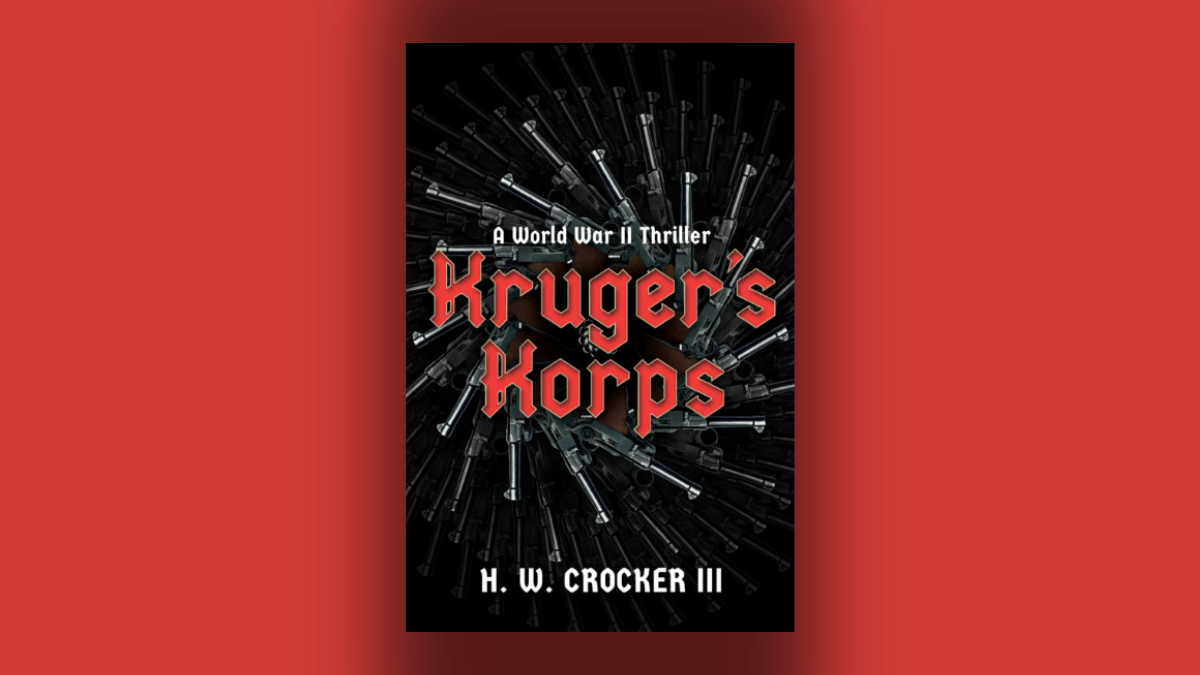
Surely one of the most amazing aspects of American fascination with the Second World War is the sheer amount of popular content we have created about it. There are at least 700, if not over 1,000 Hollywood films about the war, depending on what you count (and probably more than 1,300 globally). There are somewhere between 5,000-10,000 English-language novels about it. One might then wonder: Is there still anything interesting to say about World War II? If the new novel Kruger’s Korps by best-selling author H.W. Crocker III is any indication, the answer is absolutely yes. A spy thriller with elements of an Agatha Christie mystery and an H. Rider Haggard lost-world quest, Kruger’s Korps is an old-fashioned, page-turning adventure with a timeless religious sensibility. The titular character of Crocker’s cloak-and-dagger novel is US Navy ensign Rolf Kruger, the son of working-class Bavarian immigrants who fled Hitler’s increasingly anti-Catholic fascist regime for sunny California. The strong and handsome twenty-something Kruger, a UCLA grad, cut his teeth in Hollywood, doing stunt-work and offering fencing lessons to actors when he wasn’t riding waves in the Pacific. Driven by an infectious patriotism, Kruger joined the Naval Reserve Officers Training Corps program, though his proficiency in German attracts the attention of naval intelligence, and he is sent to Washington, D.C., where our story begins. In the nation’s capital, Kruger is recruited by Colonel William “Wild Bill” Donovan, head of the newly created Office of Strategic Services, or OSS, the predecessor of the Central Intelligence Agency. Relegated to a boring desk job, Kruger spends his days maintaining his admirable peak physical condition and flirting with secretaries. That is, until one day he is beckoned into Donovan’s office and introduced to a cast of characters — officers from Army intelligence, the US Marine Corps and British Army Special Air Services, an expert aircraft engineer, and, somewhat curiously, a Catholic priest — specially designed for a top-secret operation. Though the most junior man among the outfit, Kruger’s role in the proposed operation is the linchpin. He is to impersonate a German officer assigned to a secretive Afrika Korps unit, discover the unit’s raison d’être, and thwart it. The Americans and Brit, skeptical of Kruger’s youth and lack of experience, question his capacity for the task, which may be critical to the success of Operation Torch, the impending Allied invasion of northwest Africa. Yet Donovan silences these concerns, and thus are we off to a rip-roaring adventure across the deserts and jungles of Africa, one with enough twists and turns to surprise even the most careful of readers. One of the aspects of World War II which makes its stories so compelling to us is the clear juxtaposition of “good guys” and “bad guys.” The Germans, Italians, and Japanese were the obvious immediate aggressors of the conflict (and the Soviets, frankly, given what they did to the Poles), and were responsible for committing atrocities that dwarf the sins committed by the Allies. It’s all well and good to thus singularly and unequivocally indict the Axis Powers for their evils, but there’s also something boring and superficial in villainizing the enemy to such a degree that he no longer even seems to be human. Moreover, there were plenty of Germans who participated in the war less out of an allegiance to Hitler and his bizarre blend of pseudo-science, paganism, and ultranationalism than out of a naive or misguided patriotism (evidenced, for example, in such men as Claus von Stauffenberg and Henning von Tresckow who conspired to assassinate Hitler). Crocker’s novel commendably avoids banal stereotypes, instead presenting a fascinating (and entirely believable) espionage story of Germans within the Reich who possess varying degrees of skepticism, if not downright animus towards the Nazi creed. In this, Kruger’s Korps reminds us of that unforgettable maxim of Soviet World War II veteran Aleksandr Solzhenitsyn: “The line separating good and evil passes not through states, nor between classes, nor between political parties either — but right through every human heart — and through all human hearts.” Like so many Germans against whom he fought, Solzhenitsyn was himself a casualty of the brutal, dehumanizing tendencies of totalitarianism, arrested and imprisoned for years by the Soviet regime for daring to criticize Soviet leadership, all in spite of his own commendatory service. This hints at another reason for why Kruger’s Korps is such a great read — its reflections on how authoritarian regimes vitiate individuality and true human flourishing are perceptively relevant to the same threats America (and the broader West) still face today, whether from militant Islam, revanchist Russia, or the repressive, one-party People’s Republic of China. Just as in World War II, what is required today are brave men and women of sound mind willing to suffer and sacrifice for the sake of protecting and preserving what is good in America (and the broader West). To do that, one must of course singularly love his or her own nation, and understand in a deep and abiding way why it is good and worth dying for. Ultimately, Crocker’s thriller is a Christian, even Catholic story about those who, by God’s grace, possess those qualities necessary to combat evil, and those who, by His mercy, are given an opportunity for forgiveness and redemption, even when they have been party to evil. In an age in which we are so tempted to cancel and condemn our opponents, that’s a nobly germane narrative we sorely need. Sometimes we face an enemy that must be defeated not only in the marketplace of ideas but bloodily, on the battlefield. But even if things come to blows, that doesn’t mean we ever stop praying for our enemies. As our religious traditions teach us, there’s always a chance for repentance and redemption. Quite often, it makes for the best and most inspiring stories, too. Casey Chalk is a senior contributor at The Federalist and an editor and columnist at The New Oxford Review. He is a regular contributor at many publications and the author of three books, including the upcoming "Wisdom From the Cross: How Jesus’ Seven Last Words Teach Us How to Live (and Die)" (Sophia Institute Press, 2026). adventureH.W. Crocker IIIKruger’s KorpsnovelWorld War II
Kruger’s Korps Is An Old-Fashioned, Swashbuckling Adventure Tale
Full Article
Original Source
Read the full article at Thefederalist →KhanList aggregates and links to publicly available news content. We do not host full articles from third-party sources. Always verify important information with original sources.