
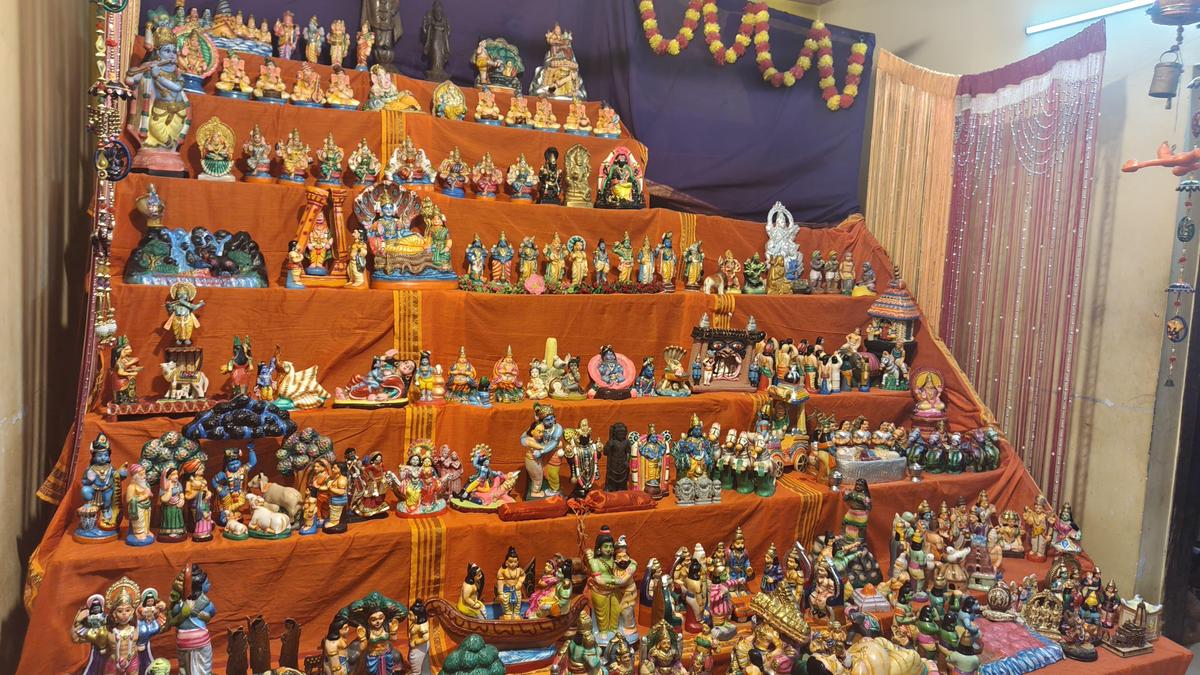
The kolu in the dining room of Ravi R Kamath and Jayalakshmi K Prabhu’s home | Photo Credit: Special Arrangement Every Navarathri, Ravi R Kamath and Jayalakshmi K Prabhu’s home at Palluruthy in Kochi transforms into a museum of dolls. Half of the living room is occupied by shelves lined with dolls made by Jayalakshmi. The dining space is entirely occupied by expansive kolus on opposite sides of the room. Since 2009, the couple has been arranging kolus, adding new dolls to their collection each year. This year, they have added 75 new ones. Though they have not kept count, the couple estimates their doll collection to number around 4,000.“Ten days before Navarathri, we get them out of the boxes in storage and start assembling them,” says Ravi, who works as senior GM at GIIMS, a logistics and supply chain management training institute in Kochi. Steel bookshelves from the library on the first floor of the house are dismantled and modelled into steps where the kolu is arranged. “After Navratri, they go back to being shelves,” he adds. A Kolu in one of the rooms | Photo Credit: Special Arrangement The displays cover everything starting with a pantheon of Gods to mythological characters, scenes from the epics, scriptures, animal world and more. What makes the kolu unique is the local flavour. Jayalakshmi includes the agent who delivers her LPG cylinder, the flower seller who brings her flowers and the thaalappoli at the Azhakiyakaavu Devi temple in the neighbourhood.The rest of the kolu has the usual displays — the dasavatharam, Sri Krishna leela, vadhya ganapathy, Ramavatharam, Srinivasa kalyanam, navagraphas, nine forms of Narasimha, the four vedas, Madurai Meenakshi, nine forms of Hanuman, the origins of the Kaveri river, the jyotirlingas, the saptarshis, and Lord Venkateswara with Goddess Lakshmi on the swing are part of the display. In addition to these are toys, models of fruits, cricket players, India’s freedom fighters and more.Ravi and Jayaklaksmi belong to the Gowda Saraswat Brahmin community. “The practice of keeping a bomma kolu emerged from our multicultural environment. Our community’s roots in Kerala goes back centuries and the practice would have been influenced by the South Indian (Tamil Nadu, Andhra Pradesh and Karnataka) tradition of arranging a kolu,” says Ravi.While a number of dolls are those they picked up on their travels, the majority of them have been made using everyday materials by Jayalakshmi. The ashtalakshmi collection that occupies pride of place is a reflection of Jayalakshmi’s creativity. The eight lakshmis have been fashioned out of pitchers, pots, hangers and coconut shells and dressed up in saris and jewellery made of string, paper, beads, plastic and more. Kolu arranged in the living room | Photo Credit: Special Arrangement The collection displayed in the living room is entirely made using the 3D origami technique and quilling. The dolls are intricately detailed, too. Though she hasn’t learnt these craft techniques formally, Jayalakshmi realised that she had a special knack for it during Covid-19-imposed lockdown. “It is a hobby I picked up and I continued to doing it. I love experimenting with materials,” she adds.With the living room, dining room and bedroom in the house devoted to the kolu, the family of three — Ravi, Jayalakshmi and son Sreeram — share one room. “This is a passion for us. So it hardly feels like an inconvenience,” adds Jayalakshmi.After Navarathri, each of these pieces are dismanted, packed into boxes and stored in the lofts in the rooms.The kolu is open to the public for viewing. Published - October 15, 2026 10:13 pm IST
Kochi couple turns house into a museum of dolls this Navarathri
Full Article
Original Source
Read the full article at Thehindu →KhanList aggregates and links to publicly available news content. We do not host full articles from third-party sources. Always verify important information with original sources.