
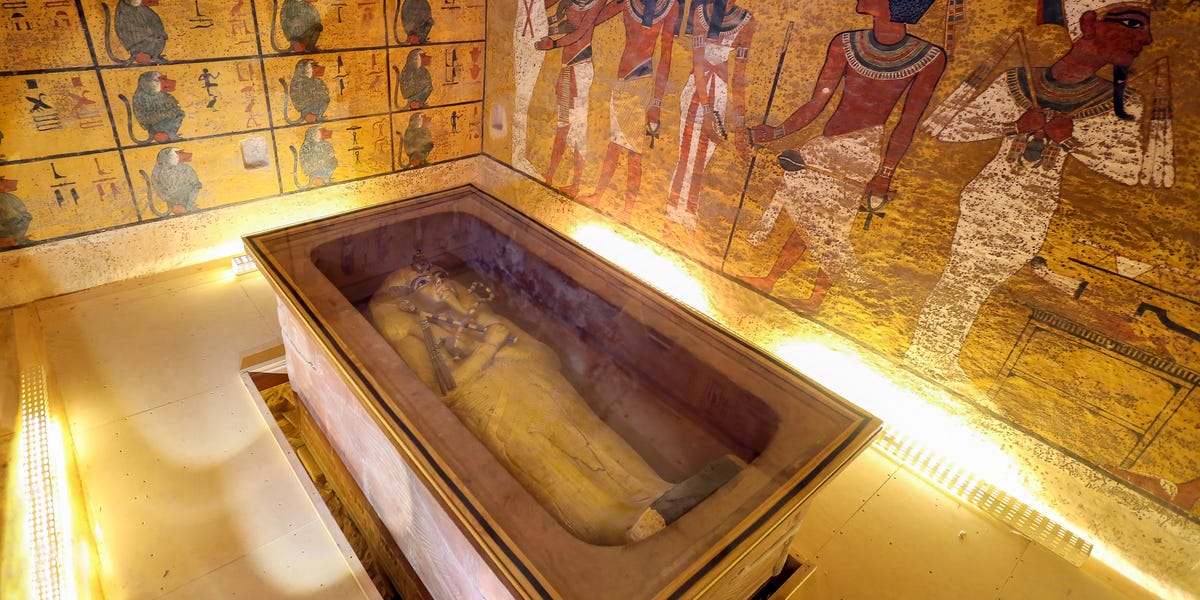
4 min readHere’s what you’ll learn when you read this story:Despite being a pharaoh of Egypt, Tutankhamun was buried in an unusually small tomb that archaeologists think might be part of an undiscovered larger complex.Scans revealed that there’s some empty space behind the north and west walls of his tomb, KV62, which could hold pathways or chambers. It’s now thought that the pharaoh’s stepmother, Nefertiti, may have been buried in KV62, especially because of certain imagery, though her tomb and mummy have yet to be found. The world has been studying Tutankhamun’s burial chamber ever since 1922, when Howard Carter saw “everywhere the glint of gold” upon breaking into the tomb for the first time. But one detail that nagged at Carter has remained in the shadows.Carter suspected that the young pharaoh wasn’t the only royal buried in this lavish underworld. Something—or someone—else was possibly behind one of the painted walls, and the wall itself may silently speak of it.In The Tomb of Tutankhamun, which Carter published in 1923, he wondered about irregularities that were too strange to overlook. The entrance to Tut’s tomb, which was given the catalog number KV62, was unusually small compared to others in the Valley of the Kings. While its design was consistent with the Eighteenth Dynasty of the New Kingdom, of which Tutankhamun was one of the last pharaohs, something made Carter question whether it was hiding another chamber, or even a mummy. Egyptologists have long pondered whether Carter was on to something. From late 2023 through early 2024, Egypt’s Supreme Council of Antiquities permitted an archaeological team led by former Minister of Antiquities Mamdouh Eldamaty to investigate. They suspected that some of the tomb’s more confusing aspects might point toward the burial of Tutankhamun’s stepmother, Nefertiti.Links between Tutankhamun and Nefertiti were previously inferred. King Tut’s iconic golden death mask bears the cartouche of Ankhkheperure Neferneferuaten, the throne name given to Nefertiti when she was raised to co-regent beside heretic pharaoh Akhenaten (who infamously tried to erase the Egyptian pantheon). The tomb is thought to have been hastily rehammered to reflect the identity of her stepson. Then there was the matter of the cartouches, in which images of Tutankhamun being buried by his successor, Ay, had been painted over older ones showing Tutankhamun burying Nefertiti. Figures appearing on the north wall may be more evidence. When compared to their profiles, existing busts of Nefertiti are an exact match. It’s believed she’s depicted in the male form she takes on in the afterlife as the pharaoh Smenkhkare.“With none but Nefertiti in her ultimate manifestation as Smenkhkare meeting these criteria, it comes as no surprise to find the north wall’s ownership imagery replicating the precise profile of this very lady,” Eldamaty said in his recently published report, An Archaeo-Geophysical Review and Assessment of the Structure and Morphology of Tutankhamun's Tomb (KV 62) (The Burial of Nefertiti? IV). Even the architecture of the tomb itself seems off. Pharaonic tombs typically featured a turn to the right at the burial chamber exit, but in Tutankhamun’s, this turn leads left. The right turn was reserved for male kings. This strange reversal of the usual layout could mean the tomb of the boy king was intended for a woman, though whether Nefertiti or anyone else is buried in a hypothetical hidden chamber remains unknown. Based on observations of archaeologist Nicholas Reeves, whose 2015 analysis of data from 3D scans revealed what might sealed and hidden doors, Eldamaty’s team conducted their own investigation. The tomb’s walls were scanned further. Outside the tomb, ground-penetrating radar searched for additional rooms from above. Inside, electrical resistivity tomography and microgravity measurements searched for gaps in the walls.When royal tombs were built, passageways were often blocked with rubble to discourage looters. It’s possible the west wall stands in front of one of these obstructed entrances. Radar picked up gaps on the other side, hinting that leftover material from the tomb’s construction was behind that wall, while anomalies in a microgravity survey on the exterior of the tomb suggested the same. Another suspicious detail on that same wall is the mural depicting Tutankhamun in the afterlife. The mural had been altered twice. In antiquity, it showed a mummiform Nefertiti as her alter ego Smenkhkare, with Tutankhamun as the living successor—until someone repainted it to make Tutankhamun the deceased. Carter then damaged and repainted the wall himself, presumably searching for another entrance or chamber.Eldamaty thinks KV62 might be part of a much larger tomb complex, with additional chambers behind its north and west walls. Whether it includes the burial chamber of Nefertiti can only be guessed at, but it’s unusually small for a pharaoh. Tutankhamun’s sudden death at such a young age meant he had no time to plan the type of grand tomb that many other pharaohs created for themselves. There are also theories that the two tombs were swapped: KV62 may have been set aside for Ay, Tutankhamun’s jealous advisor and eventual successor, while the more spacious tomb Ay was buried in was meant for the boy king. It’s unclear exactly when Nefertiti died because no record of her death exists and her mummy has never been found. If this really started out as her tomb, then what Howard Carter discovered in 1922 may only be a glimpse of all that it contains.“Even if this latter hidden complex does not ultimately prove to be the burial place of Nefertiti herself, the evidence increasingly points towards a connection with the Amarna royal family and the immediate circle of Akhenaten’s court,” said Eldamaty. “[This is] a period whose historical and funerary record remains among the most enigmatic in ancient Egyptian history.”Elizabeth Rayne is a creature who writes. Her work has appeared in Popular Mechanics, Ars Technica, SYFY WIRE, Space.com, Live Science, Den of Geek, Forbidden Futures and Collective Tales. She lurks right outside New York City with her parrot, Lestat. When not writing, she can be found drawing, playing the piano or shapeshifting.
King Tut’s Tomb Is Too Small for a Pharaoh. Scientists Say Something Is Hidden Behind Its Walls.
Full Article
Original Source
Read the full article at Popularmechanics →KhanList aggregates and links to publicly available news content. We do not host full articles from third-party sources. Always verify important information with original sources.