
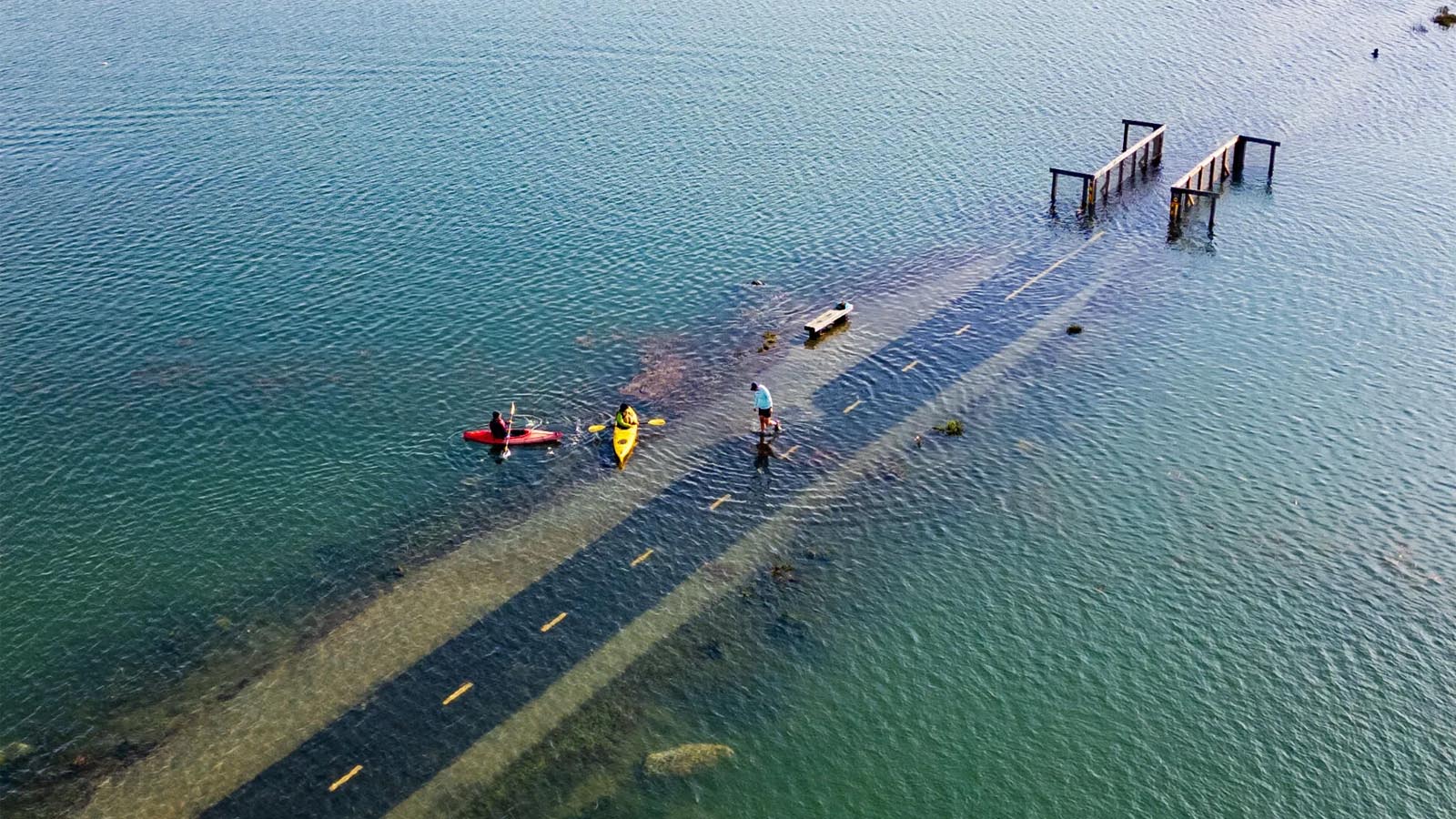
Meeting of kayakers, standup paddleboarders and intrepid walkers on the submerged Sausalito-Mill Valley Multi-use path in Marin County, California, on Nov. 24, 2026. (Image credit: California King Tides Project) The king tides of November clobbered California during the morning high tide on Nov. 25, bringing the highest coastal water levels in over a century of record-keeping to both San Diego and Los Angeles, beating records set just last month. Monterey also had its highest water level on record (since 1973), Santa Monica, its second-highest (since 1933); Point Reyes, its fourth-highest (since 1975); Alameda, its sixth-highest (since 1939); Humboldt, its fifth-highest (since 1977); and San Francisco, its ninth-highest (since 1897). Oregon also got into the act, with Charleston, located about 100 miles north of the California border, experiencing its second-highest water level on record (since 1970), and South Beach, its eighth-highest (since 1967). Of the top-10 water levels on record for California’s three largest coastal cities, 60% are now from 2026 (see yellow-highlighted entries in Fig. 1). Figure 1. Top-10 coastal water levels on record for 3 California cities. What caused the records? The high-water records occurred during weather usually unfavorable for setting such records: clear skies, light winds, and above-average surface pressures. But this week marks the arrival of the king tides, when the elliptical orbit of the moon brings it closest to the Earth, resulting in the highest tides of the year. This is one of the most extreme marine heatwaves in North American history. Over 1,000 miles of ocean is running 5°C (9°F) or more above normal, from central Baja California all the way up to Eureka on California's North Coast.This marine heatwave is unprecedented in every… pic.twitter.com/shky3NJPFw— Colin McCarthy (@US_Stormwatch) November 24, 2026 The other key factor: a very strong El Niño event that brought record-warm water to the coast, resulting in local sea level rise. Sea surface temperatures more than 5°C (9°F) above average are present along most of the California coast. That’s substantially boosting sea levels because water expands as it warms. And with the king tide and El Niño-driven warm water arriving at a time when human-caused sea level rise has substantially boosted water levels, we now have a recipe for record flooding in the absence of a storm. Figure 2. Sea level rise from 1900-2025 in San Francisco was about 9.7 inches, of which 6.1 inches (63%) was from human-caused global warming. (Image credit: Climate Central) Coastal flooding possible from a Tuesday storm next week While today marks the peak amplitude of the astronomical high tides from this king tide event, Thanksgiving Day water levels will also be very high, likely setting top-10 water level marks all along the California coast. In southern California, a long-period west swell arriving Wednesday night will worsen flooding and persist into Thursday. In San Diego, this swell will generate large breaking waves of 6-8 feet on Thursday, with 10-12-foot sets on exposed west-facing beaches. Santa Barbara is expecting breaking waves of 15-22 feet, and Los Angeles and Malibu are expecting 6-11 feet. A High Surf Advisory is in effect for most of Southern California. Growing signs of active winter storm pattern developing in California during Dec. And embedded within that are early indications of a potentially very strong storm that could affect central & southern CA next Mon/Tue w/very heavy rain, strong winds, & thunderstorms. Stay tuned.— Daniel Swain (@weatherwest.bsky.social) 2026-11-25T19:51:03.000Z While the tides will be gradually decreasing through next week, we need to keep an eye on a strong Pacific storm predicted to hit central California on Tuesday, Dec. 1. Models are predicting that this storm will bring strong southerly winds, very low surface pressures, and heavy rain to the coast – conditions ideal for generating a significant storm surge, as explained in my post Monday, What’s causing major coastal flooding in California? Figure 3. Days reaching the “minor” coastal flood threshold in San Francisco have risen in recent years because of sea level rise and have already set a record in 2026. Figure 4. Days reaching the “Minor” coastal flood threshold in Los Angeles have risen in recent years because of sea level rise, and have already set a record. More king tide flooding coming in December and January We’re not done with king tides after this week: The December 23-25 and January 21-22 full moon periods will have king tides similar in magnitude to this week’s (see the Bluesky post by Daniel Swain below to see the timing and severity of the coastal flooding severity). With this winter’s El Niño event not yet at its peak, the record-warm water by the coast isn’t going anywhere soon, and may spread farther north to the coasts of Oregon, Washington, and British Columbia, increasing coastal flooding odds there. Thanksgiving Day nor’easter clobbering the East Coast Meanwhile, the U.S. East Coast has its own coastal flooding concerns. As documented in our post from yesterday that we’ve now updated, a powerful Thanksgiving Day nor’easter will slam areas from the Outer Banks of North Carolina to Long Island, New York, with coastal flooding, heavy rains, and high winds. Numerous power outages, road closures, and flight delays are expected. At least two stations — Cape May, NJ, and Chincoteague Inlet, VA — are predicted to see all-time record coastal flooding. Irene Sans contributed to this post. Republish our articles for free, online or in print, under a Creative Commons license. Jeff Masters, Ph.D., worked as a hurricane scientist with the NOAA Hurricane Hunters from 1986-1990. After a near-fatal flight into category 5 Hurricane Hugo, he left the Hurricane Hunters to pursue a... More by Jeff Masters
King tides bring record coastal flooding to California
Full Article
Original Source
Read the full article at Yaleclimateconnections →KhanList aggregates and links to publicly available news content. We do not host full articles from third-party sources. Always verify important information with original sources.