
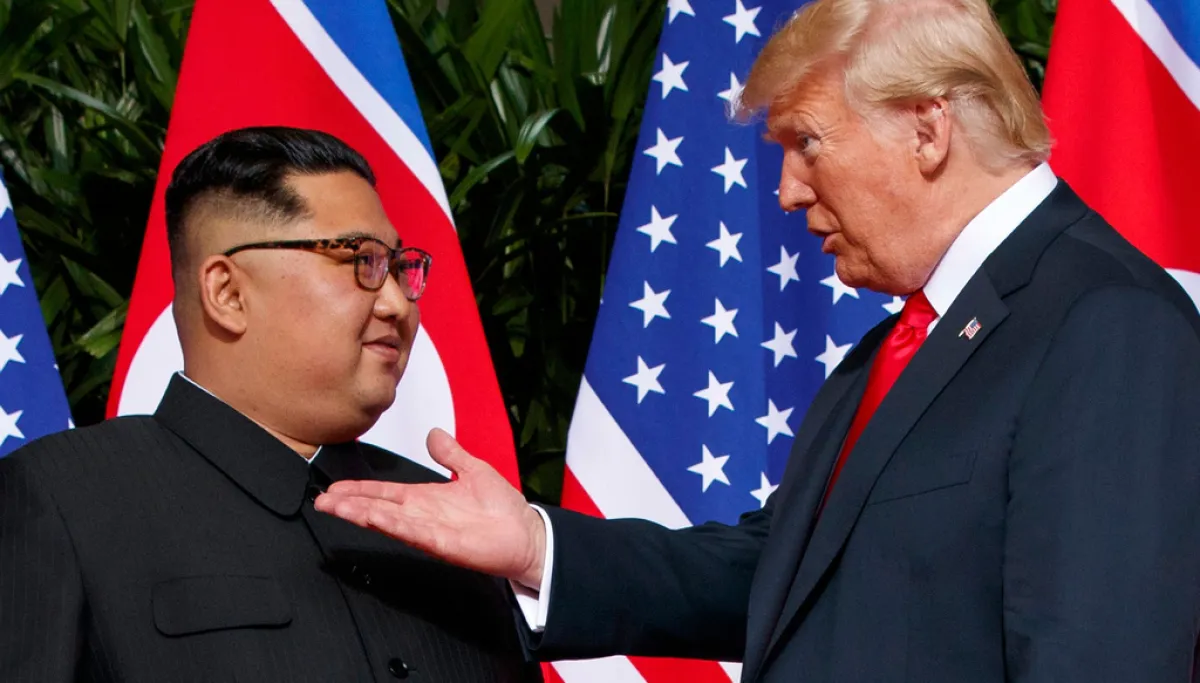
President Donald Trump has made clear that he wants to meet North Korean leader Kim Jong Un again, saying he hopes to arrange a meeting later this year. The two leaders held their first historic summit in Singapore in 2018, a second in Vietnam in 2019, and a brief meeting at the Demilitarized Zone later in 2019. However, the Hanoi summit ended without an agreement after the two sides failed to bridge their differences over North Korea’s denuclearization and U.S. sanctions.Seven years later, Trump is once again reaching out to Kim. But North Korea’s response this time is different.Kim Yo Jong, a senior North Korean official and Kim Jong Un’s sister, recently said there was no special communication between Washington and Pyongyang. Although Trump has spoken positively about his relationship with Kim and expressed his desire to meet him, North Korea has not responded in kind. Even the reduction of major U.S.-South Korean military exercises was not welcomed by Pyongyang as a goodwill gesture. So, could Trump and Kim actually meet again? For now, no one can say for certain. Trump has made his desire for dialogue clear, and Washington has left the door open, but Pyongyang has not officially agreed to a new summit. A more important question is what the two leaders would discuss if they did meet. The situation in 2026 differs sharply from 2018, when the central issue was what North Korea might receive from the United States in exchange for steps toward giving up its nuclear program. After the Hanoi summit collapsed, North Korea instead kept developing its nuclear and missile capabilities. Washington still regards the program as a major security threat and coordinates closely with Seoul, while Pyongyang keeps criticizing allied military cooperation. A new summit, then, cannot simply repeat the past. If 2018’s question was whether North Korea would give up its weapons, 2026’s question is how to bridge two fundamentally different positions on that same issue, which may matter as much as whether a summit happens at all. A meeting would certainly carry symbolic weight — the 2018 Singapore summit drew worldwide attention simply because the leaders of two long-hostile nations sat face to face. But as Hanoi showed, photographs and handshakes cannot solve the peninsula’s problems. Even a new meeting would not guarantee an agreement — it could just as easily expose how far apart the two sides remain. That is why substance would matter more than the summit itself: how Washington would approach the nuclear issue, how Pyongyang would respond, and whether the two sides could agree on concrete steps to ease military tensions.South Korea’s role would also matter. Direct Washington-Pyongyang dialogue could open a new chance to ease tensions, but Seoul’s interests must be fully reflected in any such talks. As both a U.S. ally and the country most directly facing North Korea, South Korea should play an active role if negotiations resume. Dialogue and deterrence are not mutually exclusive — wanting to talk does not mean abandoning security, nor does maintaining security mean rejecting dialogue. Lasting peace requires both diplomatic space and a stable security environment to support it, exactly the tension visible today as Trump seeks a meeting, while North Korea keeps criticizing allied exercises, and Washington and Seoul stay open to dialogue while maintaining deterrence. For that reason, watching whether real conditions for a summit are emerging matters more now than waiting for an announced date.Trump has once again extended his hand. Kim has not taken it, but he has not rejected it either. No summit has been confirmed, yet the door has not fully closed. If the two do meet again, it will not repeat 2018. The security environment has shifted over seven years, the North’s programs have become a more pressing international concern, and many issues from earlier talks remain unresolved.KIM JONG UN BUILT A MEGA-RESORT. HIS ONE PROBLEM? THE GUESTSWhat matters, then, is not the image of a handshake, but what begins after it. For such a meeting to become a genuine breakthrough, it would need to lead to substantive negotiations well beyond the encounter itself. Trump has said he wants to meet — the choice now rests with North Korea. If Kim takes that hand, the world will watch not for another photograph, but for what the two sides actually discuss and what they might agree on.Ultimately, the question is not simply whether they will meet again, but what they will talk about when they finally sit across from each other. For now, we do not have the answer.Park Joonhye is a research fellow at the Institute for Far Eastern Studies, Kyungnam University. She received her M.A. and Ph.D. in Politics and Unification Studies from the University of North Korean Studies.
Kim Jong Un is ghosting Donald Trump — and it’s working
Full Article
Original Source
Read the full article at Washingtonexaminer →KhanList aggregates and links to publicly available news content. We do not host full articles from third-party sources. Always verify important information with original sources.