
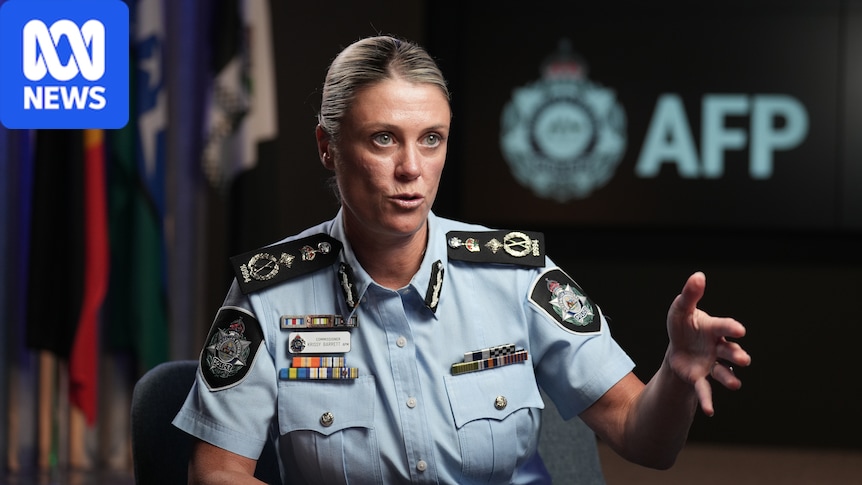
More than one in three Australian children who are sexually victimised online either tell no-one or turn to an AI chatbot for help, according to data from Adelaide University.The data has prompted Australian Federal Police Commissioner Krissy Barrett to warn law enforcement cannot be the only safety net for vulnerable young people.In an interview marking her first year in the top job, Commissioner Barrett stopped short of directly endorsing an extension of the federal government's under-16 social media ban to AI chatbots, but stressed that "anything that helps to keep our kids safer is obviously something we support".The study, an initiative between Adelaide University and the AFP-led Australian Centre to Counter Child Exploitation, has delivered sobering data on how generative tools are altering youth safety.Amid a sharp increase in children as young as 12 being manipulated through AI-altered nude images and sadistic online exploitation, the study found 35 per cent of children sexually victimised online confided in an AI chatbot or did not tell anyone. More than 15 per cent of young people report seeking personal or counselling advice from AI at least once a week.Among victimised boys, two in five disclosed their experiences solely to an AI bot or kept quiet entirely.Commissioner Barrett called the trend "heartbreaking" and warned that automated software cannot provide the human support or protection vulnerable youth require."Young people are turning to AI more and more for advice and for support and for guidance and that should be concerning to all of us, not just parents," she said.Addressing the limits of police intervention when children reach out to AI instead of adults, Commissioner Barrett was realistic about the role of law enforcement.“We're right at the end of the suite of tools here, and we're a pretty blunt object. Let's be honest, by the time we become involved, the options are reduced," she said.When pressed on whether the federal government should extend its landmark social media ban for under-16s to conversational AI tools to protect young people, Commissioner Barrett cautioned that legislative bans were not a panacea.Young people who often feel awkward talking to parents about issues are increasingly turning to AI. (ABC News)"I won't speak specifically to what government should or shouldn't do," she said."I would just say generally that anything that helps to keep our kids safer is obviously something that we support."Bans were "not the whole solution," she added, noting that while regulatory limits were effective for "starting conversations in households around dinner tables," they could not replace community vigilance.How parents and communities can step upComissioner Barrett said parents, carers, family, educators and community leaders were best placed to notice when a child began to withdraw or alter their behaviour."It starts in the home, it starts with parents knowing what their kids are doing online, creating those safe opportunities for conversations,” she said.“You remember when you're at that age, it is awkward talking to your parents about anything, but we need to create that trust in those safe spaces, because as we know, AI technology, it's not a human."While the use of artificial intelligence in the exploitation of young people was a major concern for the AFP, Commissioner Barrett was just as emphatic that AI had a place in policing.To help identify potential exploitation earlier, the AFP is working with Monash University's AiLECS Lab on a welfare tool that triages reports of harm to the Australian Centre to Counter Child Exploitation and refers them to a human for assessment.“It's quite forward leaning. This is something that we need to be doing more and more: partnering with academia, and with tech companies around how do we bring all of our knowledge, expertise and access together to come up with these solutions.”The AFP released its first AI strategy last month, a "human-led" approach to matching the "scale and pace" of offending, particularly in child exploitation and youth radicalisation.Extremist material and counterterrorismOn counterterrorism and the rise of violent extremism, Commissioner Barrett said the bulk of the AFP's terrorism caseload was still predominantly religiously motivated, but police were increasingly seeing more "mixed and unclear ideologies".“Sometimes, particularly with our young people, what we see is perhaps they're not actually driven by a particular ideology, they are driven by a grievance,” she said.“They're feeling distanced, they're feeling alone, they're looking for something to attach to, to give them meaning and purpose.”Comissioner Barrett said the rapidly evolving threat environment had validated her decision to establish national security investigation teams designed to target the "grey zone" of radicalisation, including hate crimes, misogyny, and online hostility that fell just below statutory thresholds for joint counterterrorism charges.The teams have charged 65 people since they were created at the end of last year and she expects those volumes to increase."We're going through doors and arresting and charging people very quickly after we receive the reports," Commissioner Barrett said.Asked whether she believed the definition of terrorism needed to be changed to reflect the evolving security environment, Commissioner Barrett said violent extremist material laws were already working well as a key preventative measure."That legislation gives us the ability to go and conduct a search warrant, to seize the devices, to intervene early," she said, describing the possession of extremist material as frequently being the start of a continuum that can lead to violence.Krissy Barrett says she supports any legislation that will help keep children safe. (ABC News: Matt Roberts)Commissioner Barrett said it also provided police with more options "around how we deal with a young person who's come to our attention".She said most young people in the extremism cases showed behavioural warning signs before they came to police attention, and called on parents and carers to watch out for these."I don't want to be arresting and charging young people. We want to be intervening earlier and we want to be getting them the assistance and the support that they need," Commissioner Barrett said.In 2026, 23 juveniles and 24 adults have been charged for possessing violent extremist material.The commissioner is working to strengthen ties with other nations and is scheduled to travel to Tokyo later this month.
Kids turning to chatbots to disclose online sexual victimisation
Full Article
Original Source
Read the full article at Abc →KhanList aggregates and links to publicly available news content. We do not host full articles from third-party sources. Always verify important information with original sources.