
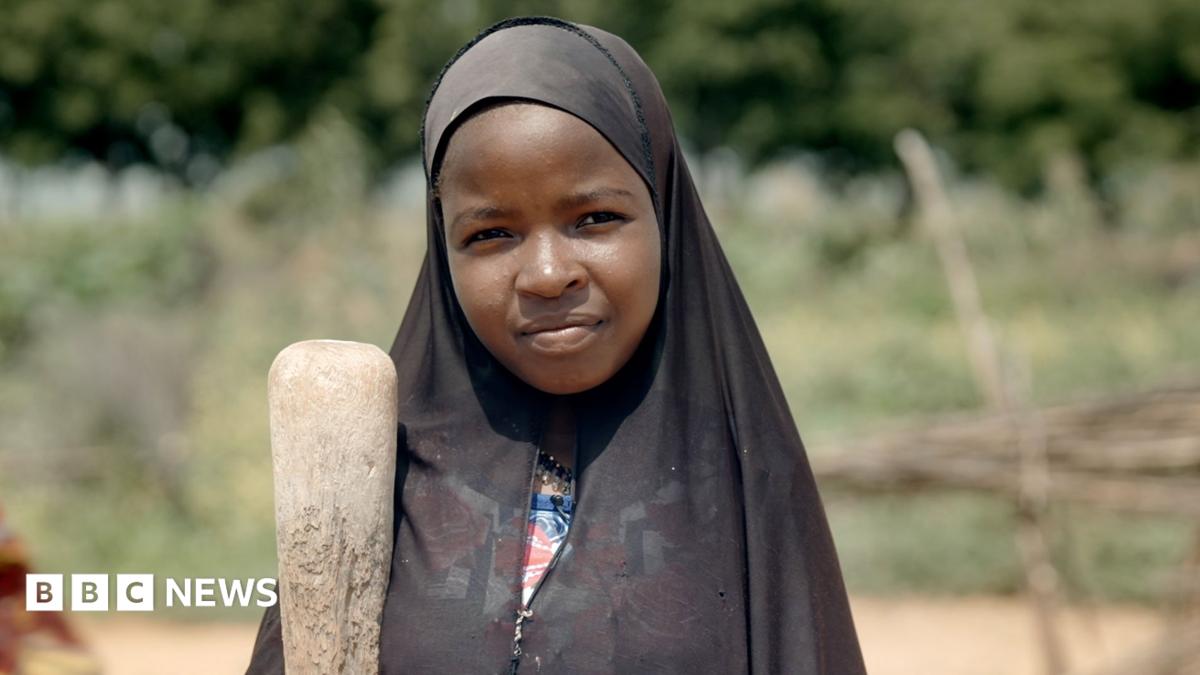
Kidnap, child marriage and poverty: Why millions of Nigerian children can't go to schoolImage source, Ifiokabasi Ettang/BBCImage caption, Hadiza left school at 13 to get married and now spends her time doing houseworkByMadina MaishanuBBC AfricaReporting fromGoronyoAs she pounds millet, 15-year-old Hadiza sings the English alphabet. It is a reminder of something that she desperately misses - going to school."Sometimes I write on the ground to practise and see if I'm still writing correctly," she says.One night, about two years ago, a group of armed men raided her village."They scared our cattle away and abducted a girl. We had to run away. We walked barefoot all the way here," she says.Since then she has lived in a displaced persons camp in Goronyo, a few kilometres from her home. For a short while she went to school here, but soon met a young man and, at the age of 13, stopped going to classes and got married."It's tradition here that once a girl is married, her education ends," she explains. Now she lives with her in-laws and helps look after the home. Although Nigerian law prohibits marriage under the age of 18, it is not always enforced.Image source, Ifiokabasi Ettang/BBCImage caption, Hadiza practises writing on the ground to make sure she doesn't forget the English alphabetHadiza is one of nearly 19 million children in Nigeria who are missing out on an education, according to estimates shared by Unesco in 2024. That's about one in four of the country's school-age children.Against this backdrop, the BBC World Service has launched Dars Hausa, an educational programme in the main language spoken in northern Nigeria, as well as neighbouring Niger, Cameroon and elsewhere in West Africa.It brings English, maths and science lessons to children across West Africa, via social media, local television partnerships and radio. Many people in the region get their news from the radio and nearly half of households in Nigeria have one, according to the charity Save the Children.Dars means "lesson" in Pashto and Dari, and it was first launched in those languages in 2023 for Afghan children barred from attending school. An Arabic version followed in February 2025.The reasons why so many Nigerian children are out of school are numerous and complex. Like Hadiza, 12-year-old Rukayya also lives in the displacement camp in Goronyo.Image source, Ifiokabasi Ettang/BBCImage caption, After Rukayya's father was killed, she gave up school to earn money instead "It pains me to see other children studying and going to school while I cannot," she says.As the eldest child, each day Rukayya goes out to gather firewood to sell and to beg so that her younger siblings can have something to eat."If my father was alive, I wouldn't have to go out and beg," she explains, saying some people mock her "but it doesn't stop me because it is our only way to survive."Bandits killed her father about a year ago in front of her, she says, and her family fled from their home to the camp.She and Hadiza are among 670,000 people in north-west and central Nigeria who have been forced from their homes by armed robbery and kidnappings, according to the International Organization for Migration.Three Girls: Lessons in Limbo features the stories of Hadiza and Rukayya - you can watch the full film on YouTube, externalSome attacks have been carried out by militant Islamist groups, but the majority in this region are by criminal gangs, known in Nigeria as bandits, who steal, kill and kidnap.The school that Hadiza once attended in Goronyo is the only one serving children in the camp and typically has about 50 students in each class.One of the teachers, Kamilu Sulaiman Jakada, says that even though lessons are free, only a tiny portion of the children attend, and even then sporadically, because parents tell him that "it is the children that are the breadwinners" and they need to earn money to eat.Image source, Ifiokabasi Ettang/BBCImage caption, Armed gangs, poverty and lack of funding all have a huge impact on children's education, says teacher Kamilu Sulaiman JakadaHe says the school does not have enough teachers or classrooms, explaining that funding is inconsistent and often comes from individuals or organisations rather than the government.The other challenge is the bandits. A gang once came to the school on motorbikes, shooting in the air, he says, and although no-one was hurt, many parents were scared and withdrew their children. That has been parents' reaction to attacks in some other parts of the country too.Every Nigerian child is meant to get nine years of free, compulsory education - six in primary and three in secondary school. Responsibility is shared between federal, state and local governments.But many schools are facing shortages and poorer families who cannot afford private education can struggle to pay for uniforms, books and transport.The crisis has built up over decades, with successive governments struggling to address chronic underfunding and poor oversight of resources.In addition, many children in the traditional Almajiri system, which provides Islamic education, are not taught subjects such as maths and science, and are considered by Unicef to be out of school.Image source, Ifiokabasi Ettang/BBCImage caption, Many of Nigeria's schools face shortages of teachers, classrooms and learning materials after years of underfunding and lack of oversightMinister of State for Education Prof Suwaiba Sa'id believes the number of children out of school is lower than has been reported, but admits that with Nigeria's growing population "the proper investment, the proper oversight, has not been done… I will not mention the names, but we know of two states that did not recruit a single teacher for eight years".She says that education is the government's "number-one priority" and initiatives such as Lumina are designed to help address "decades of neglect". Lumina aims to support one million girls by 2030, providing an accelerated learning programme for older girls who have missed years of formal education.She also says that "the government is doing everything possible" to deal with bandits and that "we have seen children that should be at school but are engaged in this banditry".In the meantime, it is children like Hadiza and Rukayya that the BBC World Service Dars Hausa programmes aim to help. Hadiza says she still has a dream to one day become a doctor "to help my fellow women".Dars Hausa will air on BBC News Hausa radio on Sundays at 06:45 West Africa Time, with a repeat at 20:45. The programme will also be available via BBC News Hausa's digital platforms, including YouTube, Facebook, X and Instagram.You may also be interested in:
Kidnap, child marriage and poverty: Why millions of Nigerian children can't go to school
Full Article
Original Source
Read the full article at Bbc →KhanList aggregates and links to publicly available news content. We do not host full articles from third-party sources. Always verify important information with original sources.